Rebirth and Nibbāna are core axioms in Buddha Dhamma (Buddhism). However, one does not need to believe in either rebirth or Nibbāna to get started.
Revised August 18, 2016; rewritten with new chart#2, February 20, 2023
Introduction
1. I participated in several internet forums on “Buddhism” in 2013 and 2014. One thing that stands out is that many people like Buddhism, but they cannot understand what the big deal is about rebirth, and they cannot comprehend what Nibbāna is. Thinking is: Why can’t we have Buddhism without rebirth (because I do not believe in rebirth) and Nibbāna (because that seems too complicated)?
They are turned off by the concept of rebirth and are mystified by the concept of Nibbāna.
Rebirth. I think the first issue is that most major religions are based on three levels of existence: This life and one of two eternal stages of life after that, committed to either heaven or hell for eternity based on what one does in this life. That model is straightforward. Buddha’s 31 realms of existence with many “unseen beings” seems far-fetched. Also, the possibility of being reborn as an animal is a disgusting thought similar to the one people had about "evolving from the monkeys” before the theory of evolution.
Nibbāna. The second issue has become a problem mainly because of Mahāyāna doctrines. Mahāyāna sect arose basically out of the philosophical analyses of Nibbāna by Nagarjuna, Asanga, and other Mahāyāna forefathers. They could not understand the concept of Nibbāna or what happens to an Arahant upon death. So, they came up with concepts like suñyatā (suññatā) or emptiness; see, "What is Sunyata or Sunnata (Emptiness)."
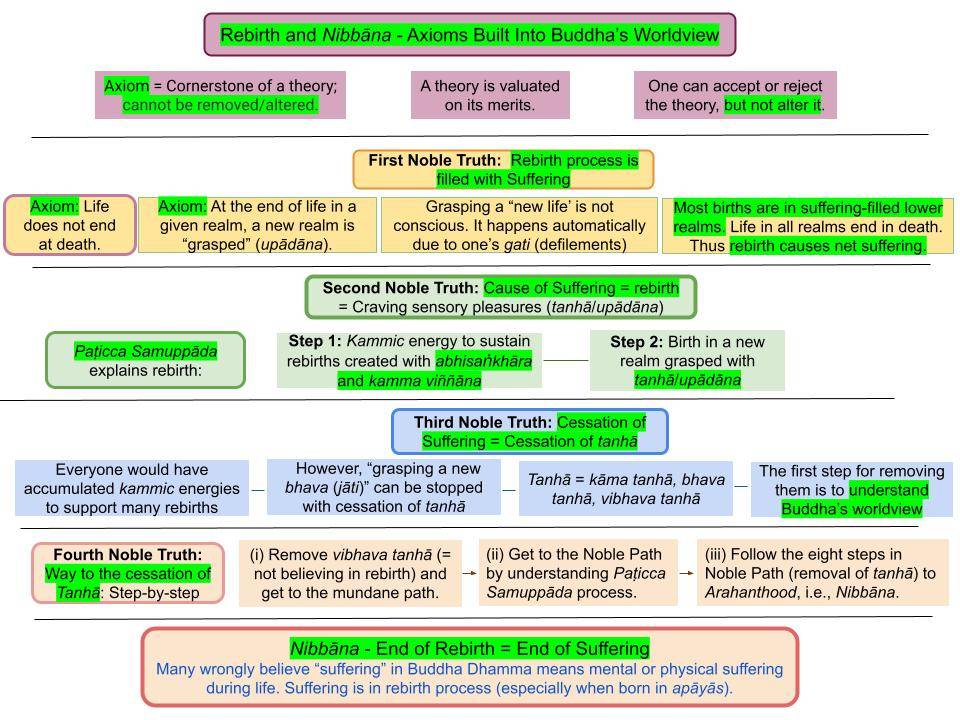
The critical point is that everything we observe and experience can be explained with the Buddha's complete "worldview," of which rebirth and Nibbāna are essential foundations. The following chart is a summary.
2. There are two co-existing facets of Buddha Dhamma:
The Buddha said, “This Dhamma is unlike anything the world has ever seen.” It needs a paradigm change to get into the “new perspective about this worldview of the Buddha.” To understand the core message, one must put aside all preconceived notions.
However, the Buddha also said, "My Dhamma is good in the beginning, good in the middle, and good at the end." People who just learned about Buddha's Dhamma can gain something from it.
In Bhikkhu Bodhi's book, "In the Buddha's Words," there is a chapter on "The Happiness Visible in this Present Life," where Buddha's discourses to those who did not have an aspiration to attain Nibbāna but were interested in pursuing moral lives, are described.
The concepts such as rebirth and Nibbāna are paradigm-changing. But as one follows what one understands, these concepts will become evident; I have summarized these two concepts below. But it will take much more effort and reading many more posts if one is interested in understanding Buddha Dhamma.
For those who do not believe in rebirth, there is a simple way to get started without believing in the rebirth process. I strongly suggest the following post: "Starting on the Path without Belief in Rebirth."
"Secular Buddhism" Can Be a Stepping Stone
3. However, in the end -- If one is to benefit fully from Buddha Dhamma -- one needs to understand its core message. And that core message is that this life is only but a little time in the cycle of rebirths that we have been on from eternity and that “our world” is much more complex than we see, with 31 realms instead of the two (human and animal realms) that we see. Even more significantly, the suffering in many of the lower realms of existence is much worse than that in the human or animal realm.
That is a lot to accept as a basis. But we are fortunate compared to those who lived even a hundred years ago. Now, we have EVIDENCE to back up this more comprehensive worldview of the Buddha; see “Views on Life.”
And both major Mahāyāna sects and TheravādaBuddhism believe in rebirth and the concept of Nibbāna. All Buddhists (except the type of Stephen Batchelor, who has written some popular books on Buddhism) believe in rebirth and Nibbāna. The label “secular Buddhism” describes those who like other aspects of Buddhism (basically moral living and meditation) but not necessarily rebirth and Nibbāna.
Thus, a Buddhist not believing in rebirth/Nibbāna is an oxymoron. The Pāli or Sinhala word for Buddhist is “Bhauddhaya,” meaning “a person trying the stop the rebirth process” (“Bhava+uddha”). Buddha Dhamma means “path or method of removing bhava and thus stopping the rebirth process.” Buddha means “one who has removed bhava (and attained Nibbāna).”
However, there is no need to accept rebirth forcefully without believing in it; that would not work in the long term.One can start at a point where one can experiencethe hidden sufferingin this life: "Starting on the Path without Belief in Rebirth."
4.Therefore, one can be a “secular Buddhist,” which could be an intermediate state (stepping stone) before becoming a Buddhist. We need to understand the difference clearly. Since there is no formal established way to declare oneself a “Buddhist” (or a need to do that), it is really in one’s mind whether one is a Buddhist or not. The Buddha clearly stated that each person is at his/her level of understanding. And there is no need to pretend; what one believes is what it is. The critical thing is to make sure one is fully informed.
One does not become a Buddhist by reciting the precepts. One gradually becomes a Buddhist as the mind embraces the Buddha's worldview and realizes that real happiness is attained by comprehending the true nature of this world: anicca, dukkha, and anatta, and eventually by stopping the rebirth process.
5. In the meantime, it is essential to realize that particular wrong views are bound to have adverse consequences, according to Buddha Dhamma. The established (firm) view that there is no rebirth process is one included in micchā diṭṭhi, which is one of the (strong) dasa akusala that makes a birth in the apāyā (four lowest realms of existence) possible. Believing rebirth at once is unnecessary; one should at least leave that as a possibility. What is critical is not to have niyata (established) micchā diṭṭhi.
6. Finally, it will take a real effort to sort through all the different versions of “Buddhism” out there. Over two thousand five hundred years, just like now, people have tried to “mold” Buddha Dhamma into a form they like, which is why we have so many versions. But when that is done, the uniqueness, the real message, gets lost. We need to keep intact this unique message, with the understanding that not everyone comprehends it right away.
The key is to discard any version or aspect that does not provide a consistent picture. Buddha Dhamma describes the laws of nature, and there cannot be any inconsistencies. That is what I am trying to do with this website. If you see something inconsistent on the website, please let me know.
I use the Tipiṭaka (Pāli Canon) as the basis. It was written over two thousand years ago (by Arahants who had experienced Nibbāna) and is the oldest document encompassing the three central teachings: Suttā, Vinaya, and Abhidhamma.
I have documented the flaws in Mahāyāna and (to a lesser extent) in current Theravāda books by pointing out the inconsistencies with the Tipiṭaka. Also, I show that everything is self-consistent, which is the scientific basis to illustrate the validity of a theory. Newton’s theory of gravity had to be modified because they were inconsistent with finer measurements.
7. It does not matter what we believe personally. We need to find the actual laws of nature that the Buddha discovered. Laws of nature, like gravity or laws of motion, do not care about our beliefs; see “Why it is Critical to Find the Pure Buddha Dhamma.”
Just like in modern science, one needs to discard any inconsistent interpretations. See "Buddha Dhamma: Non-Perceivability and Self-Consistency." Many current interpretations, even within the Theravāda tradition, have numerous inconsistencies; see "Elephants in the Room." However, the existing Tipiṭaka is fully self-consistent if the correct meanings of keywords like viññāna, saṅkhāra, anicca, anatta, etc. are adopted as explained there.
Buddha Dhamma (in its pure form) has withstood all tests; see “Dhamma and Science - Introduction.” Both current Mahāyāna and Theravāda teachings must be revised back to the original. It can be proven that both have contradictions with the teachings of the Buddha. A series of posts point out these "problem areas," starting with "Key Problems with Mahāyāna Teachings." Even the current texts of Theravada (especially Commentaries like Visuddhimagga) have contradictions: "Incorrect Theravada Interpretations – Historical Timeline."
Having established that rebirth and Nibbāna are the “lifeblood” of Buddha Dhamma, we can now turn to the following question: What evidence is there to “prove” rebirth? What is the big deal about Nibbāna, which sounds so esoteric?
A. REBIRTH
8. I have summarized some of the existing evidence for rebirth; see “Evidence for Rebirth.” I am unsure what will qualify as “proof,” but one thing is obvious: A strong case can be made for it. There is evidence from many different areas consistent with the Buddha’s other teachings, for example, the existence of a manōmaya kāya; see “Manomaya Kaya (Gandhabba) and the Physical Body.”
If a person can believe even a SINGLE piece of evidence presented there, it is not possible to explain that without accepting that there is a link between such two lives.Since there is no physical connection between the two lives (many miles apart), the connection must be outside the physical realm, i.e., the mental energy. There is new evidence from "quantum entanglement" consistent with the presumption that everything in this world is interconnected; see "Quantum Entanglement - We Are All Connected."
However, one can verify the rebirth process by developing abhiññā powers via developing the fourth jhāna. One can then “see” one's previous lives; see “Power of the Human Mind – Introduction” and the follow-up posts. And some have developed such abhiññā powers, and this number can be expected to grow. When many people can verify the rebirth process, it will be accepted. Today, not everyone has traveled outside their own country. But everyone accepts that all those countries exist because they believe the accounts of those who have visited.
9. "Bāna" in Pāli and Sinhala means "bondage"; thus, Nibbāna means becoming free of bondage (to this world). We are bound to the unending cycle of rebirths via ten fetters called "sanyōjana = "san+yōjana"; see, "What is "San"? Meaning of Sansara (or Samsara)"; yōjana means bond. Sanyōjana rhymes like saṃyojana, and that is how it is usually written.
The ten saṃyojana are removed via the four stages of Nibbāna: three at the Sōtapanna stage, two reduced at the Sakadāgāmi stage and removed at the Anāgāmi stage, and the remaining five removed at the Arahant stage.
Removal of the ten saṃyojana also removes greed, hate, and ignorance from our minds; the nirāmisa sukha increases step-wise at each of the four stages, and the "cooling down" or "nivana" becomes complete; see "How to Taste Nibbāna." There are many synonyms for Nibbāna, and nivana (or niveema) is one of them. The Sanskrit name "nirvana" does not convey any of these meanings.
10. When the mind becomes pure, a being is not reborn anywhere in the 31 realms. The mind has attained full release and unconditioned happiness called nirāmisa sukha. Thus Nibbāna is stopping the rebirth process; the suffering stops. It is as simple as that. That mind cannot grasp an existence anywhere in "the 31 realms".The mind becomes free of a body subject to decay and death (suffering). That is Nibbāna.
Any terminology within "this world" cannot describe the Nibbānic experience; it is transcendental or "lōkuttara" beyond "this world." See, "Nibbāna “Exists”, but Not in This World."
Also, all we can say about what happens to an Arahant at his/her death is that he/she will not be reborn in "this world" of 31 realms. There is no more suffering. The mind is free of bondage to a physical body that leads to so much suffering.
Many say, “What suffering? I do not feel that much suffering”. But the real suffering is in the lowest four realms, so the complete picture of the 31 realms of existence is essential. Furthermore, there is much suffering that is masked, especially when one is young. As one ages, one will inevitably start experiencing suffering at a higher degree and then face death. Here is a video that illustrates this point:
11. That happens to all of us. However, the point is NOT to get depressed about this inevitability. Some people get depressed thinking about old age and try to "give up" everything to follow the Path of the Buddha.
Someone unfamiliar with Buddha Dhamma can't start working on attaining Arahanthood immediately, and it is not advised either. It needs to be done with understanding. As one follows the Path and learns Dhamma, one could start feeling the early stages of Nibbānic pleasure (nirāmisa sukha) and thus will start having fact-based faith on concepts like rebirth and Nibbāna: see "Is It Necessary for a Buddhist to Eliminate Sensual Desires?" and "Three Kinds of Happiness - What is Niramisa Sukha?".
Have you seen any depressed Buddhist monks? They have given up worldly pleasures voluntarily, NOT with the mindset of a depressed person. Depression leads to hate; "giving up" is done with wisdom.
Buddha's key message was that this 100-year life could only be compared to a “drop of water in a huge ocean," a cycle of rebirths filled with suffering. Thus, one should at least critically examine the evidence to see whether that message needs to be taken seriously. All these are described in detail with supporting evidence on this website.
O Renascimento e o Nibbāna são axiomas fundamentais no Buddha Dhamma (Buddhismo). No entanto, não é necessário acreditar no Renascimento ou no Nibbāna para começar.
Revisado em 18 de agosto de 2016; reescrito com o novo gráfico nº 2, em 20 de fevereiro de 2023
Introdução
1. Participei de vários fóruns na internet sobre “Buddhismo” em 2013 e 2014. Uma coisa que se destaca é que muitas pessoas gostam do Buddhismo, mas não conseguem entender por que o Renascimento é tão importante e não conseguem compreender o que é Nibbāna. O pensamento é: por que não podemos ter o Buddhismo sem Renascimento (porque não acredito no Renascimento) e Nibbāna (porque isso parece muito complicado)?
Elas se sentem repelidas pelo conceito de Renascimento e ficam perplexas com o conceito de Nibbāna.
Renascimento. Acho que a primeira questão é que a maioria das principais religiões se baseia em três níveis de existência: esta vida e um dos dois estágios eternos da vida após ela, comprometidos com o céu ou o inferno para a eternidade, com base no que se faz nesta vida. Esse modelo é direto. Os 31 reinos de existência de Buddha, com muitos “seres invisíveis”, parecem improváveis. Além disso, a possibilidade de renascer como um animal é um pensamento repugnante, semelhante ao que as pessoas tinham sobre “evoluir dos macacos” antes da teoria da evolução.
Nibbāna. A segunda questão tornou-se um problema principalmente por causa das doutrinas Mahāyāna. A seita Mahāyāna surgiu basicamente das análises filosóficas de Nibbāna por Nagarjuna, Asanga e outros antepassados Mahāyāna. Eles não conseguiam entender o conceito de Nibbāna ou o que acontece com um Arahant após a morte. Então, eles criaram conceitos como suñyatā (Suññatā) ou vazio; veja “O que é Sunyata ou Sunnata (Vazio)”.
O ponto crítico é que tudo o que observamos e experimentamos pode ser explicado com a “visão de mundo” completa do Buddha, da qual o Renascimento e o Nibbāna são fundamentos essenciais. O quadro a seguir é um resumo.
2. Existem duas facetas coexistentes do Buddha Dhamma:
O Buddha disse: “Este Dhamma é diferente de tudo que o mundo já viu”. É necessária uma mudança de paradigma para entrar na “nova perspectiva sobre esta visão de mundo do Buddha”. Para compreender a mensagem central, é preciso deixar de lado todas as noções preconcebidas.
No entanto, o Buddha também disse: “Meu Dhamma é bom no início, bom no meio e bom no fim”. As pessoas que acabaram de aprender sobre o Buddha Dhamma podem ganhar algo com isso.
No livro de Bhikkhu Bodhi, “Nas Palavras do Buddha”, há um capítulo sobre “A Felicidade Visível nesta Vida Presente”, onde são descritos os discursos do Buddha para aqueles que não tinham a aspiração de alcançar o Nibbāna, mas estavam interessados em seguir uma vida moral.
Os conceitos como Renascimento e Nibbāna são paradigmáticos. Mas, à medida que se segue o que se compreende, esses conceitos se tornam evidentes; resumi esses dois conceitos abaixo. Mas será necessário muito mais esforço e a leitura de muitos outros ensaios se a pessoa estiver interessada em compreender o Buddha Dhamma.
Para aqueles que não acreditam no Renascimento, há uma maneira simples de começar sem acreditar no processo de Renascimento. Recomendo fortemente o seguinte ensaio: “Começando no Caminho sem acreditar no Renascimento”.
O “Buddhismo secular” pode ser um trampolim
3. No entanto, no final das contas, para se beneficiar plenamente do Buddha Dhamma, é preciso compreender sua mensagem central. E essa mensagem central é que esta vida é apenas um pequeno intervalo no ciclo de renascimentos em que estamos desde a eternidade e que “nosso mundo” é muito mais complexo do que vemos, com 31 reinos em vez dos dois (reinos humano e animal) que vemos. Ainda mais significativo é o fato de que o sofrimento em muitos dos reinos inferiores da existência é muito pior do que no reino humano ou animal.
Isso é muito para se aceitar como base. Mas temos sorte em comparação com aqueles que viveram há cem anos. Agora, temos EVIDÊNCIAS para apoiar essa visão de mundo mais abrangente do Buddha; veja “Visões sobre a vida”.
E tanto as principais seitas Mahāyāna quanto o Buddhismo Theravāda acreditam no Renascimento e no conceito de Nibbāna. Todos os Buddhistas (exceto o tipo de Stephen Batchelor, que escreveu alguns livros populares sobre o Buddhismo) acreditam no Renascimento e no Nibbāna. O rótulo “Buddhismo secular” descreve aqueles que gostam de outros aspectos do Buddhismo (basicamente vida moral e meditação), mas não necessariamente do Renascimento e do Nibbāna.
Assim, um buddhista que não acredita no renascimento/Nibbāna é um oxímoro. A palavra Pālī ou Cingalês para buddhista é “Bhauddhaya”, que significa “uma pessoa que tenta interromper o processo de renascimento” (“Bhava+uddha”). Buddha Dhamma significa “caminho ou método para remover Bhava e, assim, interromper o processo de Renascimento”. Buddha significa “aquele que removeu Bhava (e alcançou Nibbāna)”.
No entanto, não há necessidade de aceitar o Renascimento à força sem acreditar nele; isso não funcionaria a longo prazo.Pode-se começar em um ponto em que se pode experimentaro sofrimento oculto nesta vida: “Começando no Caminho sem acreditar no Renascimento”.
4.Portanto, pode-se ser um “Buddhista secular”, o que poderia ser um estado intermediário (um trampolim) antes de se tornar Buddhista. Precisamos entender claramente a diferença. Como não há uma maneira formal estabelecida de se declarar “Buddhista” (ou necessidade de fazer isso), é realmente na mente de cada um que se decide se é Buddhista ou não. O Buddha afirmou claramente que cada pessoa está em seu nível de compreensão. E não há necessidade de fingir; o que se acredita é o que é. O importante é garantir que se esteja totalmente informado.
Não se torna Buddhista recitando os preceitos. Gradualmente, torna-se Buddhista à medida que a mente abraça a visão de mundo do Buddha e percebe que a verdadeira felicidade é alcançada pela compreensão da verdadeira natureza deste mundo: Anicca, Dukkha e Anattā, e, eventualmente, pela interrupção do processo de Renascimento.
5. Enquanto isso, é essencial perceber que visões erradas específicas estão fadadas a ter consequências adversas, de acordo com o Buddha Dhamma. A visão estabelecida (firme) de que não existe processo de renascimento está incluída em Micchā Diṭṭhi, que é um dos (fortes) Dasa Akusala que torna possível o nascimento no apāyā (quatro reinos mais baixos da existência). Não é necessário acreditar imediatamente no renascimento; deve-se pelo menos deixar isso como uma possibilidade. O que é fundamental é não ter niyata (estabelecido) Micchā Diṭṭhi.
6. Finalmente, será necessário um esforço real para classificar todas as diferentes versões do “Buddhismo” que existem. Ao longo de mais de dois mil e quinhentos anos, assim como agora, as pessoas tentaram “moldar” o Buddha Dhamma em uma forma que lhes agradasse, e é por isso que temos tantas versões. Mas, quando isso é feito, a singularidade, a verdadeira mensagem, se perde. Precisamos manter intacta essa mensagem única, com a compreensão de que nem todos a compreendem imediatamente.
A chave é descartar qualquer versão ou aspecto que não forneça uma imagem consistente. O Buddha Dhamma descreve as leis da natureza, e não pode haver inconsistências. É isso que estou tentando fazer com este site. Se você vir algo inconsistente no site, por favor, me avise.
Eu uso o Tipiṭaka (Cânone Pālī) como base. Ele foi escrito há mais de dois mil anos (por Arahants que experimentaram Nibbāna) e é o documento mais antigo que abrange os três ensinamentos centrais: Suttā, Vinaya e Abhidhamma.
Documentei as falhas no Mahāyāna e (em menor grau) nos livros atuais do Theravāda, apontando as inconsistências com o Tipiṭaka. Além disso, mostro que tudo é auto-consistente, o que é a base científica para ilustrar a validade de uma teoria. A teoria da gravidade de Newton teve que ser modificada porque era inconsistente com medições mais precisas.
7. Não importa o que acreditamos pessoalmente. Precisamos encontrar as leis reais da natureza que o Buddha descobriu. As leis da natureza, como a gravidade ou as leis do movimento, não se importam com nossas crenças; veja “Por que é fundamental encontrar o Buddha Dhamma puro”.
Assim como na ciência moderna, é preciso descartar quaisquer interpretações inconsistentes. Veja “Buddha Dhamma: Não Perceptibilidade e Coerência Interna”. Muitas interpretações atuais, mesmo dentro da tradição Theravāda, têm inúmeras inconsistências; veja “Elefantes na sala”. No entanto, o Tipiṭaka existente é totalmente auto-consistente se os significados corretos de palavras-chave como viññāna, Saṅkhāra, Anicca, Anattā, etc. forem adotados conforme explicado lá.
O Buddha Dhamma (em sua forma pura) resistiu a todos os testes; veja “Dhamma e Ciência - Introdução”. Tanto os ensinamentos atuais do Mahāyāna quanto os do Theravāda devem ser revisados de volta ao original. Pode-se provar que ambos têm contradições com os ensinamentos do Buddha. Uma série de ensaios aponta essas “áreas problemáticas”, começando com “Problemas-chave com os ensinamentos do Mahāyāna”. Mesmo os textos atuais do Theravada (especialmente comentários como Visuddhimagga) têm contradições: “Interpretações incorretas do Theravada - Linha do tempo histórica”.
Tendo estabelecido que o Renascimento e o Nibbāna são a “força vital” do Buddha Dhamma, podemos agora passar à seguinte questão: Que evidências existem para “provar” o Renascimento? Qual é a importância do Nibbāna, que parece tão esotérico?
A. RENASCIMENTO
8. Resumi algumas das evidências existentes para o renascimento; veja “Evidências para o renascimento”. Não tenho certeza do que se qualificaria como “prova”, mas uma coisa é óbvia: há argumentos fortes a favor disso. Há evidências de muitas áreas diferentes consistentes com outros ensinamentos do Buddha, por exemplo, a existência de um manōmaya Kāya; veja “Manomaya Kaya (Gandhabba) e o corpo físico”.
Se uma pessoa puder acreditar em apenas UMA única evidência apresentada ali, não é possível explicar isso sem aceitar que existe uma ligação entre essas duas vidas.Como não há conexão física entre as duas vidas (separadas por muitas milhas), a conexão deve estar fora do reino físico, ou seja, na energia mental. Há novas evidências do “entrelaçamento quântico” consistentes com a presunção de que tudo neste mundo está interconectado; veja “Entrelaçamento Quântico – Estamos Todos Conectados”.
No entanto, é possível verificar o processo de renascimento desenvolvendo os poderes Abhiññā através do desenvolvimento do quarto Jhāna. É então possível “ver” as vidas anteriores; veja “O poder da mente humana – Introdução” e os ensaios subsequentes. E algumas pessoas desenvolveram esses poderes Abhiññā, e é de se esperar que esse número cresça. Quando muitas pessoas puderem verificar o processo de renascimento, ele será aceito. Hoje, nem todos viajaram para fora de seu próprio país. Mas todos aceitam que todos esses países existem porque acreditam nos relatos daqueles que os visitaram.
9. “Bāna” em Pālī e Cingalês significa “escravidão”; assim, Nibbāna significa libertar-se da escravidão (a este mundo). Estamos presos ao ciclo interminável de renascimentos por meio de dez grilhões chamados “sanyōjana = san+yōjana”; veja “O que é “San”? Significado de Sansara (ou Samsara)”; yōjana significa vínculo. Sanyōjana rima como Saṃyojana, e é assim que geralmente é escrito.
Os dez Saṃyojana são removidos através dos quatro estágios de Nibbāna: três no estágio Sotāpanna, dois reduzidos no estágio Sakadāgāmi e removidos no estágio Anāgāmi, e os cinco restantes removidos no estágio Arahant.
A remoção dos dez Saṃyojana também remove a ganância, o ódio e a ignorância de nossas mentes; o nirāmisa Sukha aumenta gradualmente em cada um dos quatro estágios, e o “esfriamento” ou “nivana” se torna completo; veja “Como saborear o Nibbāna”. Existem muitos sinônimos para Nibbāna, e nivana (ou niveema) é um deles. O nome sânscrito “Nirvana” não transmite nenhum desses significados.
10. Quando a mente se torna pura, um ser não renasce em nenhum dos 31 reinos. A mente alcançou a libertação total e a felicidade incondicional chamada nirāmisa Sukha. Assim, Nibbāna é interromper o processo de Renascimento; o sofrimento cessa. É tão simples quanto isso. Essa mente não pode compreender uma existência em nenhum dos “31 reinos”.A mente se torna livre de um corpo sujeito à decadência e à morte (sofrimento). Isso é Nibbāna.
Nenhuma terminologia dentro deste mundo pode descrever a experiência Nibbānica; ela é transcendental ou “lōkuttara”, além deste mundo. Veja “Nibbāna ‘existe’, mas não neste mundo”.
Além disso, tudo o que podemos dizer sobre o que acontece a um Arahant na sua morte é que ele/ela não renascerá neste mundo de 31 reinos. Não há mais sofrimento. A mente está livre da escravidão a um corpo físico que leva a tanto sofrimento.
Muitos dizem: “Que sofrimento? Eu não sinto tanto sofrimento”. Mas o verdadeiro sofrimento está nos quatro reinos mais baixos, então é essencial ter uma visão completa dos 31 reinos da existência. Além disso, há muito sofrimento que fica mascarado, especialmente quando se é jovem. À medida que envelhecemos, inevitavelmente começamos a experimentar um grau mais alto de sofrimento e, então, enfrentamos a morte. Aqui está um vídeo que ilustra esse ponto:
11. Isso acontece com todos nós. No entanto, o ponto é NÃO ficar deprimido com essa inevitabilidade. Algumas pessoas ficam deprimidas ao pensar na velhice e tentam “desistir” de tudo para seguir o Caminho do Buddha.
Alguém que não está familiarizado com o Buddha Dhamma não pode começar a trabalhar para alcançar o estado de Arahant imediatamente, e isso também não é aconselhável. Isso precisa ser feito com compreensão. À medida que se segue o Caminho e se aprende o Dhamma, pode-se começar a sentir os estágios iniciais do prazer deNibbāna (nirāmisa sukha) e, assim, começar a ter fé baseada em fatos em conceitos como Renascimento e Nibbāna: veja “É necessário para um Buddhista eliminar os desejos sensuais?” e “Três tipos de felicidade - O que é Niramisa Sukha?”.
Você já viu algum monge Buddhista deprimido? Eles abriram mão dos prazeres mundanos voluntariamente, NÃO com a mentalidade de uma pessoa deprimida. A depressão leva ao ódio; “abrir mão” é feito com sabedoria.
A mensagem principal de Buddha era que esta vida de 100 anos só poderia ser comparada a uma “gota d'água em um enorme oceano”, um ciclo de renascimentos cheio de sofrimento. Assim, deve-se pelo menos examinar criticamente as evidências para ver se essa mensagem precisa ser levada a sério. Tudo isso é descrito em detalhes com evidências de apoio neste site.
Auxiliary derived media
Auxiliary audio/video in English is being prepared. The Portuguese companion is available under the Português tab. For study and verification, use the original PureDhamma.net essay.
Material auxiliar
Este áudio e vídeo são materiais auxiliares de estudo preparados com apoio do NotebookLM a partir do ensaio original do PureDhamma.net.
Eles não substituem o texto original em inglês, que continua sendo a referência principal para estudo e verificação.
Atenção: o NotebookLM pode cometer erros de pronúncia ou reconhecimento de termos em Pāli e Sinhala/Cingalês, inclusive confundindo palavras com formas em Sânscrito.