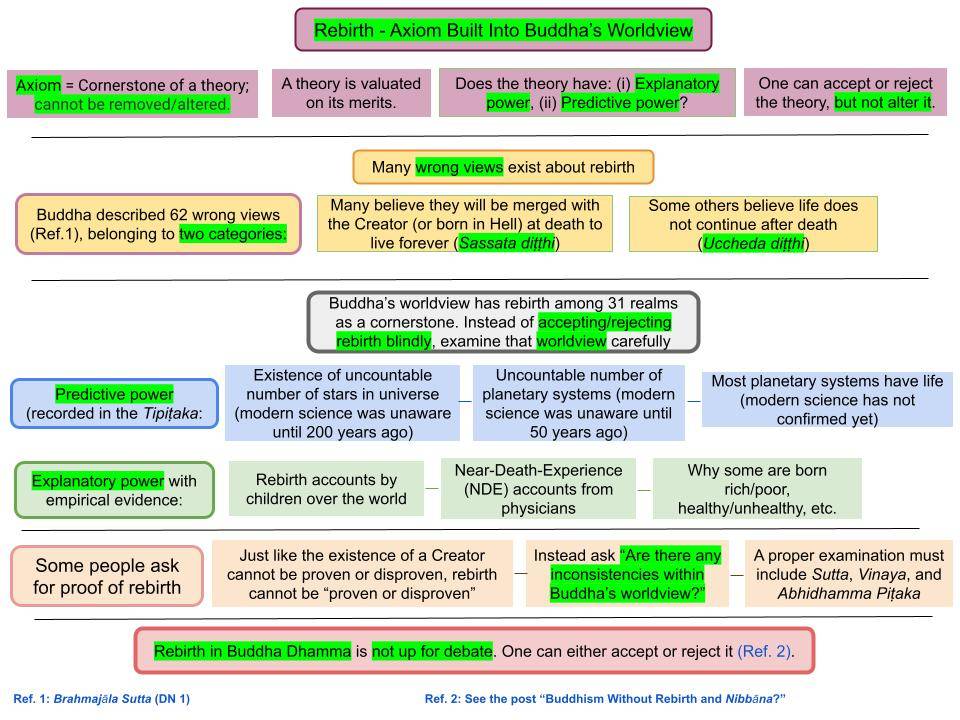
Rebirth is a foundational axiom of Buddhism (Buddha Dhamma.) There is much evidence from rebirth accounts, Near Death Experiences, child prodigies, and other areas.
Revised January 18, 2020; September 3, 2020; rewritten February 25, 2023
1. Most people in Western societies are not familiar with the concept of rebirth. However, that is changing because there is a lot of evidence emerging, and scientists and philosophers are beginning to take it seriously.
One needs to look at the mounting evidence without any preconceived ideas. There is no plausible way to explain these accounts from a purely "materialistic" point of view, i.e., that consciousness arises from inert matter. The brain does not produce consciousness but plays a critical role in human consciousness: "Brain – Interface between Mind and Body."
Here is a video of a recent discussion on Western research on children's past lives, Near Death Experiences, etc.:
OBE and NDE Studies
2. "Near-Death Experiences," or NDEs, are unique and fascinating phenomena that occur when an individual comes close to death, either through a life-threatening event or a medical emergency. Even with being declared dead with no brain function, individuals report seeing their "dead bodies" from above and what happened even in other rooms. They could move with their "mental bodies." In recent years, modern science has become interested in NDEs because some accounts of those who go through such experiences can be tested. Ongoing studies may significantly impact scientific thinking about consciousness in the coming years.
Here is a popular YouTube video on the presentation of a physician on Near-Death Experiences:
There is an ever-growing number of reports of Out-of-Body Experiences (OBE) and Near-Death Experiences (NDE) that not only support rebirth but also are consistent with the concept of a 'mental body" or "manōmaya kāya"; see, "Out-of-Body Experience (OBE) and Manōmaya Kāya" and other related posts.
3. There are many YouTube videos, but here are three recent books on these subjects:
"Consciousness Beyond Life" by Pim van Lommel (2010) gives detailed accounts of case studies on NDE by a renowned cardiologist.
"After: A Doctor Explores What Near-Death Experiences Reveal about Life and Beyond" by Bruce Greyson (2021).
"Brain Wars" by Mario Beauregard (2012) is a book by a scientist on NDE, OBE, and the mind-body problem in general.
"Dying to be Me: My Journey from Cancer, to Near Death, to True Healing," by Anita Moorjani (2012), is a personal story of a cancer survivor who had been diagnosed to die within a few weeks but had an "unexplainable recovery" within days during which time she had an out-of-body experience.
Rebirth Accounts
4. The late Professor Ian Stevenson at the University of Virginia conducted over 20 years of research on the authenticity of rebirth accounts, which Professor Jim Tucker is continuing.
These two professors have written several books about rebirth. A good book is "Twenty Cases Suggestive of Reincarnation" by Ian Stevenson. By the way, Professor Stevenson became a Buddhist later on in his life, presumably because of his studies (see “Rebirth as Doctrine and Experience” by Francis Story (2003); first edition 1975). He mentions this in the introduction he wrote to this book by Francis Story; I have scanned that introduction: "Introduction to "Rebirth by Francis Story - Ian Stevenson."
Here is a video that discusses the work of the late Dr. Ian Stevenson, Dr. Jim Tucker, and colleagues at the University of Virginia:
5. In their book, "Soul Survivor: The Reincarnation of a World War II Fighter Pilot," Bruce and Andrea Leininger detail the amazing story of their son's recount of a past life.
Here is a recent YouTube video on James Leininger's rebirth account:
Here is another story of the rebirth of a Civil War General:
Here is a three-year-old chanting Buddhistsuttā (and doing a very good job). Can a three-year-old memorize such complex lines of suttā?
Also, see the post, "Boy Who Remembered Pāli Suttas for 1500 Years." This is a true story about a boy (Dhammaruwan) who recited complex and lengthy Pālisuttā at five years of age, which sounded very different from current chantings. Furthermore, he remembers accounts of his previous life 1500 years ago, when he accompanied the famous Buddhaghosa on his trip to Sri Lanka.
Child Prodigies
Another piece of evidence comes from child prodigies. Here is a report on "10 Mind-Blowing Child Prodigies":
Here is a list of child prodigies from Wikipedia. You will recognize many of the names:
6. Many people say that direct “proof” for rebirth cannot be given; it is the other way around. If one's memories are in the brain (as science believes), all those memories will be lost when one dies. There is no "physical connection" between the brains of those involved in the rebirth stories.
Therefore, even if just one of those rebirth accounts can be proven true, there is no way to explain that other than rebirth. How can the brain in this life recall memories from the brain in a previous life?
If there is a connection between two lives that lived in two geographical locations (also separated by time), there is no explanation for that in current science, i.e., no way to make a connection between the DNA of those two "persons." A purely materialistic view cannot explain it.
And how could we ever explain the birth of such prodigies as Jeremy Bentham, who, already in his fourth year, could read and write Latin and Greek? John Stuart Mill read Greek at the age of three and wrote a history of Rome at six years of age. Babington Macaulay wrote a compendium of world history at age six. Beethoven gave public concerts when he was seven; Mozart had written musical compositions before his sixth year. Voltaire read the fables of Lafontaine when he was three years old.
Does it not seem infinitely more probable that all these prodigies and geniuses, who in many cases came from illiterate parents, had already, in previous births, laid the foundations for their extraordinary faculties?
Healing with Hypnosis
8. The late Dr. Richard Feynman was skeptical about the claims in hypnosis studies until he subjected himself to hypnosis on two occasions. In both instances, he verified that hypnosis works if done correctly. He describes these two cases in his book, "Surely You're Joking, Mr. Feynman!" (1985), pp. 66-68.
Therefore, hypnosis provides yet another set of "supporting material." There are many cases of people remembering past lives when hypnotized. It is hard to evaluate the validity of most such cases.
However, there is a branch of hypnosis that uses it as therapy. Some people seem to have "phobias" based on a horrific event from a past life. They cannot determine why they have these phobias, but they become cured when a hypnotist brings out that experience. Here is a 20/20 documentary of three such cases, where they vouch for the authenticity of the therapy sessions:
9. There are hundreds of youtube videos on rebirth stories and many on child prodigies and hypnosis-based curing of specific ailments.
The following books are also good reads:
"Many Lives, Many Masters," by Brian Weiss (1988).
"Many Mansions: The Edgar Cayce Story on Reincarnation," by Gina Cerminara (1988).
"Children's Past Lives: How Past Life Memories Affect Your Child" by Carol Bowman (1998)
"Return to Life: Extraordinary Cases of Children Who Remember Past Lives," Jim B. Tucker (2013).
One White Crow Is Enough to Disprove the Hypothesis, “All Crows Are Black”
10. If even a SINGLE rebirth account or an NDE is valid, then the hypothesis “consciousness arises in the brain” is false. American philosopher William James stated the following that is widely quoted today (“After the White Crow: Integrating Science and Anomalous Experience,” Jerry E. Wesch (click on the link to download pdf)):
In order to disprove the assertion that all crows are black, one white crow is sufficient.
That is a logical statement. It is unnecessary to prove that all or even many rebirth accounts/NDE accounts are true. Even if just one account is valid, that is enough to conclude that the brain is not the “seat of the mind.”
We have thousands of rebirth/NDE accounts scrutinized by scientists/physicians.
11. Some of you may wonder whether there is an inconsistency here. I have repeatedly mentioned that the Buddha clearly stated that it is extremely rare to be born a human. Yet, from the above rebirth case studies, it appears that people have been born in the human realm in successive lives. If it is so hard to attain a human birth, how can this be?
Upon exhausting the kammic energy for one existence, a living being grabs hold of another strong kammic potential for the next existence. A human existence (bhava) can last thousands of years. Yet, each human birth (jāti) lasts only about 100 years. Therefore, there can be many births (jāti) within human existence (bhava.)
Between successive births, that human lives in para loka with just the "mental body" or manōmaya kāya. Another word for that entity is gandhabba. The concept of gandhabba is explained in simple terms in "Ghost 1990 Movie – Good Depiction of Gandhabba Concept."
The same is true for the animal realm. The life of a dog is less than 20 years, but a "dog bhava" can last thousands or more years.
13. Thus, if one has done a highly meritorious deed and at some point in samsāra (rebirth process) latches on to that "kamma seed" (see, "Saṅkhāra, Kamma, Kamma Bīja, Kamma Vipaka"), that energy may be able to sustain that existence for many rebirths.
In these cases, when physical death occurs BEFORE exhausting the energy of the kamma seed, the manōmaya kāya (also called gandhabba) leaves the dead body and waits until a suitable womb is ready; see, "Manomaya Kaya (Gandhabba) and the Physical Body." In this case, the gandhabba may carry a physical resemblance to the next life, including scars of any significant wounds, birthmarks, etc.
When rebirth occurs, the new physical body could resemble parts of the old body. In many rebirth cases, such physical resemblances have been confirmed (as in the case of the civil war general in one of the above videos).
14. In summary, it is essential to remember that in Paṭicca Samuppāda, it is "upādānapaccayābhavo," i.e., grasping or craving (upādāna) that leads to existence (bhava): for example, existence as a dog.
That existence (bhava) may have enoughkammic energy to support many repeated births as a dog. Therefore, once a given bhava or existence is grasped, the next step of "bhava paccayā jāti" will lead to repeated births as a dog until that kammic energy is exhausted; see "Bhava and Jāti – States of Existence and Births Therein."
15. Conversely, if the kammic energy for that "bhava" has run out when death occurs, a new "bhava" will be grasped at the death moment.
For example, a human may exhaust the kammic energy for that human existence (bhava) and grasp a kammic seed for bhava (existence) of an elephant. In that case, an "elephant gandhabba" will come out of the dead body of the human. Then it will stay in that "mental body" until a matching "elephant womb" appears. That means the mother elephant must have a gati similar to this new elephant.
16. It may be difficult to grasp these concepts initially. One must carefully examine the evidence provided in the links and go back to several layers to grasp these ideas. It is not possible to explain everything in one post. Buddha Dhamma can be very deep if one wants to comprehend how nature works.
The deep connection between mind and matter is discussed in detail in “Brain and the Gandhabba.”
O renascimento é um axioma fundamental do Buddhismo (Buddha Dhamma). Há muitas evidências provenientes de relatos de renascimento, experiências de quase morte, crianças prodígios e outras áreas.
Revisado em 18 de janeiro de 2020; 3 de setembro de 2020; reescrito em 25 de fevereiro de 2023
1. A maioria das pessoas nas sociedades ocidentais não está familiarizada com o conceito de Renascimento. No entanto, isso está mudando porque há muitas evidências surgindo, e cientistas e filósofos estão começando a levá-lo a sério.
É preciso analisar as evidências crescentes sem quaisquer ideias preconcebidas. Não há maneira plausível de explicar esses relatos a partir de um ponto de vista puramente “materialista”, ou seja, de que a consciência surge da matéria inerte. O cérebro não produz consciência, mas desempenha um papel fundamental na consciência humana: “Cérebro – Interface entre Mente e Corpo”.
Aqui está um vídeo de uma discussão recente sobre pesquisas ocidentais sobre vidas passadas de crianças, experiências de quase morte (EQM), etc.:
Estudos sobre EFC e EQM
2. “Experiências de Quase Morte”, ou EQMs, são fenômenos únicos e fascinantes que ocorrem quando um indivíduo se aproxima da morte, seja por meio de um evento com risco de vida ou de uma emergência médica. Mesmo após serem declarados mortos, sem função cerebral, os indivíduos relatam ver seus “corpos mortos” de cima e o que aconteceu até mesmo em outras salas. Eles podiam se mover com seus “corpos mentais”. Nos últimos anos, a ciência moderna passou a se interessar pelas NDEs porque alguns relatos daqueles que passam por tais experiências podem ser testados. Estudos em andamento podem impactar significativamente o pensamento científico sobre a consciência nos próximos anos.
Aqui está um vídeo popular do YouTube sobre a apresentação de um médico sobre Experiências de Quase-Morte:
Há um número cada vez maior de relatos de Experiências Fora do Corpo (EFC) e Experiências de Quase Morte (EQM) que não apenas apoiam o Renascimento, mas também são consistentes com o conceito de um “corpo mental” ou “manōmaya Kāya”; veja “Experiência Fora do Corpo (EFC) e Manōmaya Kāya” e outros ensaios relacionados.
3. Existem muitos vídeos no YouTube, mas aqui estão três livros recentes sobre esses assuntos:
“Consciousness Beyond Life”, de Pim van Lommel (2010), apresenta relatos detalhados de estudos de caso sobre ECM por um renomado cardiologista.
“After: A Doctor Explores What Near-Death Experiences Reveal about Life and Beyond”, de Bruce Greyson (2021).
"Brain Wars", de Mario Beauregard (2012), é um livro escrito por um cientista sobre EQM, EFC e o problema mente-corpo em geral.
"Dying to be Me: My Journey from Cancer, to Near Death, to True Healing", de Anita Moorjani (2012), é a história pessoal de uma sobrevivente de câncer que havia sido diagnosticada com poucas semanas de vida, mas teve uma "recuperação inexplicável" em poucos dias, período durante o qual teve uma experiência extracorpórea.
Relatos de Renascimento
4. O falecido professor Ian Stevenson, da Universidade da Virgínia, conduziu mais de 20 anos de pesquisa sobre a autenticidade de relatos de Renascimento, pesquisa que o professor Jim Tucker continua.
Esses dois professores escreveram vários livros sobre Renascimento. Um bom livro é “Vinte Casos Sugestivos de Renascimento”, de Ian Stevenson. A propósito, o professor Stevenson tornou-se Buddhista mais tarde na vida, provavelmente devido aos seus estudos (ver “Renascimento como Doutrina e Experiência”, de Francis Story (2003); primeira edição de 1975). Ele menciona isso na introdução que escreveu para este livro de Francis Story; digitalizei essa introdução: “Introdução a ‘Renascimento’, de Francis Story – Ian Stevenson”.
Aqui está um vídeo que discute o trabalho do falecido Dr. Ian Stevenson, do Dr. Jim Tucker e de colegas da Universidade da Virgínia:
5. Em seu livro, “Soul Survivor: O Renascimento de um Piloto de Caça da Segunda Guerra Mundial”, Bruce e Andrea Leininger detalham a incrível história do relato de vida passada de seu filho.
Aqui está um vídeo recente do YouTube sobre o relato de Renascimento de James Leininger:
Aqui está outra história sobre o renascimento de um general da Guerra Civil:
Aqui está uma criança de três anos recitando Suttā Buddhistas (e fazendo um ótimo trabalho). Será que uma criança de três anos consegue memorizar versos tão complexos de Suttā?
Veja também o ensaio “Menino que se lembrava de Suttās em Pālī há 1.500 anos”. Esta é uma história real sobre um menino (Dhammaruwan) que recitava Suttās complexas e extensas aos cinco anos de idade, que soavam muito diferentes dos cantos atuais. Além disso, ele se lembra de relatos de sua vida passada, há 1.500 anos, quando acompanhou o famoso Buddhaghosa em sua viagem ao Sri Lanka.
Crianças prodígios
Outra evidência vem das crianças prodígios. Aqui está uma reportagem sobre “10 crianças prodígios impressionantes”:
Aqui está uma lista de crianças prodígios da Wikipedia. Você reconhecerá muitos dos nomes:
Evidências de Renascimento muito mais fortes do que se imagina
6. Muitas pessoas dizem que não é possível apresentar uma “prova” direta do Renascimento; na verdade, é o contrário. Se as memórias de uma pessoa estão no cérebro (como acredita a ciência), todas essas memórias serão perdidas quando ela morrer. Não há nenhuma “conexão física” entre os cérebros das pessoas envolvidas nas histórias de Renascimento.
Portanto, mesmo que apenas um desses relatos de renascimento possa ser comprovado como verdadeiro, não há como explicar isso a não ser pelo renascimento. Como o cérebro nesta vida pode recordar memórias do cérebro de uma vida anterior?
Se existe uma conexão entre duas vidas que viveram em dois locais geográficos (também separados pelo tempo), não há explicação para isso na ciência atual, ou seja, não há como estabelecer uma conexão entre o DNA dessas duas “pessoas”. Uma visão puramente materialista não consegue explicar isso.
E como poderíamos explicar o nascimento de prodigios como Jeremy Bentham, que, já aos quatro anos, sabia ler e escrever latim e grego? John Stuart Mill lia grego aos três anos e escreveu uma história de Roma aos seis anos. Babington Macaulay escreveu um compêndio de história mundial aos seis anos. Beethoven deu concertos públicos aos sete anos; Mozart já havia escrito composições musicais antes dos seis anos. Voltaire leu as fábulas de Lafontaine quando tinha três anos de idade.
Não parece infinitamente mais provável que todos esses prodígios e gênios, que em muitos casos eram filhos de pais analfabetos, já tivessem, em vidas anteriores, lançado as bases para suas faculdades extraordinárias?
Cura com Hipnose
8. O falecido Dr. Richard Feynman era cético em relação às alegações dos estudos sobre hipnose até que se submeteu à hipnose em duas ocasiões. Em ambos os casos, ele verificou que a hipnose funciona se for feita corretamente. Ele descreve esses dois casos em seu livro, “Surely You’re Joking, Mr. Feynman!” (1985), pp. 66-68.
Portanto, a hipnose fornece mais um conjunto de “material de apoio”. Há muitos casos de pessoas que se lembram de vidas passadas quando hipnotizadas. É difícil avaliar a validade da maioria desses casos.
No entanto, existe um ramo da hipnose que a utiliza como terapia. Algumas pessoas parecem ter “fobias” baseadas em um evento horrível de uma vida passada. Elas não conseguem determinar por que têm essas fobias, mas ficam curadas quando um hipnotizador traz à tona essa experiência. Aqui está um documentário do 20/20 sobre três desses casos, nos quais as pessoas atestam a autenticidade das sessões de terapia:
9. Existem centenas de vídeos no YouTube sobre histórias de Renascimento e muitos sobre crianças prodígios e a cura de doenças específicas por meio da hipnose.
Os seguintes livros também são boas leituras:
"Muitas Vidas, Muitos Mestres", de Brian Weiss (1988).
"Many Mansions: The Edgar Cayce Story on Renascimento", de Gina Cerminara (1988).
"Vidas Passadas das Crianças: Como as Memórias de Vidas Passadas Afetam Seu Filho", de Carol Bowman (1998)
"Retorno à Vida: Casos Extraordinários de Crianças que se Lembram de Vidas Passadas", de Jim B. Tucker (2013).
Um corvo branco é suficiente para refutar a hipótese de que “todos os corvos são pretos”
10. Se mesmo um ÚNICO relato de Renascimento ou uma experiência de quase morte (NDE) for válido, então a hipótese de que “a consciência surge no cérebro” é falsa. O filósofo americano William James afirmou o seguinte, que é amplamente citado hoje (“After the White Crow: Integrating Science and Anomalous Experience”, Jerry E. Wesch (clique no link para baixar o PDF)):
Para refutar a afirmação de que todos os corvos são pretos, basta um corvo branco.
Essa é uma afirmação lógica. Não é necessário provar que todos ou mesmo muitos relatos de Renascimento/experiências de quase morte (EQM) sejam verdadeiros. Mesmo que apenas um relato seja válido, isso é suficiente para concluir que o cérebro não é a “sede da mente”.
Temos milhares de relatos de Renascimento/EMD analisados por cientistas/médicos.
11. Alguns de vocês podem se perguntar se há uma inconsistência aqui. Mencionei repetidamente que o Buddha afirmou claramente que é extremamente raro nascer como humano. No entanto, a partir dos estudos de caso de Renascimento acima, parece que as pessoas têm nascido no reino humano em vidas sucessivas. Se é tão difícil alcançar um nascimento humano, como isso pode ser?
Ao esgotar a energia de Kamma de uma existência, um ser vivo se apega a outro forte potencial de Kamma para a próxima existência. Uma existência humana (Bhava) pode durar milhares de anos. No entanto, cada nascimento humano (Jāti) dura apenas cerca de 100 anos. Portanto, pode haver muitos nascimentos (Jāti) dentro da existência humana (Bhava).
Entre nascimentos sucessivos, esse ser humano vive em para loka apenas com o “corpo mental” ou manōmaya Kāya. Outra palavra para essa entidade é Gandhabba. O conceito de Gandhabba é explicado em termos simples em “Filme Ghost de 1990 – Boa representação do conceito de Gandhabba”.
O mesmo se aplica ao reino animal. A vida de um cão é inferior a 20 anos, mas um “Bhava de cão” pode durar milhares de anos ou mais.
13. Assim, se alguém realizou uma ação altamente meritória e, em algum momento do Saṃsāra (processo de renascimento), se apega a essa “semente de Kamma” (ver “Saṅkhāra, Kamma, Kamma Bīja, Kamma Vipaka”), essa energia pode ser capaz de sustentar essa existência por muitos renascimentos.
Nesses casos, quando a morte física ocorre ANTES de esgotar a energia da semente deKamma, o manōmaya Kāya (também chamado de Gandhabba) deixa o corpo morto e espera até que um útero adequado esteja pronto; veja “Manomaya Kāya (Gandhabba) e o Corpo Físico”. Nesse caso, o Gandhabba pode apresentar uma semelhança física com a próxima vida, incluindo cicatrizes de ferimentos significativos, marcas de nascença, etc.
Quando ocorre o renascimento, o novo corpo físico pode se assemelhar a partes do corpo antigo. Em muitos casos de renascimento, tais semelhanças físicas foram confirmadas (como no caso do general da guerra civil em um dos vídeos acima).
14. Em resumo, é essencial lembrar que, em Paṭicca Samuppāda, é “Upādāna Paccayā Bhava”, ou seja, o apego ou desejo (Upādāna) que leva à existência (Bhava): por exemplo, a existência como um cão.
Essa existência (Bhava) pode ter energia Kamma suficiente para sustentar muitos renascimentos repetidos como um cão. Portanto, uma vez que um determinado Bhava ou existência é agarrado, o próximo passo de “Bhava Paccayā Jāti” levará a renascimentos repetidos como um cão até que essa energia Kamma se esgote; veja “Bhava e Jāti – Estados de Existência e Renascimentos Neles”.
15. Por outro lado, se a energia de Kamma para esse “Bhava” se esgotar quando a morte ocorrer, um novo “Bhava” será agarrado no momento da morte.
Por exemplo, um ser humano pode esgotar a energia Kamma para essa existência humana (Bhava) e agarrar-se a uma semente Kamma para o Bhava (existência) de um elefante. Nesse caso, um “Gandhabba de elefante” sairá do corpo morto do humano. Em seguida, ele permanecerá nesse “corpo mental” até que um “útero de elefante” compatível apareça. Isso significa que a mãe elefante deve ter uma Gati semelhante à dessa nova elefante.
16. Pode ser difícil compreender esses conceitos inicialmente. É preciso examinar cuidadosamente as evidências fornecidas nos links e voltar a várias camadas para compreender essas ideias. Não é possível explicar tudo em um único ensaio. O Buddha Dhamma pode ser muito profundo se quisermos compreender como a natureza funciona.
A profunda conexão entre mente e matéria é discutida em detalhes em “O Cérebro e o Gandhabba”.