As of August 2022, there are over 700 posts on the website. Recently, I have been getting inquiries on "where to start?" when one first comes to the website.
1. First, there are a few general tools that can be used to navigate the website:
-
- Following is what the home page of the site should look like.
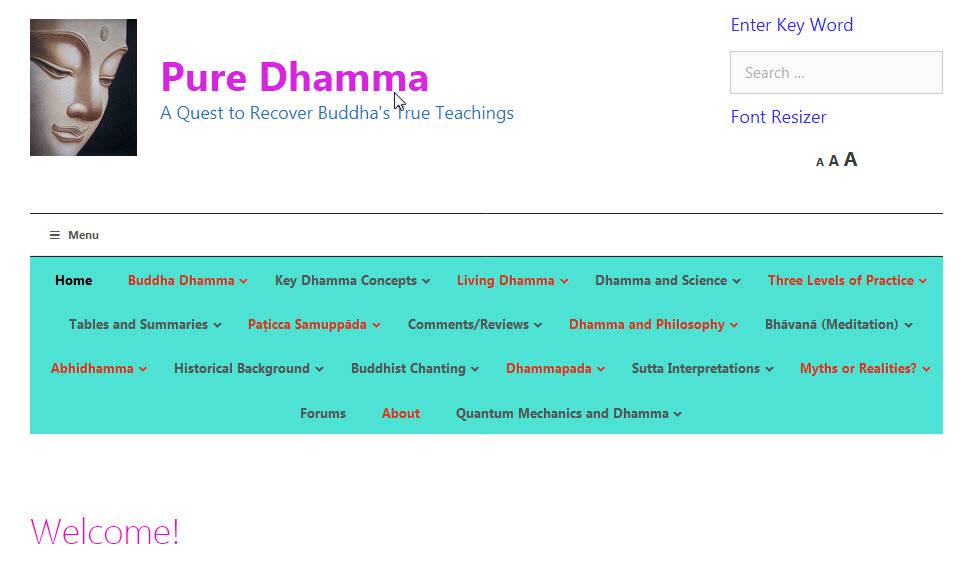
- If you do not see it like that with the menu system, you should update your browser (Google Chrome, Microsoft Explorer, Firefox, etc.) so that you would be able to see the menu as shown above.
- Another way to look at the whole menu is “Pure Dhamma – Sitemap. “ All posts are categorized under sections and subsections there. One could scan through it to locate relevant posts of interest.
- The “Search” button at the top right is also good at extracting relevant posts for a given keyword or keywords.
- I have added a “bread crumbs” link at the top of each page so you can see which section/subsection the page belongs to. You can go to that section/subsection and read more on that topic.
- January 30, 2019: For those new to Buddha Dhamma (or just want to look at the essential fundamentals, see "Essential Buddhism."
- February 28, 2022: New section pointing out the glaring inconsistencies (with the Tipiṭaka) in the current Theravada texts: "Elephants in the Room."
2. First, for those familiar with Buddha Dhamma (Buddhism), I like to point out that three main misconceptions are prevalent today. They not only block the path to Nibbāna but are micchā diṭṭhi that could be responsible for rebirth in the apāyā. I am not trying to scare anyone, but "making adhamma to be dhamma is a serious offense."
- Misinterpretation of anicca, dukkha, anatta: "Anicca, Dukkha, Anatta – Wrong Interpretations."
- Misinterpretation of breath meditation as Ānāpānasati: "Is Ānāpānasati Breath Meditation?".
- Insisting that the gandhabba (manomaya kaya) is a Mahāyāna concept: "Gandhabba State – Evidence from Tipiṭaka".
- These misconceptions are not the fault of current Theravadins; they have been handed down for hundreds of years, as explained in the "Historical Background." However, it makes no sense to adhere to them when solid evidence is presented, per the above posts and many others on this website.
- Of course, no one should be able to insist, "this is the only truth, and nothing else is the truth," but the truth can be verified to one's satisfaction by critically examining the evidence. I am open to discussing any valid contrary evidence. We need to sort out the truth for the benefit of all.
3. Now, let us discuss which sections could interest people with different backgrounds on their exposure to Buddha Dhamma.
- The "Moral Living and Fundamentals" section is a good start for anyone since the fundamentals of Buddha Dhamma are discussed. In particular, the subsections "Buddha Dhamma and Buddhism" and "Dhamma Concepts" could be informative.
- The subsection on "Working Towards Good Rebirths" broadens the concepts discussed in the above subsection to indicate how one's actions need to be tailored to seek rebirths in higher realms and to avoid births in the lower realms (apāyā) in case one is unable to attain any stages of Nibbāna in this life.
- Even those exposed to "Buddhism" may realize that some fundamental aspects have been misrepresented in many textbooks and websites.
4. The "Buddha Dhamma" section is a more advanced version of the abovementioned sections. It discusses the basis of the Buddha Dhamma, i.e., the importance of purifying one's mind in the first few posts.
- The Buddha described a wider world of 31 realms, of which we know only two: the animal and human realms: "The Grand Unified Theory of Dhamma."
- Then it discusses how the Buddha could see that "bigger picture" in the post, "Buddha Dhamma: Non-Perceivability and Self-Consistency."
- The two posts "Saṃsāric Time Scale, Buddhist Cosmology, and the Big Bang Theory" and "Evidence for Rebirth" discuss how we have been going through the birth/death/rebirth process from the beginning-less time.
5. For Those who have had exposure mainly to "Mahāyāna Buddhism," the following two posts will provide an idea of why Mahāyāna sutrās are very different from the suttā that the Buddha delivered: "Saddharma Pundarika Sutra (Lotus Sutra) – A Focused Analysis" and "What is Sunyata or Sunnata (Emptiness)?".
- Further details on how various "schools of Buddhism" -- like Mahāyāna, Vajrayāna (Tibetan), Zen, etc. -- evolved within the first 1000 years after the Buddha can be found in the "Historical Background" section.
6. Even Theravāda Buddhism -- which is supposed to be closest to the Buddha's original teachings -- has been contaminated over the years, mainly due to three key reasons. The first reason is losing the true interpretations of ten types of micchā diṭṭhi (wrong views).
- There are two types of Eightfold Paths: mundane and transcendental (lokottara). One needs to first get into the mundane Path by getting rid of the ten types of micchā diṭṭhi; see "Buddha Dhamma – In a Chart" and "Maha Chattarisaka Sutta (Discourse on the Great Forty)".
- One of the ten micchā diṭṭhi is "para lōka" ("para loka" in Sinhala), or the world of gandhabba does not exist. Many people think that gandhabba is a Mahāyāna concept, but that is a big mistake; see below.
- One cannot even get into the mundane Eightfold Path if one believes that para lōka and gandhabba are not real.
7. Second, various Hindu meditation techniques -- including wrong interpretations of kasina meditation and Ānāpānasati (as breath mediation) -- were incorporated into Theravāda teachings, especially after Buddhaghosa's Visuddhimagga; see "Buddhaghosa’s Visuddhimagga – A Focused Analysis," and the posts referred to there.
8. Third and most important reason is the incorrect translation of key Pāli words like anicca and anatta by the Early European scholars in the 1800s, see "Misinterpretation of Anicca and Anatta by Early European Scholars."
- Let us briefly discuss each of those three and point to a few more relevant posts.
9. Many people don't realize that the concept of gandhabba (mental body) is a critical component in explaining how life functions in human and animal realms.
- First, it is a misconception that gandhabba is a Mahāyāna concept; see "Antarabhava and Gandhabba" and "Gandhabba State – Evidence from Tipiṭaka."
- Without the concepts of gandhabba, it is not possible to explain so many rebirth stories and out-of-body experiences that have been widely reported in recent years; see "Evidence for Rebirth" and "Out-of-Body Experience (OBE) and Manōmaya Kāya."
- The main opposition to the concept of gandhabba in current Theravāda circles is the misconception that it is an "antarābhava," i.e., between two bhava. But a human gandhabba is in the same "human bhava." This is clarified in "Antarabhava and Gandhabba."
- The critical role of the mental body (gandhabba) in giving rise to multiple births (jāti) within human and animal existences (bhava) has been disregarded. However, not believing in the existence of gandhabba is a micchā diṭṭhi and is a hindrance to attaining the Sōtāpanna stage; see, "Miccā Diṭṭhi, Gandhabba, and Sotāpanna Stage."
- Because of its high importance, gandhabba is discussed in two main sections: "Mental Body – Gandhabba" and "Gandhabba (Manomaya Kaya)".
- Regarding the problems with Buddhaghosa's Visuddhimagga -- published 1500 years ago -- the two issues mentioned above are:
- Regarding kasina mediations discussed in the Visuddhimagga, there is not a single sutta in the Tipiṭaka that discusses kasina mediation.
- Regarding the breath meditation discussed in the Visuddgimagga, no suttā in the Tipiṭaka discusses BREATH MEDITATION. Those suttā have been mistranslated. Furthermore, there is a sutta in the Tipiṭaka that specifically says breath meditation is not Ānāpānasati meditation, see, "Is Ānāpānasati Breath Meditation?".
11. The critical problem of incorrect translation of anicca and anatta has prevented so many people from making progress over the past 200 years. I strongly recommend the post “Anicca, Dukkha, Anatta – Wrong Interpretations. “
- More posts can be found in the section "Anicca, Dukkha, Anatta." The correct interpretation of many relevant key suttā is discussed in that section.
- The introductory timeline on those historical developments is given in "Incorrect Theravāda Interpretations – Historical Timeline," and all relevant posts are in the "Historical Background" section.
12. Now, let us turn to an issue of relevance to many new to Buddha Dhamma. Many people -- especially in Western countries -- have a hard time believing in rebirth; see, "Buddhism without Rebirth and Nibbāna?".
- The section, "Living Dhamma," is specially designed for one to start following Buddha Dhamma even without believing in the concept of rebirth.
- The first two subsections there are good to be read by everyone. One can experience a real "cooling down" even without believing in rebirth.
- The latter subsections gradually take one to advanced concepts, and the latter sections are appropriate even for people with advanced backgrounds in Buddha Dhamma. One would be able to clarify advanced concepts in later subsections.
13. Once one starts looking into Buddha Dhamma seriously, it is a good idea to learn a few basic things about the Pāli language. The Pāli Canon, first transmitted orally and then written 2000 years ago, still has all the suttā composed by the Buddha and memorized by Ven. Ananda.
- See "Preservation of the Dhamma" and other relevant posts in the "Historical Background."
- While the Buddha encouraged delivering Dhamma to others in their native language, there are some advantages to learning at least some key Pāli words, see, "Why is it Necessary to Learn Key Pāli Words?".
- In particular, learning the meanings behind some key roots like "san" makes a huge difference in gaining an understanding of keywords like samsāra and sammā, see the subsection on "What is “San”? Meaning of Sansāra (or Saṃsāra)".
14. Learning the correct meanings of the suttā in the Tipiṭaka is essential to learning Buddha Dhamma. Most existing literature, even on Theravāda, has incorrect translations.
- The section "Sutta Interpretations" discusses some key suttā in the Tipiṭaka.
- It is a good idea first to read two important posts in that section, "Sutta – Introduction" and "Pāli Dictionaries – Are They Reliable?".
- Short and succinct sayings of the Buddha in the Dhammapada provide deep insights in short verses. Some of these are discussed in the "Dhammapada" section.
15. Meditation (both formal and informal) is essential to following the Path of the Buddha. The "Bhāvanā (Meditation)" provides a series of posts on the fundamentals of meditation and also on advanced topics.
- A critical misconception that is prevalent today is that Ānāpānasati bhāvanā is breath meditation. Several posts discuss the correct version, and the post "Is Ānāpānasati Breath Meditation?" discusses evidence from the Tipiṭaka that breath meditation is not Ānāpāna.
- The Satipattāna bhāvanā is discussed in the subsection, "Maha Satipaṭṭhāna Sutta."
16. Buddha Dhamma is based on the principle of causation (cause and effect), which in Pāli is Paṭicca Samuppāda. The principles are discussed in the section "Paṭicca Samuppāda."
- While the meaning of Paṭicca Samuppāda is clear from its name itself, "Paṭicca Samuppāda – “Pati+ichcha”+” Sama+uppāda," the main concepts are discussed in plain English: "Paṭicca Samuppāda in Plain English."
-
Comprehension of the Four Noble Truths requires understanding Paṭicca Samuppāda and Tilakkhana. See "Paṭicca Samuppāda, Tilakkhana, Four Noble Truths."
-
Just because causes exist does not necessarily mean that effects (results) will follow. There must be suitable conditions for those results (also called vipāka). This is discussed in detail in the subsection "Paṭṭhāna Dhamma."
17. Chanting of suttā and reciting the virtues of Buddha, Dhamma, and Saṅgha can prepare one's mind to be receptive to learning Dhamma and thus could be an important part of the practice, see "Buddhist Chanting."
- The section on "Myths or Realities?" is also important since it discusses many concepts and practices that some consider to not belong to Buddha Dhamma.
18. For Those who would like to see how compatible Buddha Dhamma is with modern science, the "Dhamma and Science" section is a good resource.
- That section points out both consistencies and inconsistencies with modern science.
- Modern science has had to revise or come up with new theories to explain many phenomena over the past 500 years, but Buddha Dhamma (in the Tipiṭaka) has remained the same for over 2500 years.
- I predict the remaining inconsistencies will also be resolved in favor of Buddha Dhamma.
19. The section on "Tables and Summaries" is an important collection of posts summarizing bits of information or "data" that are not necessary to be memorized but could be needed to explain things in detail.
- There are several posts with listings of types of citta, cetasika, 28 types of rūpa, etc., in this section.
- There is also a Pāli glossary with pronunciation: "Pāli Glossary – (A-K)" and "Pāli Glossary – (L-Z)."
- The section on "Comments/Reviews" has two subsections on "Discussion of Comments" and "Book Reviews."
20. Some either have already learned Abhidhamma or would like to learn. For them, the "Abhidhamma" section could be useful. There are several subsections in this section on various topics.
- The "Abhidhamma via Science" section highlights some overlaps between Abhidhamma Science.
- One of my favorite subjects is Abhidhamma. When one has proceeded along the Path to some extent, it could be useful to learn Abhidhamma, which will help gain a deeper understanding.
21. Finally, but most importantly, three important subsections discuss issues involved in attaining magga phala (stages of Nibbāna). The primary goal of this website is to provide enough material for one to attain the Sōtāpanna stage of Nibbāna.
- First, the concept of Nibbāna is a puzzle to many. It is discussed in several posts in the subsection: "Nibbāna."
- Some critical points to consider by those making an effort in that direction are discussed in the subsection: "Seeking Nibbāna."
- The first goal of those who seek Nibbāna is the Sōtāpanna stage. Many concepts are requirements for achieving that goal are discussed in the subsection: "Sōtāpanna Stage of Nibbāna."
- The section “Living Dhamma“is specially designed for one to start following Buddha Dhamma even without believing in the concept of rebirth, all the way to the Sōtāpanna stage. People with a more advanced background can start at later subsections, skipping the early ones.