The four conditions for attaining the Sotapanna stage are discussed. One must understand the "previously unknown real nature of this world" revealed by the Buddha.
Revised March 22, 2016; last revised on October 25, 2025
Buddha Dhamma - A Paradigm-Change of Worldview
1. Buddhism is commonly treated as "another religion." However, it is strikingly different from traditional religions based on a Creator. See "Is Buddha Dhamma (Buddhism) a Religion?"
- It is imperative to understand what the Buddha meant by saying, "My Dhamma (teaching) has not been known to the world." Most people follow the mundane version of Buddhism, which mainly involves living a moral life and following rituals. Instead, they need first to understand the "real nature" of this world, which involves rebirths in suffering-filled existences.
- Becoming a Sotapanna REQUIRES understanding the Buddha's "previously unheard description of nature."
- There are eight types of Noble Persons, with the highest at the Arahant stage. One starts at the Sotapanna Anugāmi stage with a vague understanding of this new worldview; see "Sōtapanna Anugāmi – No More Births in the Apāyās." One fully comprehends the new worldview and can refrain from attaching to "distorted saññā" (built into the physical body) only at the Arahant stage. It is critical to understand that "view" (diṭṭhi) and "perception" (saññā) are different. See “Sotapanna Stage via Understanding Perception (Saññā).”
Pre-Conditions to Prepare for the Sotapanna Stage
2. As discussed in the following posts, one must first complete the mundane (lōkiya) eightfold Path to become a Sōtapanna Anugāmi. The Noble Eightfold Path starts at the Sōtapanna Anugāmi stage.
- I strongly advise reading the following posts and thinking about this issue: "Buddha Dhamma - In a Chart" and the discussion at "What is Unique in Buddha Dhamma?".
- As I pointed out in many posts, one on the mundane Path abstains from immoral deeds out of fear of bad outcomes.
- But when one starts comprehending the Four Noble Truths at the Sōtapanna Anugāmi stage, one avoids such deeds because one sees the futility of such actions. What is the point in hurting others to acquire sensory pleasures that, in the end, do not provide any lasting happiness? Not only that, but such actions will lead to much suffering in future lives.
Four Requirements to Attain the Sotapanna Stage
3. In many suttās, including "Sotāpattiphala Sutta (SN 55.55)" and "Dutiya Sāriputta Sutta (SN 55.5)," the four requirements for someone to attain the Sōtapanna stage of Nibbāna are stated: "Cattārome, bhikkhave, dhammā bhāvitā bahulīkatā sotāpattiphalasacchikiriyāya saṃvattanti. Katame cattāro? Sappurisasaṃsevo, saddhammassavanaṃ, yonisomanasikāro, dhammānudhammappaṭipatti".
- It is necessary to associate with (Sappurisasaṃsevo) and learn from (saddhammassavanaṃ) a Noble Person (Ariya) to fulfill the first two requirements. Since written texts were not available at the time of the Buddha, one had to listen to (saddhammassavanaṃ) to learn, but nowadays, one can learn by reading or listening.
- A "sappurisa (sath + purisa or "Noble friend," i.e., an Ariya)," is sometimes called a "kalyāna mittā" ("kalyāna mitrā" in Sanskrit.)
- Therefore, the first two conditions fulfill the requirement of grasping the basic ideas from an Ariya. This is also called "jānato" or "to become aware of." Thus, one becomes a "Sotapanna Anugami" at this stage.
4. Once the basic ideas are grasped, a "Sotapanna Anugami" must contemplate and firmly establish the foundational views in their minds. That involves the last two conditions. That is the "passato" stage, to be fulfilled by the Sotapanna Anugami, who fully grasps the new worldview and attains the Sotapanna stage. See "'Jānato Passato' and Ājāniya – Critical Words to Remember."
- Yōniso manasikāra means to understand how various rebirths occur according to Paṭicca Samuppāda. Here, "yōni" means "origins," and "manasikāra" means to "sink into the mind."
- The final condition, dhammānudhamma Paṭipadā, involves living by the principles (dhamma) grasped and examining the details of those principles (anudhamma.)
Must One be Listening to an Ariya to Reach the Sotapanna Phala Moment?
5. There is an ongoing debate about whether the Sotapanna magga phala moment is possible only when listening to Dhamma. In the following video (starting around 8 minutes), Waharaka Thero states that it is required. He says one can read and reach the Sotapanna Anugāmi stage, but the phala moment occurs only while listening to a discourse by an Ariya.
- However, attaining the Sotapanna phala moment can happen anytime, anywhere, while contemplating. Of course, one must have learned the necessary Dhamma concepts from a Noble Person (an Ariya).
- We can look at two accounts from the Tipitaka to verify the above statement (apparently, Waharaka Thero was unaware of them). Ven. Koṇḍañña attained the Sotapanna phala moment while contemplating the Dhamma he learnt from the first discourse delivered by the Buddha: "Imasmiñca pana veyyākaraṇasmiṁ bhaññamāne āyasmato koṇḍaññassa virajaṁ vītamalaṁ dhammacakkhuṁ udapādi." It is mistranslated as "And while this discourse was being spoken, the stainless, immaculate vision of the Dhamma arose in Venerable Koṇḍañña." See "Dhammacakkappavattana Sutta (SN 56.11)." The correct translation is, "While contemplating (analyzing) the Dhamma he learned from the Buddha, the stainless, immaculate vision of the Dhamma arose in Venerable Koṇḍañña (i.e., he attained the Sotapanna phala moment.)
- Another example is Ven. Cittahattha's account, "The Five Dullabha (Rare Things)." See the description under "Venerable Cittahattha's Account" and other comments. Another reference to Ven. Cittahattha's account: "Dhammapada Verses 38 and 39: Cittahatthatthera Vatthu." As stated in those accounts, Ven. Cittahattha attained the Sotapanna phala moment while walking to the monastery to become a bhikkhu for the seventh time; along the way, he reflected on the Dhamma he had learned and realized the Sotapanna phala.
Sotapanna Anugāmi - Dhammānusārī or Saddhānusārī
6. A Sōtapanna Anugāmi is either a dhammānusārī or a saddhānusārī. For details, see "Sōtapanna Anugāmi – No More Births in the Apāyā."
- Also see "Sōtapanna Anugāmi and a Sōtapanna."
- During the process of becoming a Sotapanna, one removes three of the ten sanyōjana (or samyōjana or "mental bonds"). Those ten MENTAL bonds bind one to the cycle of rebirth; see "Conditions for the Four Stages of Nibbāna."
Uniqueness of Buddha's Teachings
7. Let us briefly address the issue of the "uniqueness of Buddha's teachings." It can be understood only if one accepts (at least temporarily) the "wider worldview of the Buddha." They include the existence of 31 realms and a rebirth process within those realms based on the natural laws of kamma (karma in Sanskrit). I have a section discussing the validity of those assumptions/axioms: "Origin of Life."
- The central assumption of all puthujjana (those who have not understood Buddha Dhamma) is the following: The world has "pleasurable things," and the goal is to acquire as many such as possible (and that will lead to happiness). That seems logical in many cases. Those who have wealth seem to be enjoying life. Modern economies are built around the development of mind-pleasing gadgets, residences, movies, music, etc.
- However, when looked closely, one can see problems in that assumption. Let us discuss a few.
- Some people have a lot of wealth but suffer due to mental stress or other issues that even lead to suicide. Some are born wealthy but suffer due to an ailment. All, without exception, will suffer in old age.
Paṭicca Samuppāda Leads to Two Key Aspects of Life
8. From the "wider worldview of the Buddha," the picture is very different. There are two main aspects to pay attention to:
- Immoral thoughts, speech, and actions by humans seeking "pleasurable things" have unfathomable, harsh consequences. Moral and immoral thoughts, speech, and actions maintain the rebirth process. Immoral ones lead to rebirths in the apāyās (lowest four realms), where suffering is harsh. While moral ones lead to rebirths in good (human, Deva, and Brahma) realms, such "good rebirths" are rare. See "How the Buddha Described the Chance of Rebirth in the Human Realm." The mechanism of how that happens is described by Paṭicca Samuppāda, and the meaning is embedded in the title itself ( “attachment to something leading to the generation of the corresponding 'bhava' (and thus jāti)"); see "Paṭicca Samuppāda – 'Pati+ichcha' + 'Sama+uppāda'.”
- The second aspect is related to the first: "The new existence has features (specifically "distorted saññā") built-in according to the type of attachment." That is also consistent with and explained by Paṭicca Samuppāda. That aspect is to embed a "distorted saññā" according to the type of attachment. For example, human birth arises from craving sensory pleasures without involving immoral deeds; thus, a human body is formed by kammic energy to produce a "distorted saññā" that such sensory experiences are "mind-pleasing." On the other hand, the birth of a pig originated in an immoral, lowly deed. The pig's body is designed by kammic energy to provide a "distorted saññā" of "tastiness in rotten meat or even feces."
- I only recently started discussing the second aspect. See “Sotapanna Stage via Understanding Perception (Saññā).” More recent posts in the new “Satipaṭṭhāna Sutta – New Series” section.
Four Noble Truths, Paṭicca Samuppāda, Tilakkhana
9. Those two aspects explain WHY the Buddha said: "this wider world of 31 realms" has much suffering. Illusory sensory pleasures (due to built-in distorted saññā) keep us bound to the kāma loka and often to the four apāyā. That is the First Noble Truth.
- The Buddha also said that if one comprehends the First Noble Truth, one will automatically understand the other three. That essential vision or the first inkling of "Sammā Diṭṭhi" is critical.
- Understanding Paṭicca Samuppāda is essential to understanding the Four Noble Truths. Paṭicca Samuppāda explains how rebirths in various existences occur, including in the apāyās (the four lowest realms, including the animal realm.)
- That will lead to an understanding of the actual frightful nature of this world, i.e., Tilakkhana (anicca, dukkha, anatta). Details at "Paṭicca Samuppāda, Tilakkhana, Four Noble Truths."
Only a Noble Person Can Explain Those Concepts
10. Now, it is easier to grasp why the Buddha emphasized the importance of those four conditions. First, since Buddha's message is unique (as summarized in #7 above), it has to come from a Buddha or "someone whose knowledge traces back to the Buddha." The following is an analogy to explain that.
- The Buddha can be compared to a great tree, standing tall and firm. All other humans are like "climbers" that need a tree to "climb up." Such climbers lack strong enough stems, so they cannot stand upright on their own. They need the support of another plant or a stick to stand. Those plants are called climbers. Climbers have tendrils to hold the supporting plant or a post. The following are some examples.
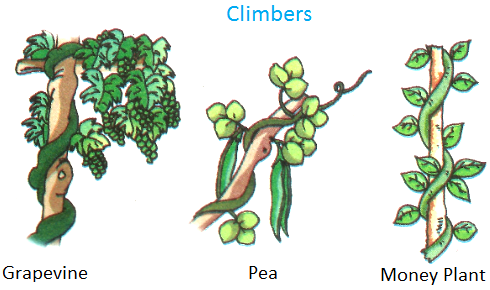
- Let us think of a forest with numerous climbers, but only one tree, and no other supports such as sticks. The only way for a climber to "climb up" would be to get hold of that tree.
- Only climbers close to the tree can reach it and climb. But now others can, too. Thus, as more climbers start climbing, the "access area" grows.
- Therefore, if we can find a climber climbing up, we can ALWAYS trace it back to the original tree. In the same way, an Ariya or a Noble person (a Sōtapanna, Sakadāgāmi, Anāgāmi, or Arahant) can ALWAYS be traced back in lineage to the Buddha.
- Because the message is unique, it must come from the Buddha himself or from someone whose lineage can be traced to the Buddha. Without exposure to the correct message, one cannot attain even the Sōtapanna Anugāmi stage. Someone aspiring to become an Ariya MUST learn that Dhamma from another Ariya; see "Buddha Dhamma - In a Chart."
11. Now, we can see the logic of the first two conditions. One has to learn Dhamma (the correct version), AND thus, it can be learned only from an Ariya (Noble) person.
- The phrase "Kalyāna mitrā" is Sanskrit; in Pāli, it is "kalyāna mittā" (pronounced "miththā"), for "a friend who helps to remove defilements" ("kāla" is for "dirty" or "blackish" as in "dirty water" and "na" is for "removing").
- Many people consider "Kalyāna mitrā" to be a "good friend" in the conventional sense. But it is more than just "good." One needs to understand the Buddha's message to convey it to others.
- That is possible by listening to or reading about this correct message, which fulfills the first two conditions and leads to a tentative grasping of the foundational concepts (jānato).
Value of a Noble Friend (Kalyāna Mittā)
12. One time, Ven. Ananda, who was the personal assistant to the Buddha for many years, in the end, approached the Buddha and said, "Bhante (Venerable Sir), I have been thinking that the future of the Buddha Sāsana (doctrine) must be dependent at least 50% on the kalyāna mittās".
- The Buddha replied, "Ananda, do not say that. The Buddha Sāsana will depend 100% on the kalyāna mittās". Now we can see why. See "Upaḍḍha Sutta (SN 45.2)."
- If that lineage breaks, the Buddha Sāsana will end. The words may still be in books, but no one will explain the true meanings of keywords such as anicca, dukkha, and anatta.
- In the Vinaya Pitaka, the Buddha said Buddha Dhamma would FLOURISH only for 500 years (that does not mean it would disappear): “20. Nuns (Bhikkhunī)” The “Gotamī Sutta (AN 8.51)” says the same.
- After that, there will be periods when the teachings will go "underground," meaning there will be no Ariyas to explain them. A jāti Sōtapanna with the paṭisambhidā ñāṇa must be born from time to time to recover the actual teachings.
13. The Buddha emphasized that his teachings (among humans) will not disappear as long as there are at least Sotapannas among humans who can keep passing down the teachings to the next generation.
- That is in the “Mahāparinibbāna Sutta (DN 16)”: “Yasmiṁ kho, subhadda, dhammavinaye ariyo aṭṭhaṅgiko maggo na upalabbhati, samaṇopi tattha na upalabbhati. Dutiyopi tattha samaṇo na upalabbhati. Tatiyopi tattha samaṇo na upalabbhati. Catutthopi tattha samaṇo na upalabbhati. Yasmiñca kho, subhadda, dhammavinaye ariyo aṭṭhaṅgiko maggo upalabbhati, samaṇopi tattha upalabbhati, dutiyopi tattha samaṇo upalabbhati, tatiyopi tattha samaṇo upalabbhati, catutthopi tattha samaṇo upalabbhati. Imasmiṁ kho, subhadda, dhammavinaye ariyo aṭṭhaṅgiko maggo upalabbhati, idheva, subhadda, samaṇo, idha dutiyo samaṇo, idha tatiyo samaṇo, idha catuttho samaṇo, suññā parappavādā samaṇebhi aññehi. –Ime ca, subhadda, bhikkhū sammā vihareyyuṁ, asuñño loko arahantehi assāti.”
That means: “Subhadda, in whatever teaching and training the noble eightfold path is not found, there is no true Sotapanna, Sakadāgāmi, Anāgāmi, or Arahant. In whatever teaching and training the noble eightfold path is found, there is a true Sotapanna, a Sakadāgāmi, an Anāgāmi, and an Arahant. The noble eightfold path is found in this teaching (Buddha Dhamma) and training (Vinaya).
– As long as bhikkhus maintain the Ariya lineage, this world will have Arahants.”
Jāti Sōtapanna With Paṭisambhidā Ñāṇa
14. Thus, the teachings of the Buddha go "underground" for long periods. But once in a while, a "jāti Sōtapanna" is born who has fulfilled his pāramitas to bring back the message of the Buddha, as in the case of the Venerable Mahinda, about 600 years after the Buddha. They must not only be jāti Sōtapannas but also have the "paṭisambhidā ñāṇa" to understand the true meanings of key Pāli words, such as anicca, dukkha, anatta, and Paṭicca Samuppāda.
- I believe this is such a time. Pure Buddha Dhamma was hidden for hundreds of years until revealed by Waharaka Thēro: "Parinibbāna of Waharaka Thēro."
- Many "climbers" worldwide have already started "climbing up." I am encouraged by the emails from many who read this website about their joy in comprehending the "pure Dhamma."
Yōniso Manasikāra With the Comprehension of Paṭicca Samuppāda
15. The third condition is to "act with yōniso manasikāra." Here, "yōni" means "origin," "so" means "oneself," and "manasikara" means "comprehension."
- One understands how one can be reborn in a given realm (existence) based on one's actions (abhisaṅkhāra.) One acts with the opposite of yōniso manasikāra (i.e., ayōniso manasikāra) when one generates abhisaṅkhāra with "avijjā paccayā saṅkhāra." That initiates the Paṭicca Samuppāda process.
- "Yōni" in Pāli and Sinhala means the birth canal; thus, yōniso manasikāra means the "understanding of origins." One grasps yōniso manasikāra (i.e., the causes that lead to births in various realms) by comprehending Paṭicca Samuppāda.
16. Paṭicca Samuppāda explains the arising of "bhava" and "jāti" according to one's gati; see "Gati to Bhava to Jāti – Ours to Control."
- With that understanding, one will be motivated to cultivate "gati" to make good decisions, either automatically or by contemplating them. In other words, one can make better moral judgments and act with paññā (wisdom).
- No one wants to be born a dog. But if one acts like a dog, one will likely be born a dog. Dogs won't hesitate to engage in inappropriate behavior: they defecate anywhere, engage in sex with any female dog, possibly even their kids, etc. With the comprehension of Paṭicca Samuppāda, we can figure out what kind of actions/speech/thoughts (abhisaṅkhāra) lead to what types of rebirths.
Connection to Tilakkhana
17. The Vibhangapakarana (Book 2, p. 234) explains ayōniso manasikāra as "perceiving anicca as nicca, dukkha as sukha, and anatta as atta." Thus, acting with yōniso manasikāra requires comprehending anicca, dukkha, and anatta. That is another way to express the deductions from Paṭicca Samuppāda.
- To state that briefly, one generates abhisaṅkhāra with "avijjā paccayā saṅkhāra" because one believes that things in this world can provide happiness in the long run. But that is acting with ayōniso manasikāra because those only lead to "bhava" and "jāti," ending with a "whole mass suffering." To act with yōniso manasikāra is to see the unfruitfulness of these struggles to attain something that is not attainable. See #7 of "Yoniso Manasikāra and Paṭicca Samuppāda."
- Even more importantly, one will automatically avoid those deeds (done with abhisaṅkhāra) that can lead to rebirth in the apāyā.
- Thus, "yōniso manasikāra" has a deeper meaning than "appropriate attention." In particular, a Sōtapanna comprehends "paṭi + icca" leads to "sama+uppāda"; see, "Paṭicca Samuppāda – “Pati+ichcha”+”Sama+uppäda".
Fourth Condition - Dhammānudhamma Paṭipadā
18. When meeting the first three conditions, one is set to fulfill the fourth, "Dhammānudhamma Paṭipadā." Here "Dhammānudhamma" is "Dhamma + anuhamma," where "Dhamma" is Buddha Dhamma, which is Paṭicca Samuppāda. The Buddha stated, “Yō Paṭiccasamuppādam passati, so Dhammam passati." (i.e., "Whoever understands Paṭicca Samuppāda understands my Dhamma.")
- Here, we need to understand that "Dhamma" can mean to bear "things in this world" or "Buddha Dhamma," which is to bear "things that will enable one to transcend/escape this world." See "Dhamma – Different Meanings Depending on the Context" and "What are Rūpa? – Dhammā are Rūpa too!"
19. Anudhamma means "other Dhamma compatible with Paṭicca Samuppāda," and "Paṭipadā" is "to follow." Thus, it means following other aspects of the Buddha Dhamma (such as the Tilakkhana, moral conduct, etc.).
- There are four suttas, starting with the "Anudhamma Sutta (SN 22.39)" that describe various "anudhamma" like anicca, dukkha, and anatta.
- Those suttas describe Dhammānudhamma Paṭipadā as living with a clear vision of the anicca, dukkha, and anatta nature of the pancakkhandha (rupa, vedana, saññā, saṅkhāra, viññāṇa).
20. Fulfilling the third and fourth conditions leads to firmly grasping the "correct worldview" at some point. That can happen anywhere, anytime, while engaged in contemplation. That is the second step of "passato" mentioned in #4 above. That is also the Sotapanna phala moment, making one a Sotapanna.
- It is to be noted that a Sōtapanna Anugāmi will attain the Sotāpanna stage within that lifetime (before dying.) See "Sōtapanna Anugāmi – No More Births in the Apāyā."
Next, "How Does One Know whether the Sōtapanna Stage is Reached?", ...........