Buddha Dhamma (Buddhism) is about much more than living a moral life. It is about eliminating future suffering without a trace.
Revised November 16, 2019; February 1, 2023; revised with new chart July 22, 2023
All Religions Are the Same?
1. When I hear the frequent statement, "All religions are the same; they teach you how to live a moral life," I cringe. That is because I think about all those unaware of the Buddha's unique message. In particular, this is the mindset of those who follow "secular Buddhism."
- Most religions indeed teach how to live a moral life. And there is also evidence that atheists may be as moral as religious people are; see "Morality in everyday life-Science-2014-Hofmann".
- However, Buddha Dhamma goes beyond that. The Buddha said no matter how well we live this life, that will not help us in the long term in the rebirth process.
- Any suffering one may experience in this life is nothing compared to the harsh suffering in some other realms in the rebirth process. Understanding that constitutes the first (mundane) path. The second, Noble Path, is followed to stop that harsher suffering permanently. Thus, the Buddha split the path to be followed into two paths.
Two Eightfold Paths
2. I have made a chart to illustrate the two types of Eightfold Paths explained by the Buddha:
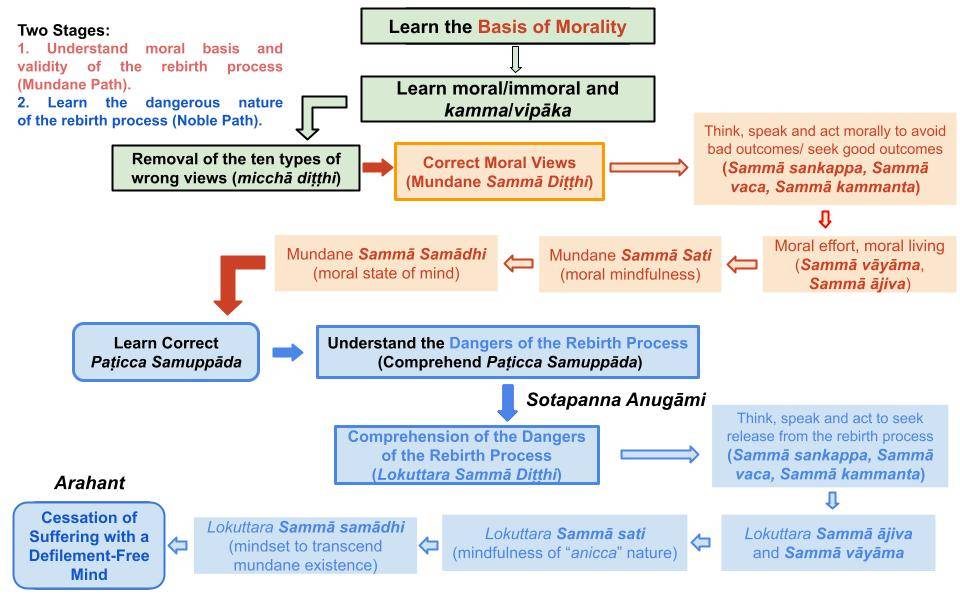
Download/Print: "A. Buddha Dhamma - In a Chart."
3. In the "Mahā Cattārisaka Sutta (MN 117)," the Buddha discussed that one must first complete the mundane eightfold path. That will remove the ten types of wrong views (micchā diṭṭhi) listed in #3 of the post “Maha Chattarisaka Sutta (Discourse on the Great Forty).
- After that, one needs to comprehend the Four Noble Truths, Paṭicca Samuppāda, and Tilakkhana (anicca, dukkha, anatta) to some extent to start on the Noble Eightfold Path. See "Paṭicca Samuppāda, Tilakkhana, Four Noble Truths."
- Thus, one starts on the Noble Eightfold Path starting with lokuttara (transcendental) sammā diṭṭhi of a Sōtapanna (set of blue boxes in the chart). One has seen a "glimpse of Nibbāna," i.e., one KNOWS that permanent happiness is not possible anywhere in the 31 realms and that whatever effort one makes to achieve such happiness is like chasing a mirage.
First, the Mundane Path
4. To reach a specific location, one must first find the path. When grasping a new concept, it is called "seeing with wisdom." Before being able to "see" what is meant by Nibbāna (escape suffering in the rebirth process), one must first "see" or "be convinced" of specific essential criteria. For example, actions (kamma) have consequences (vipāka), there is a rebirth process, etc.
- Many Buddhists today believe they can make spiritual progress by following rituals. However, making progress on both paths requires "seeing with wisdom" (or "Dhamma cakkhu.") Thus, each of the two paths starts with its version of sammā diṭṭhi.
- The "mundane Eightfold Path" is depicted by the set of boxes in red, starting with "mundane sammā diṭṭhi." One would have that "mundane sammā diṭṭhi" when one removes doubts about the ten types of wrong views. See "Dangers of Ten Types of Wrong Views and Four Possible Paths."
- The next box depicts mundane versions of sammā saṅkappa, sammā vācā, and sammā kammanta," meaning "think, speak, and act morally to avoid bad outcomes/seek good outcomes") and so on until "mundane sammā samadhi."
- Most of these steps (not all) are in other religions and conventional or secular "Buddhism." They advocate living a moral life (i.e., engaging in "good deeds" or "good kamma.") That means understanding actions (kamma) have consequences (vipāka), the same as in Buddha Dhamma.
5. However, most other religions aim to gain a (permanent) heavenly life at death. While living a moral life can be conducive to getting a rebirth in a good realm, the Buddha taught that it will not be a permanent existence. That is the main difference.
- We create causes and conditions to bring new rebirths via our defiled actions, speech, and thoughts with greed, anger, and ignorance of the true nature of the world; they are all kamma. The point is that kamma (more precisely, kammic energies) lead to kamma vipāka (results of kamma.) "Good kamma" lead to rebirths in "good realms," and "bad kamma" lead to rebirths in "bad realms." We keep moving among the two types of realms, and that is the basis of the rebirth process. There is no end to it until we understand the deeper Buddha Dhamma.
- Stated simply, we can stop kamma bringing their vipāka by eliminating the conditions for such vipāka to take place, i.e., kamma vipāka are not pre-determined; see "What is Kamma? – Is Everything Determined by Kamma?" One can begin to see the truth of that when one gets rid of the ten wrong views while on the mundane path. To comprehend that mechanism, one needs to understand Paṭicca Samuppāda, as discussed below.
What Is a "Good Rebirth"?
6. The joys of heavenly lives are highlighted in the distorted versions of "Buddhism" that are mainstream today. Sometimes one is encouraged to "enjoy such heavenly lives" before attaining Nibbāna.
- A phrase used by some bhikkhus in Sri Lanka goes as, "May you enjoy heavenly pleasures and then attain Nibbāna at the time of the Buddha Maitreya (next Buddha)." Why not attain Nibbāna in this life? Who is going to give guarantees that one will be born human during the time of the Buddha Maitreya?
- They don't understand that anyone living today may not get an opportunity to be born human during the time of the next Buddha. Not surprising because they don't understand the "anicca nature" of any realm in this world.
- That misconception in "Buddhism" arises because the rarity of a "good rebirth" has not been comprehended; see "How the Buddha Described the Chance of Rebirth in the Human Realm." This is why the Buddha said, "No happiness can be found anywhere in the 31 realms" (the true meaning of anicca). I highly recommend "Nibbāna “Exists,” but Not in This World."
The vision of the Noble Path - "No Permanent Good Existences"
7. Even if a heavenly rebirth is attained in the next life, a future rebirth in the four lowest realms (apāyā) cannot be avoided without attaining the Sōtapanna stage of Nibbāna.
- Until one comprehends Paṭicca Samuppāda, one will always value "sensory pleasures." That holds for atheists as well as for theists. The latter also believe that future happiness is in permanent heaven (most religions) OR temporary happiness in heavenly worlds (traditional "Buddhists"). The difference between a traditional "Buddhist" and a Bhauddhayā (or a Noble Person or an "Ariya") is discussed in "A Buddhist or a Bhauddhayā?".
- One starts on the transcendental (lokuttara) or the Noble Eightfold Path when one comprehends the dangers of the rebirth process and BECOMES a Sōtapanna. See "Paṭicca Samuppāda, Tilakkhana, Four Noble Truths."
- When one is starting to gain that understanding, one is called a Sōtapanna magga anugāmi or a Sōtapanna Anugāmi; see "Sōtapanna Anugami and a Sōtapanna."
Two Types of "Sammā Diṭṭhi"
8. Note the difference in the box next to "sammā diṭṭhi" in the two cases. In the mundane path, "sammā saṅkappa, sammā vācā, sammā kammanta" are "moral thoughts, speech, and actions" intended to avoid bad outcomes and to seek good outcomes.
- In the Noble path, "sammā saṅkappa, sammā vācā, sammā kammanta" are "thoughts, speech, and actions" intended to stop the rebirth process. One would not do immoral things because there is "no point" in doing such things. One knows that such things are unfruitful and dangerous in the long run because of their bad outcomes, i.e., they lead to "bad rebirths."
- And one becomes more compassionate towards all living beings (not just humans) because one can see that each living being suffers because of ignorance of the Buddha's key message. Any living being in any realm (including the apāyās) had been born human many times in the "beginningless rebirth process."
Mundane Eightfold Path
9. The above-described unique message of the Buddha went underground only 500 years after the Buddha; thus, only a relatively few have been able to make real progress toward Nibbāna for two thousand years. What is conventionally practiced today is just this mundane Eightfold Path. This is what we call "Buddhism" today. See "Counterfeit Buddhism – Current Mainstream Buddhism" and "Anicca, Dukkha, Anatta – Distortion Timeline."
- That superficial or "secular" Buddhism is not that different from what is advised by most other religions. Thus, it is easier for people to resonate with the mundane concepts in "Buddhism." Sammā Diṭṭhi, for example, is considered the "correct vision" of "how to live a moral life."
- Of course, that is the first necessary step. That will help one to be able to experience the benefits of moral behavior (even in this life as a "nirāmisa sukha"; see "How to Taste Nibbāna") and then comprehend anicca, dukkha, anatta, and embark on the Noble Eightfold Path to stop even a trace of suffering in Nibbāna.
Noble Eightfold Path
10. One has the ability to become a Sōtapanna Anugāmi (the path to the Sōtapanna stage) anytime after getting to the "red boxes," i.e., while one is on the mundane Eightfold Path. Of course, one MUST learn the correct version of Buddha Dhamma or Paṭicca Samuppāda.
- Anyone at or above the Sōtapanna Anugāmi stage is a Bhauddhayā. See "A Buddhist or a Bhauddhayā?" Even though not in the Tipiṭaka, sometimes the word "Cūla Sōtapanna" (pronounced "chūla sōtapanna") is also used to describe a Sōtapanna Anugāmi.
- The key is comprehending the "true nature of this world of 31 realms," Buddha described. That says it is impossible to achieve/maintain anything that can be kept to one's satisfaction (anicca.) Thus one gets to suffer (dukkha), and thus, one is truly helpless in the rebirth process (anatta). This realization is like lifting a heavy load that one has been carrying, the first taste of Nibbāna.
- This "change of mindset" for a Sōtapanna is PERMANENT, i.e., it will not change even in future rebirths. One has attained an "unbreakable" level of confidence (saddhā) in the Buddha, Dhamma, and Saṅgha.
Material Phenomena Arise After Mental Phenomena
11. Buddha Dhamma focuses on the mind, as stated in the first Dhammapada verse, "Manōpubbangamā Dhammā.." Almost all fundamental concepts in Buddha Dhamma involve "mental entities" and not "material entities." For example, when referring to a "rupa," it is about the "mental image" that arises in the mind; see "Difference Between Physical Rūpa and Rūpakkhandha." Thus when the Buddha states, "Rūpaṁ, bhikkhave, aniccaṁ," that refers to the "mental image of a rupa that arises in mind" (it is of "anicca nature") and NOT merely to an external rupa.
- Most people incorrectly interpret the verse “Rūpaṁ, bhikkhave, aniccaṁ” to mean an external rupa (like that of a person or a tree) is "impermanent." It is the tendency to adopt such "mundane interpretations" that led to the distortion of Buddha Dhamma only 500 years after the Buddha; see "Anicca, Dukkha, Anatta – Distortion Timeline."
- A person or a tree arises based on mental entities arising in the mind: "Manōpubbangamā Dhammā.." The mind creates "dhammā" that gives rise to all material phenomena; also see "Dhamma and Dhammā - Different but Related." We will discuss that issue in detail (again, with a different approach) in upcoming posts.
- When one becomes a Sotapanna, one breaks three of the ten "mental bonds" (saṁyojana) that bind one to the rebirth process. It is a permanent change of mindset.
- A Sōtapanna can follow the rest of the seven steps in the Noble Eightfold Path even without help from others. Thus one will attain the following three stages of Nibbāna (Sakadāgāmi, Anāgāmi, Arahant) successively by following those steps.
O Buddha Dhamma (Buddhismo) é muito mais do que viver uma vida moral. Trata-se de eliminar o sofrimento futuro sem deixar vestígios.
Revisado em 16 de novembro de 2019; 1º de fevereiro de 2023; revisado com novo gráfico em 22 de julho de 2023
Todas as religiões são iguais?
1. Quando ouço a afirmação frequente: “Todas as religiões são iguais; elas ensinam como viver uma vida moral”, sinto-me incomodado. Isso porque penso em todos aqueles que desconhecem a mensagem única do Buddha. Em particular, essa é a mentalidade daqueles que seguem o “Buddhismo secular”.
- A maioria das religiões realmente ensina como viver uma vida moral. E também há evidências de que os ateus podem ser tão morais quanto as pessoas religiosas; veja “Moralidade na vida cotidiana – Ciência – 2014 – Hofmann”.
- No entanto, o Buddha Dhamma vai além disso. O Buddha disse que, por melhor que vivamos esta vida, isso não nos ajudará a longo prazo no processo de Renascimento.
- Qualquer sofrimento que se possa experimentar nesta vida não é nada comparado ao sofrimento severo em alguns outros reinos no processo de Renascimento. Compreender isso constitui o primeiro caminho (mundano). O segundo, o Nobre Caminho, é seguido para parar esse sofrimento mais severo permanentemente. Assim, o Buddha dividiu o caminho a ser seguido em dois caminhos.
Dois Caminhos Óctuplos
2. Fiz um gráfico para ilustrar os dois tipos de Caminhos Óctuplos explicados pelo Buddha:
Baixar/Imprimir: “A. Buddha Dhamma - Em um gráfico”.
3. No “Mahā Cattārisaka Sutta (MN 117)”, o Buddha discutiu que primeiro é preciso completar o caminho óctuplo mundano. Isso removerá os dez tipos de visões erradas (Micchā Diṭṭhi) listados no nº 3 do ensaio “Mahā Chattarisaka Sutta (Discurso sobre os Grandes Quarenta)”.
- Depois disso, é preciso compreender as Quatro Nobres Verdades, Paṭicca Samuppāda e Tilakkhaṇa (Anicca, Dukkha, Anattā) até certo ponto para iniciar o Nobre Caminho Óctuplo. Veja “Paṭicca Samuppāda, Tilakkhaṇa, Quatro Nobres Verdades”.
- Assim, inicia-se o Nobre Caminho Óctuplo começando com Lokuttara (transcendental) Sammā Diṭṭhi de um Sótapanna (conjunto de caixas azuis no gráfico). A pessoa teve um “vislumbre do Nibbāna”, ou seja, SABE que a felicidade permanente não é possível em nenhum dos 31 reinos e que qualquer esforço que se faça para alcançar tal felicidade é como perseguir uma miragem.
Primeiro, o Caminho Mundano
4. Para chegar a um local específico, é preciso primeiro encontrar o caminho. Ao compreender um novo conceito, isso é chamado de “ver com sabedoria”. Antes de ser capaz de “ver” o que significa Nibbāna (escapar do sofrimento no processo de Renascimento), é preciso primeiro “ver” ou “estar convencido” de critérios essenciais específicos. Por exemplo, as ações (Kamma) têm consequências (Vipāka), existe um processo de Renascimento, etc.
- Muitos Buddhistas hoje acreditam que podem progredir espiritualmente seguindo rituais. No entanto, progredir em ambos os caminhos requer “ver com sabedoria” (ou “Dhamma Cakkhu”). Assim, cada um dos dois caminhos começa com sua versão de Sammā Diṭṭhi.
- O “Caminho Óctuplo mundano” é representado pelo conjunto de caixas em vermelho, começando com “Sammā Diṭṭhi mundano”. Alguém teria esse “Sammā Diṭṭhi mundano” quando removesse as dúvidas sobre os dez tipos de visões erradas. Veja “Perigos dos Dez Tipos de Visões Erradas e Quatro Caminhos Possíveis”.
- A caixa seguinte representa as versões mundanas de Sammā Saṅkappa, Sammā Vācā e Sammā Kammanta, que significam “pensar, falar e agir moralmente para evitar resultados ruins/buscar resultados bons”) e assim por diante até “Sammā Samadhi mundano”.
- A maioria dessas etapas (não todas) está presente em outras religiões e no “Buddhismo” convencional ou secular. Elas defendem uma vida moral (ou seja, praticar “boas ações” ou “bom kamma”). Isso significa compreender que as ações (Kamma) têm consequências (Vipāka), da mesma forma que no Buddha Dhamma.
5. No entanto, a maioria das outras religiões tem como objetivo obter uma vida celestial (permanente) após a morte. Embora viver uma vida moral possa ser propício para obter um Renascimento em um bom reino, o Buddha ensinou que essa não será uma existência permanente. Essa é a principal diferença.
- Criamos causas e condições para trazer novos renascimentos por meio de nossas ações, palavras e pensamentos impuros, com ganância, raiva e ignorância da verdadeira natureza do mundo; tudo isso é Kamma. A questão é que o Kamma (mais precisamente, as energias kármicas) leva ao Kamma Vipāka (resultados do Kamma). O “bom Kamma” leva a renascimentos em “reinos bons”, e o “mau Kamma” leva a renascimentos em “reinos maus”. Continuamos nos movendo entre os dois tipos de reinos, e essa é a base do processo de renascimento. Não há fim para isso até que compreendamos o Buddha Dhamma mais profundamente.
- Em termos simples, podemos impedir que o Kamma traga seu Vipāka eliminando as condições para que tal Vipāka ocorra, ou seja, o Kamma Vipāka não é predeterminado; veja “O que é Kamma? – Tudo é determinado pelo Kamma?” É possível começar a ver a verdade disso quando nos livramos das dez visões erradas enquanto estamos no caminho mundano. Para compreender esse mecanismo, é preciso entender Paṭicca Samuppāda, conforme discutido abaixo.
O que é um “bom Renascimento”?
6. As alegrias das vidas celestiais são destacadas nas versões distorcidas do “Buddhismo” que são predominantes hoje em dia. Às vezes, a pessoa é encorajada a “desfrutar dessas vidas celestiais” antes de atingir o Nibbāna.
- Uma frase usada por alguns Bhikkhū no Sri Lanka é: “Que você desfrute dos prazeres celestiais e então alcance o Nibbāna na época do Buddha Maitreya (próximo Buddha)”. Por que não alcançar o Nibbāna nesta vida? Quem vai garantir que alguém nascerá humano durante a época do Buddha Maitreya?
- Eles não compreendem que qualquer pessoa que vive hoje pode não ter a oportunidade de nascer humano durante o tempo do próximo Buddha. Não é surpreendente, pois eles não compreendem a “natureza Anicca” de qualquer reino neste mundo.
- Esse equívoco no “Buddhismo” surge porque a raridade de um “bom renascimento” não foi compreendida; veja “Como o Buddha descreveu a chance de renascimento no reino humano”. É por isso que o Buddha disse: “Nenhuma felicidade pode ser encontrada em nenhum dos 31 reinos” (o verdadeiro significado de Anicca). Recomendo vivamente “Nibbāna ‘existe’, mas não neste mundo”.
A visão do Nobre Caminho - “Não Existem Existências Boas Permanentes”
7. Mesmo que se alcance um renascimento celestial na próxima vida, um renascimento futuro nos quatro reinos mais baixos (apāyā) não pode ser evitado sem atingir o estágio Sotāpanna do Nibbāna.
- Até que se compreenda Paṭicca Samuppāda, sempre se valorizará os “prazeres sensoriais”. Isso vale tanto para ateus quanto para teístas. Estes últimos também acreditam que a felicidade futura está no céu permanente (a maioria das religiões) OU na felicidade temporária nos mundos celestiais (os “Buddhistas” tradicionais). A diferença entre um “Buddhista” tradicional e um Bhauddhayā (ou uma Pessoa Nobre ou um “Ariya”) é discutida em “Um Buddhista ou um Bhauddhayā?”.
- Começa-se no transcendental (Lokuttara) ou no Nobre Caminho Óctuplo quando se compreende os perigos do processo de renascimento e se TORNA um Sotāpanna. Veja “Paṭicca Samuppāda, Tilakkhaṇa, Quatro Nobres Verdades”.
- Quando se começa a adquirir essa compreensão, é-se chamado de Sotāpanna magga anugāmi ou Sotāpanna Anugāmi; veja “Sotāpanna Anugami e um Sotāpanna”.
Dois tipos de “Sammā Diṭṭhi”
8. Observe a diferença na caixa ao lado de “Sammā Diṭṭhi” nos dois casos. No caminho mundano, “Sammā Saṅkappa, sammā vācā, sammā kammanta” são “pensamentos, palavras e ações morais” destinados a evitar resultados ruins e buscar resultados bons.
- No caminho nobre, “Sammā Saṅkappa, sammā vācā, sammā kammanta” são “pensamentos, palavras e ações” destinados a interromper o processo de Renascimento. A pessoa não faria coisas imorais porque “não há sentido” em fazer tais coisas. Sabe-se que tais coisas são infrutíferas e perigosas a longo prazo devido aos seus maus resultados, ou seja, elas levam a “maus renascimentos”.
- E torna-se mais compassivo para com todos os seres vivos (não apenas humanos), porque se percebe que cada ser vivo sofre devido à ignorância da mensagem fundamental do Buddha. Qualquer ser vivo em qualquer reino (incluindo os apāyās) já nasceu humano muitas vezes no “processo de renascimento sem início”.
O Caminho Óctuplo Mundano
9. A mensagem única do Buddha descrita acima foi ocultada apenas 500 anos após o Buddha; assim, apenas um número relativamente pequeno de pessoas foi capaz de fazer progressos reais em direção ao Nibbāna por dois mil anos. O que é convencionalmente praticado hoje é apenas este Caminho Óctuplo mundano. É isso que chamamos de “Buddhismo” hoje. Veja “Buddhismo Falsificado – Buddhismo Convencional Atual” e “Anicca, Dukkha, Anattā – Linha do Tempo da Distorção”.
- Esse Buddhismo superficial ou “secular” não é tão diferente do que é aconselhado pela maioria das outras religiões. Assim, é mais fácil para as pessoas se identificarem com os conceitos mundanos do “Buddhismo”. Sammā Diṭṭhi, por exemplo, é considerado a “visão correta” de “como viver uma vida moral”.
- É claro que esse é o primeiro passo necessário. Isso ajudará a pessoa a ser capaz de experimentar os benefícios do comportamento moral (mesmo nesta vida como um “nirāmisa sukha”; veja “Como saborear o Nibbāna”) e, então, compreender Anicca, Dukkha, Anattā e embarcar no Nobre Caminho Óctuplo para acabar com até mesmo um traço de sofrimento no Nibbāna.
Nobre Caminho Óctuplo
10. A pessoa tem a capacidade de se tornar um Sotāpanna Anugāmi (o caminho para o estágio Sotāpanna) a qualquer momento depois de chegar às “caixas vermelhas”, ou seja, enquanto estiver no Caminho Óctuplo mundano. É claro que a pessoa DEVE aprender a versão correta do Buddha Dhamma ou Paṭicca Samuppāda.
- Qualquer pessoa no estágio Sotāpanna Anugāmi ou acima dele é um Bhauddhayā. Veja “Um Buddhista ou um Bhauddhayā?” Mesmo não estando no Tipiṭaka, às vezes a palavra “Cūla Sotāpanna” (pronuncia-se “chūla sōtapanna”) também é usada para descrever um Sotāpanna Anugāmi.
- A chave é compreender a “verdadeira natureza deste mundo de 31 reinos”, descrita por Buddha. Isso significa que é impossível alcançar/manter qualquer coisa que possa ser mantida para a satisfação de alguém (Anicca). Assim, a pessoa passa a sofrer (Dukkha) e, portanto, fica verdadeiramente impotente no processo de Renascimento (Anattā). Essa compreensão é como levantar um fardo pesado que se carregava, o primeiro gostinho do Nibbāna.
- Essa “mudança de mentalidade” para um Sotāpanna é PERMANENTE, ou seja, não mudará mesmo em renascimentos futuros. A pessoa alcançou um nível “inquebrantável” de confiança (Saddhā) no Buddha, no Dhamma e no Saṅgha.
Os fenômenos materiais surgem após os fenômenos mentais
11. O Buddha Dhamma concentra-se na mente, conforme declarado no primeiro versículo do Dhammapada, “Manōpubbangamā Dhammā...”. Quase todos os conceitos fundamentais do Buddha Dhamma envolvem “entidades mentais” e não “entidades materiais”. Por exemplo, quando se refere a um “Rūpa”, trata-se da “imagem mental” que surge na mente; veja “Diferença entre Rūpa físico e Rūpakkhandha”. Assim, quando o Buddha afirma: “Rūpaṁ, bhikkhave, aniccaṁ”, isso se refere à “imagem mental de um rupa que surge na mente” (é de “natureza Anicca”) e NÃO apenas a um rupa externo.
- A maioria das pessoas interpreta incorretamente o versículo “Rūpaṁ, bhikkhave, aniccaṁ” como significando que um Rūpa externo (como o de uma pessoa ou uma árvore) é “impermanente”. É a tendência de adotar tais “interpretações mundanas” que levou à distorção do Buddha Dhamma apenas 500 anos após o Buddha; veja “Anicca, Dukkha, Anattā – Linha do tempo da distorção”.
- Uma pessoa ou uma árvore surge com base em entidades mentais que surgem na mente: “Manōpubbangamā Dhammā...”. A mente cria “Dhammā” que dá origem a todos os fenômenos materiais; veja também “Dhamma e Dhammā – Diferentes, mas relacionados”. Discutiremos essa questão em detalhes (novamente, com uma abordagem diferente) em ensaios futuros.
- Quando alguém se torna um Sotāpanna, rompe três dos dez “laços mentais” (saṁyojana) que o prendem ao processo de Renascimento. É uma mudança permanente de mentalidade.
- Um Sotāpanna pode seguir os restantes sete passos do Nobre Caminho Óctuplo, mesmo sem a ajuda de outros. Assim, alcançará os três estágios seguintes do Nibbāna (Sakadāgāmi, Anāgāmi, Arahant) sucessivamente, seguindo esses passos.