June 4, 2016; revised October 3, 2019; October 17, 2022; December 9, 2022 (figure in #3 revised)
Difference Between Bhava (Existence) and Jāti (Births)
1. Many posts on the critical concept of gandhabba are in this series. More are scattered throughout the site, especially in the "Gandhabba (Manomaya Kaya)" section. These posts discuss how a living-being goes through rebirths without having an unchanging "soul." But they maintain (ever-changing) personal characteristics or gati (pronounced "gati") between two adjacent lives.
- It all started with a post on this basic concept at the start of this website: "What Reincarnates? – Concept of a Lifestream".
- While it is good to get an idea of the nature of all living beings in the 31 realms, it is unnecessary to learn those in detail. I want to provide a complete and inter-consistent picture compatible with the Buddha's original teachings in this section.
- However, the concept of the gandhabba is essential to understand how we are reborn with physically different bodies -- multiple times -- in a single human existence (human bhava.) A human bhava may last thousands of years; see "Bhava and Jāti – States of Existence and Births Therein." Unlike devas and Brahmās (born just once,) we live and die to be reborn human multiple times before switching to another realm.
This World Has Thirty-One Realms of Existence
2. We will first review two significant aspects of the 31 realms. Then we will discuss the concept of a gandhabba (which applies only to human and animal realms) in more detail.
- First is that the transition from one existence (bhava) to another is ALWAYS instantaneous; it happens at the cuti-paṭisandhi moment ("cuti" pronounced "chuthi"); see, "Patisandhi Citta – How the Next Life is Determined According to Gati" and "Cuti-Patisandhi – An Abhidhamma Description."
- The second aspect is that in the 20 higher-lying realms, those beings (Brahmā) weigh less than a billionth of an atom in modern science!
- All beings with dense bodies are in the 11 realms of the kāma lōka. Even there, the six deva realms have less-dense bodies compared to humans.
Death of Physical Body Different From the End of an Existence
3. The following chart shows the major features of what happens at the cuti-paṭisandhi moment. That is when a transition occurs from one bhava (existence) to another, e.g., from being a human to a Brahma.
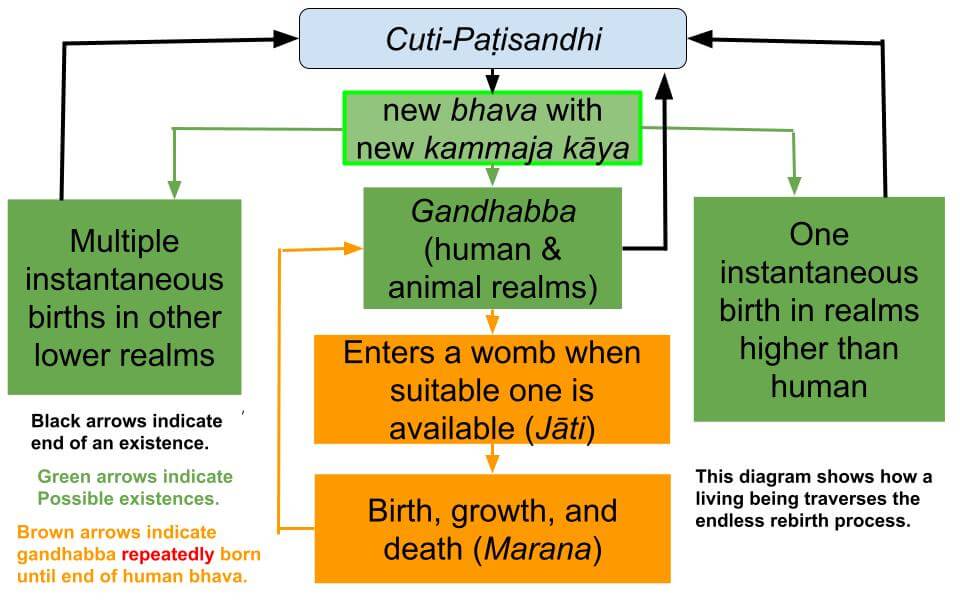
Click to open the pdf file: Births in Different Realms
- Without exception, at each such cuti-paṭisandhi moment, a new kammaja kāya is generated by the kammic energy fueling a new existence. That kammaja kāya ALWAYS has a hadaya vatthu. That is the seat of the mind (the quality of which depends on the realm).
Types of "Bodies" In Different Realms
4. Thus, it is essential to realize that the critical thing that happens at the cuti-paṭisandhi moment is the generation of the unbelievably small kammaja kāya, which contains the blueprint for the new existence. At that point, the mechanism of "birth" can be roughly divided into three categories, as shown in the chart.
- The Brahmā in the rupi and arupi realms (top 20 realms) are instantaneously born with very little else other than several suddhāṭṭhaka-size "material elements." Their body features are discussed below. The main feature here is that they are spontaneously born in those realms and live long until death. Then another cuti-paṭisandhi moment takes that being to a new bhava.
- The only difference in the six deva realms (in kāma lōka) compared to the Brahmā is that they do have well-defined physical bodies (karaja kāya) like us. However, those bodies are much less dense, and we cannot see them even if they stand right before us.
- A deva is born with the body equivalent of a 16-year-old, and their food is a drink called amurtha. Devas have all five sense faculties like us and are said to have the optimum sense pleasures available in kāma lōka. They also live that one life until death and then switch to a new existence (bhava) at the cuti-paṭisandhi moment.
- That completes the discussion on the green box to the right.
5. What happens in the green box to the left is a bit more complicated. That is because each realm in the apāyā (lowest four realms) is somewhat different. We will discuss the animal realm together with the human realm (middlebox) below. Let us first discuss briefly the lowest three realms indicated by the green box on the left.
- The lowest is the niraya (hell), where beings are born with full dense bodies like ours instantaneously. They undergo ceaseless cutting, burning, and various other forms of torture. They die innumerable times, only to be reborn promptly. Only when the kammic energy for that existence is exhausted (usually after millions of years) that they encounter the next cuti-paṭisandhi moment.
- Beings in the preta (peta) realm also are born instantaneously and can have subtle or dense bodies. The distinguishing feature there is suffering due to hunger.
- Beings in the asura realm are beings with massive, very inactive bodies. They are also born instantaneously and live those miserable lives until the next cuti-paṭisandhi moment.
Kammaja Kaya (Gandhabba) Can Last Thousands of Years With Many Human Rebirths
6. That brings us to the middle green box, representing the human and animal realms. A little bit more complicated process takes place here. Here also, a being with a subtle (energy) body is produced at the cuti-paṭisandhi moment, just like in the rupa lōka realms. It is called a gandhabba.
- A gandhabbā has the basic thrija kāya of a rupi Brahma: kammaja kāya, cittaja kāya, and utuja kāya, which we will discuss in detail below. Besides, a gandhabba may acquire a very fine karaja kāya (physical body) by inhaling the aroma. Thus a gandhabba is denser than a rupi Brahma. It has a "body" more like a deva in density.
- A gandhabba could be in that state for many years until a suitable womb becomes available. More precisely, the mother's mental state at that time must match the gati of the gandhabba. The evolution of the gandhabba in the womb is discussed in "What does Buddha Dhamma (Buddhism) say about Birth Control?". Then it is born as a new baby, grows, and eventually, that physical body also dies. If more kammic energy is left for the bhava, then the gandhabba leaves that dead body and waits for another womb. That process continues until the bhava energy is exhausted, and then it goes through the cuti-paṭisandhi moment to receive a new bhava; see the chart above.
- In addition to going into a womb (in some animal species), gandhabba may enter an egg inside a female animal. At the death of an "egg-born" animal, gandhabba comes out of the dead body and waits for another egg. It is the same procedure as above.
Physical Body is Just a Temporary Shelter
7. One of the main benefits of learning about the gandhabba is helping remove the wrong view that "I am my physical body."
- On the contrary, a physical body is a temporary shelter that the gandhabba uses to experience the much-coveted "sense pleasures." In particular, smelling, eating, and touching (most of all, sex) require a dense human body. Unfortunately, the human body can last only about 100 years. Even that body is in the "decay mode" after about 50 years. Thus, those sensory pleasures start diminishing, and eventually, that body dies.
- Then the gandhabba emerges from that dead body and waits for a suitable womb. If and when it gets into a womb, the new physical body is influenced by the new parents. Thus the new body can be very different from that in the previous birth. Even during this same "human bhava," our bodies may look very different from birth to birth (as confirmed by rebirth stories).
- Of course, the gandhabba does not stay the same either. The only things that can be called "personal" to that gandhabba are its gati, which also evolve.
- That is a brief explanation of the above chart.
Brahma "Bodies" Have Only a Trace of Matter
8. As mentioned in #4 above, most lifeforms in the 31 realms have unbelievably tiny physical bodies. They are more like "energy bodies." Brahmās in the 16 rupa lōka realms and the four arupa lōka realms weigh less than a billionth of an atom! They may be thought of more as energy packets.
- In case it was unclear from previous posts, we recall that an arupa lōka Brahma has a kammaja kāya consisting of just a vatthu dasaka.
- Rupa lōka Brahmā have vatthu dasaka (seat of the mind) and two pasada rupa for seeing and hearing. They also have kāya dasaka and bhava dasaka. Thus their kammaja kāya has five suddhāṭṭhaka-size elements. A rupa lōka Brahma also has a cittaja kāya (thought stream) and a utuja kāya (very fine).
- Thus, any Brahmās cannot be seen with the most sophisticated microscope we have today.
- More details in "Body Types in 31 Realms – Importance of Manomaya Kaya". A manomaya kāya, when referred to the human and animal realms, is the same as gandhabba.
Kammaja Kāya of a Human Gandhabba
9. Let us again summarize the make up of a kammaja kāya of a human gandhabba. It has a hadaya vatthu (consisting of a vatthu dasaka), bhava dasaka, and kāya dasaka, and four pasada rupa (cakkhu dasaka, sota dasaka, gandha dasaka, jivaha dasaka).
- This kammaja kāya consists of 7 suddhāṭṭhaka in different bramana (spin) and paribramana (rotation) modes. That is how they become dasaka (units of ten or decads); see "31 Realms Associated with the Earth".
- Six of these define the sense faculties of the gandhabba: vatthu dasaka is the mind, and kāya, cakkhu, sota, gandha, and jivha dasaka) are the "fine senses" that correspond to the body, eyes, ears, nose, and tongue in the physical body. Gandhabba can interact with the external world directly via them when outside the physical body. It can smell and inhale aroma giving rise to a very fine and subtle material body. However, that body is not solid enough to physically touch anything or be able to eat.
- The seventh dasaka is bhava dasaka, which -- together with the kāya dasaka -- defines what kind of a physical body it will start building once inside a womb. For example, bhava dasaka determines sex.
10. The mind becomes active as soon as the kammaja kāya forms at the cuti-paṭisandhi moment. The thought stream (cittaja kāya) starts, and the mind will be mainly in the bhavaṅga state. Simultaneously, an utuja kāya forms by the suddhāṭṭhaka generated by both the kammaja kāya and cittaja kāya.
- Thus immediately after the cuti-paṭisandhi moment, gandhabba has three "bodies" or thrija kāya. However, the cittaja kāya is all mental, and both the kammaja kāya and utuja kāya are very fine. They are more like "energy bodies."
- Soon after this "initial formation," the gandhabba can build a "subtle, misty" body (karaja kāya) by inhaling aroma (from fruits, trees, etc.). Still, an average human cannot see it since it is not "dense enough." However, some people (especially those with abhiññā powers) can see "sufficiently solidified" gandhabbā.
The desire for a Dense Human Body
11. But this gandhabba is continuously under stress because it cannot enjoy the most coveted sense pleasures of those with dense human bodies, i.e., eating and sex. It can see people enjoying these sense pleasures and is very much frustrated not being able to acquire a "real physical body." Some can stay in this state for many years if a suitable womb is unavailable.
- Sometimes, they may spend the kammic energy for the human bhava and undergo another cuti-paṭisandhi moment without inheriting a human body. That is why one is indebted to one's parents, no matter how bad they may be.
12. The story of the gandhabba gets more interesting (and complicated) after it goes through the first birth as an average human, and that human body dies. The gandhabba that comes out of that dead body is, of course, different from the original gandhabba. Its kammaja kāya has changed due to whatever abhisaṅkhāra that the humans cultivated. But the kammic energy for the human bhava does not change; if it had 1000 years' worth of kammic energy at the cuti-paṭisandhi moment, that would deplete with time.
- Of course, there is no cuti-paṭisandhi moment when a human dies with extra kammic energy for the human bhava. Death is the death of the physical body. The gandhabba comes out of that dead body and awaits a new womb; see the above chart. Thus all three components of the thrija kāya continue after the "death of the human."
New Physical Body Incorporates Characteristics of New Parents Too
13. Let us consider some important features of this gandhabba that comes out of that dead body after its birth as a human.
- The kammaja kāya still has a copy of the previous physical body. However, when it starts a new physical body in the new womb, it also takes some physical features from the new parents. Thus the new physical body is a trade-off between those three influences. For example, it may keep some distinguishing features (birthmarks or gunshot wounds), as we have encountered in rebirth accounts. But it will acquire new features also from the new parents (skin color, size, etc.).
- The gandhabba coming from the dead body is a "misty, fine version" of the person at death. They often come out with imprints of the clothes they wore at death and may look just like that (in a ghostly, misty form) until entering a new womb. My teacher Thero has seen gandhabbā of people who died hundreds of years ago "wearing" those old costumes. Of course, they are not actual physical clothes.
14. Since the cittaja kāya also continues, their thought streams continue. So, if someone dies in an accident, he may not realize he is dead for a while. If he died from a gunshot instantly, the gandhabba comes out and will look at the dead body, trying to figure out what happened. He may wish to go home and finds himself instantly at home. And he will try to shout to others, but they don't hear. He may try to touch them, but he cannot. It takes seven days for a gandhabba to comprehend what happened entirely and to resign to his/her new life.
- That is also why children can recall their past life. But just like we start forgetting things from years ago, those children forget about their previous life when they grow older. Furthermore, it is harder to remember from a past life than this.
- Another point is that most such rebirth accounts are from people who died while young in accidents. Those gandhabbās who come out of the bodies of people dying in old age are not likely to remember that life. That is because they might have lost their memories even during that life.
Next in the series, “Body Types in 31 Realms – Importance of Manomaya Kaya“, ...........
4 de junho de 2016; revisado em 3 de outubro de 2019; 17 de outubro de 2022; 9 de dezembro de 2022 (figura no n.º 3 revisada)
Diferença entre Bhava (Existência) e Jāti (Nascimentos)
1. Muitos ensaios sobre o conceito fundamental de Gandhabba estão nesta série. Outros estão espalhados pelo site, especialmente na seção “Gandhabba (Manomaya Kaya)”. Esses ensaios discutem como um ser vivo passa por renascimentos sem possuir uma “alma” imutável. Mas eles mantêm características pessoais (em constante mudança) ou Gati (pronuncia-se “Gati”) entre duas vidas adjacentes.
- Tudo começou com um ensaio sobre esse conceito básico no início deste site: “O que ocorre no processo de Renascimento? – Conceito de um fluxo de vida”.
- Embora seja bom ter uma ideia da natureza de todos os seres vivos nos 31 reinos, não é necessário aprendê-los em detalhes. Quero fornecer, nesta seção, um quadro completo e coerente, compatível com os ensinamentos originais do Buddha.
- No entanto, o conceito de Gandhabba é essencial para compreender como renascemos com corpos fisicamente diferentes — várias vezes — em uma única existência humana (Bhava humano). Um Bhava humano pode durar milhares de anos; veja “Bhava e Jāti – Estados de Existência e Nascimentos Neles”. Ao contrário dos Devās e dos Brahmās (que nascem apenas uma vez), vivemos e morremos para renascer como humanos várias vezes antes de passar para outro reino.
Este Mundo Tem Trinta e Um Reinos de Existência
2. Primeiro, revisaremos dois aspectos significativos dos 31 reinos. Em seguida, discutiremos o conceito de Gandhabba (que se aplica apenas aos reinos humano e animal) com mais detalhes.
A morte do corpo físico é diferente do fim de uma existência
3. O gráfico a seguir mostra as principais características do que ocorre no momento do Paṭisandhi. É quando ocorre a transição de um Bhava (existência) para outro, por exemplo, de ser humano para Brahmā.
Clique para abrir o arquivo PDF: Nascimentos em Diferentes Reinos
- Sem exceção, em cada um desses momentos de Paṭisandhi, um novo kammaja Kāya é gerado pela energia Kamma que alimenta uma nova existência. Esse kammaja Kāya SEMPRE possui um Hadaya Vatthu. Essa é a sede da mente (cuja qualidade depende do reino).
Tipos de “Corpos” em Diferentes Reinos
4. Assim, é essencial compreender que o que ocorre de fundamental no momento do Paṭisandhi é a geração do kammaja Kāya, incrivelmente pequeno, que contém o projeto para a nova existência. Nesse ponto, o mecanismo do “nascimento” pode ser dividido, de forma geral, em três categorias, conforme mostrado no quadro.
- Os Brahmā nos reinos rupi e arupi (os 20 reinos superiores) nascem instantaneamente com muito pouco além de vários “elementos materiais” do tamanho de Suddhāṭṭhaka. Suas características corporais são discutidas abaixo. A principal característica aqui é que eles nascem espontaneamente nesses reinos e vivem por muito tempo até a morte. Então, outro momento de Paṭisandhi leva esse ser a um novo Bhava.
- A única diferença nos seis reinos Deva (no Kāma lōka) em comparação com os Brahmā é que eles possuem corpos físicos bem definidos (karaja kāya) como nós. No entanto, esses corpos são muito menos densos, e não podemos vê-los mesmo que estejam bem diante de nós.
- Um Deva nasce com um corpo equivalente ao de um jovem de 16 anos, e sua alimentação consiste em uma bebida chamada amurtha. Os Devā possuem os cinco sentidos, assim como nós, e diz-se que desfrutam dos prazeres sensoriais mais elevados disponíveis no Kāma lōka. Eles também vivem essa única vida até a morte e, então, passam para uma nova existência (Bhava) no momento do Paṭisandhi.
- Isso conclui a discussão sobre a caixa verde à direita.
5. O que acontece na caixa verde à esquerda é um pouco mais complicado. Isso porque cada reino nos apāyā (os quatro reinos mais baixos) é um pouco diferente. Discutiremos o reino animal juntamente com o reino humano (caixa do meio) abaixo. Vamos primeiro discutir brevemente os três reinos mais baixos indicados pela caixa verde à esquerda.
- O mais baixo é o Niraya (inferno), onde os seres nascem instantaneamente com corpos densos completos, como os nossos. Eles passam por cortes incessantes, queimaduras e várias outras formas de tortura. Eles morrem inúmeras vezes, apenas para renascer imediatamente. Somente quando a energia Kamma para essa existência se esgota (geralmente após milhões de anos) é que eles encontram o próximo momento de Paṭisandhi.
- Os seres no reino preta (Peta) também nascem instantaneamente e podem ter corpos sutis ou densos. A característica distintiva ali é o sofrimento devido à fome.
- Os seres no reino asura são seres com corpos enormes e muito inativos. Eles também nascem instantaneamente e vivem essas vidas miseráveis até o próximo momento de Paṭisandhi.
Kammaja Kaya (Gandhabba) pode durar milhares de anos com muitos Renascimentos humanos
6. Isso nos leva à caixa verde do meio, representando os reinos humano e animal. Um processo um pouco mais complicado ocorre aqui. Aqui também, um ser com um corpo sutil (energético) é produzido no momento Paṭisandhi, assim como nos reinos Rūpa lōka. Ele é chamado de Gandhabba.
- Um gandhabba possui os três Kāya básicos (thrija Kāya) de um Brahmā rupi: kammaja Kāya, cittaja Kāya e utuja Kāya, que discutiremos em detalhes a seguir. Além disso, um Gandhabba pode adquirir um karaja Kāya (corpo físico) muito fino ao inalar o aroma. Assim, um Gandhabba é mais denso do que um Brahmā rupi. Ele possui um “corpo” mais semelhante ao de um Deva em termos de densidade.
- Um Gandhabba pode permanecer nesse estado por muitos anos até que um útero adequado se torne disponível. Mais precisamente, o estado mental da mãe naquele momento deve corresponder à Gati do Gandhabba. A evolução do Gandhabba no útero é discutida em “O que o Buddha Dhamma (Buddhismo) diz sobre o controle de natalidade?”. Então ele nasce como um novo bebê, cresce e, eventualmente, esse corpo físico também morre. Se ainda houver energia Kamma restante para o Bhava, o Gandhabba deixa esse corpo morto e aguarda outro útero. Esse processo continua até que a energia do Bhava se esgote, e então ele passa pelo momento Paṭisandhi para receber um novo Bhava; veja o gráfico acima.
- Além de entrar em um útero (em algumas espécies animais), o Gandhabba pode entrar em um ovo dentro de um animal fêmea. Com a morte de um animal “nascido de ovo”, o Gandhabba sai do corpo morto e aguarda outro ovo. É o mesmo procedimento descrito acima.
O corpo físico é apenas um abrigo temporário
7. Um dos principais benefícios de aprender sobre o Gandhabba é ajudar a eliminar a visão errada de que “eu sou meu corpo físico”.
- Pelo contrário, o corpo físico é um abrigo temporário que o Gandhabba usa para experimentar os tão cobiçados “prazeres sensoriais”. Em particular, cheirar, comer e tocar (acima de tudo, o sexo) requerem um corpo humano denso. Infelizmente, o corpo humano dura apenas cerca de 100 anos. Mesmo esse corpo entra em “decadência” após cerca de 50 anos. Assim, esses prazeres sensoriais começam a diminuir e, eventualmente, o corpo morre.
- Então, o Gandhabba emerge daquele corpo morto e aguarda um útero adequado. Se e quando ele entra em um útero, o novo corpo físico é influenciado pelos novos pais. Assim, o novo corpo pode ser muito diferente daquele do nascimento anterior. Mesmo durante este mesmo “Bhava humano”, nossos corpos podem parecer muito diferentes de um nascimento para outro (conforme confirmado pelas histórias de Renascimento).
- É claro que o Gandhabba também não permanece o mesmo. As únicas coisas que podem ser chamadas de “pessoais” para esse Gandhabba são suas Gati, que também evoluem.
- Essa é uma breve explicação do gráfico acima.
Os “Corpos” de Brahmā Têm Apenas um Traço de Matéria
8. Conforme mencionado no ponto 4 acima, a maioria das formas de vida nos 31 reinos possui corpos físicos incrivelmente minúsculos. Eles se assemelham mais a “corpos de energia”. Os Brahmās nos 16 reinos Rūpa lōka e nos quatro reinos arupa lōka pesam menos de um bilionésimo de um átomo! Eles podem ser considerados mais como pacotes de energia.
- Caso não tenha ficado claro nos ensaios anteriores, lembramos que um Brahmā arupa lōka possui um kammaja Kāya composto apenas por um Vatthu dasaka.
- Os Brahmās do rupa lōka possuem um Vatthu dasaka (sede da mente) e dois pasada rupa para ver e ouvir. Eles também possuem um Kāya dasaka e um Bhava dasaka. Assim, seu kammaja Kāya possui cinco elementos do tamanho de um Suddhāṭṭhaka. Um Brahmā do rupa lōka também possui um cittaja Kāya (fluxo de pensamentos) e um utuja Kāya (muito fino).
- Assim, nenhum Brahmā pode ser visto com o microscópio mais sofisticado que temos hoje.
- Mais detalhes em “Tipos de Corpo nos 31 Reinos – Importância do Manomaya Kāya”. Um manomaya Kāya, quando referido aos reinos humano e animal, é o mesmo que Gandhabba.
Kammaja Kāya de um Gandhabba Humano
9. Vamos resumir novamente a composição de um kammaja kāya de um gandhabba humano. Ele possui um Hadaya Vatthu (consistindo em um Vatthu dasaka), Bhava dasaka e Kāya dasaka, e quatro pasada rupa (Cakkhu dasaka, Sota dasaka, Gandha dasaka, Jivaha dasaka).
- Este kammaja Kāya consiste em 7 Suddhāṭṭhaka em diferentes modos de bramana (giro) e paribramana (rotação). É assim que eles se tornam dasaka (unidades de dez ou décadas); veja “31 Reinos Associados à Terra”.
- Seis delas definem as faculdades sensoriais do Gandhabba: Vatthu dasaka é a mente, e Kāya, Cakkhu, sota, gandha e jivha dasaka são os “sentidos sutis” que correspondem ao corpo, olhos, ouvidos, nariz e língua no corpo físico. Gandhabba pode interagir diretamente com o mundo externo por meio deles quando está fora do corpo físico. Ele pode cheirar e inalar aromas, dando origem a um corpo material muito fino e sutil. No entanto, esse corpo não é sólido o suficiente para tocar fisicamente em nada ou ser capaz de comer.
- O sétimo dasaka é o Bhava dasaka, que — juntamente com o Kāya dasaka — define que tipo de corpo físico ele começará a construir uma vez dentro do útero. Por exemplo, o Bhava dasaka determina o sexo.
10. A mente se torna ativa assim que o kammaja Kāya se forma no momento do Paṭisandhi. O fluxo de pensamentos (cittaja Kāya) se inicia, e a mente permanecerá principalmente no estado de Bhavaṅga. Simultaneamente, um utuja Kāya se forma a partir do Suddhāṭṭhaka gerado tanto pelo kammaja Kāya quanto pelo cittaja Kāya.
- Assim, imediatamente após o momento do Paṭisandhi, o Gandhabba possui três “corpos” ou thrija kāya. No entanto, o cittaja kāya é inteiramente mental, e tanto o kammaja kāya quanto o utuja kāya são muito sutis. Eles se assemelham mais a “corpos energéticos”.
- Logo após essa “formação inicial”, o Gandhabba pode construir um corpo “sutil e nebuloso” (karaja Kāya) inalando aromas (de frutas, árvores, etc.). Ainda assim, um ser humano comum não consegue vê-lo, pois não é “denso o suficiente”. No entanto, algumas pessoas (especialmente aquelas com poderes de Abhiññā) podem ver gandhabbā “suficientemente solidificados”.
O desejo por um corpo humano denso
11. Mas esse Gandhabba está continuamente sob estresse porque não pode desfrutar dos prazeres sensoriais mais cobiçados por aqueles com corpos humanos densos, ou seja, comer e sexo. Ele pode ver as pessoas desfrutando desses prazeres sensoriais e fica muito frustrado por não conseguir adquirir um “corpo físico real”. Alguns podem permanecer nesse estado por muitos anos se um útero adequado não estiver disponível.
- Às vezes, eles podem gastar a energia Kamma destinada ao Bhava humano e passar por outro momento de Paṭisandhi sem herdar um corpo humano. É por isso que se tem uma dívida para com os pais, por piores que eles possam ser.
12. A história do Gandhabba fica mais interessante (e complicada) depois que ele passa pelo primeiro nascimento como um humano comum e esse corpo humano morre. O Gandhabba que sai desse corpo morto é, naturalmente, diferente do Gandhabba original. Seu kammaja Kāya mudou devido a quaisquer Abhisaṅkhāra que os humanos tenham cultivado. Mas a energia de Kamma para o Bhava humano não muda; se ele tivesse energia de Kamma equivalente a 1.000 anos no momento do Paṭisandhi, ela se esgotaria com o tempo.
- É claro que não há momento de Paṭisandhi quando um humano morre com energia Kamma extra para o Bhava humano. A morte é a morte do corpo físico. O Gandhabba sai daquele corpo morto e aguarda um novo útero; veja o gráfico acima. Assim, todos os três componentes do thrija Kāya continuam após a “morte do humano”.
O novo corpo físico incorpora características dos novos pais também
13. Vamos considerar algumas características importantes desse Gandhabba que sai daquele corpo morto após seu nascimento como humano.
- O kammaja Kāya ainda possui uma cópia do corpo físico anterior. No entanto, quando inicia um novo corpo físico no novo útero, ele também adquire algumas características físicas dos novos pais. Assim, o novo corpo físico é um equilíbrio entre essas três influências. Por exemplo, ele pode manter algumas características distintivas (marcas de nascença ou ferimentos de bala), como encontramos em relatos de Renascimento. Mas também adquirirá novas características dos novos pais (cor da pele, tamanho, etc.).
- O Gandhabba proveniente do corpo morto é uma “versão nebulosa e sutil” da pessoa no momento da morte. Eles frequentemente surgem com marcas das roupas que usavam no momento da morte e podem parecer exatamente assim (em uma forma fantasmagórica e nebulosa) até entrarem em um novo útero. Meu professor Thero já viu Gandhabba de pessoas que morreram há centenas de anos “vestindo” essas roupas antigas. É claro que não se trata de roupas físicas reais.
14. Como o cittaja Kāya também continua, seus fluxos de pensamento continuam. Assim, se alguém morre em um acidente, pode não perceber que está morto por um tempo. Se morreu instantaneamente de um tiro, o Gandhabba sai e olha para o cadáver, tentando entender o que aconteceu. Ele pode desejar ir para casa e se encontrar instantaneamente em casa. E ele tentará gritar para os outros, mas eles não o ouvem. Ele pode tentar tocá-los, mas não consegue. Leva sete dias para um Gandhabba compreender totalmente o que aconteceu e se resignar à sua nova vida.
- É também por isso que as crianças conseguem se lembrar de sua vida passada. Mas, assim como começamos a esquecer coisas de anos atrás, essas crianças esquecem sua vida anterior à medida que crescem. Além disso, é mais difícil lembrar-se de uma vida passada do que desta.
- Outro ponto é que a maioria desses relatos de renascimento vem de pessoas que morreram jovens em acidentes. Os gandhabbās que saem dos corpos de pessoas que morrem na velhice provavelmente não se lembrarão dessa vida. Isso porque eles podem ter perdido suas memórias ainda durante essa vida.
Próximo da série, “Tipos de Corpo nos 31 Reinos – Importância do Manomaya Kaya”, ...........