🏠
⚗️ LABZ MODE — Stardust Overworld  ·  Features experimentais ativas  · 
Three Levels of Practice · Post 77 / 97 · TL.II.013

Sanna Nidana Hi Papanca Sae1B985Kha Immoral Thoughts Based On Distorted Sanna

Sanna Nidana Hi Papanca Sae1B985Kha Pensamentos imorais baseados em Sanna distorcido

PDPNTL.II.013
SectionThree Levels of Practice
Levelintermediate
Reading time11

"Saññānidānā hi papañcasaṅkhā" verse captures the root cause for defilements to arise in mind. The "built-in distorted saññā" is why it is so hard to eliminate the tendency to crave sensual pleasures.

January 26, 2024; revised March 16, 2025

Previously Unheard Teachings of a Buddha

1. The Buddha called saññā a mirage in the “Pheṇapiṇḍūpama Sutta (SN 22.95),” and we discussed that in the postsSotapanna Stage and Distorted/Defiled Saññā” and "Fooled by Distorted Saññā (Sañjānāti) – Origin of Attachment (Taṇhā)."

  • Here, we will discuss another critical sutta with the above verse to provide evidence that the "sweetness of sugar" or the "beauty of a woman" is a "mirage" created in the human mind by the "distorted saññā" built into our biological bodies. Those are not vedanā but "made-up saññā." However, "distorted saññā" leads to  "mind-made vedanā" or "samphassa-jā-vedanā," i.e., becoming joyful or unhappy depending on the sensory input.
  • The physical and mental bodies of any living being arise via kammic energy (also called uppatti bhava), which gives rise to that existence. That happens via the "bhava paccaya jāti" step in the Uppatti Paṭicca Samuppāda
  • That is the "previously unheard teachings of a Buddha."
Jāti (With a Physical Body) Dictated by Paṭicca Samuppāda

2. The "bhava paccaya jāti" step in the Uppatti Paṭicca Samuppāda came about starting with attachment to similar sensory stimulations ("avijjā paccayā saṅkhāra.") Attachment to certain stimulations ("paṭi icca") leads to "births to provide matching experiences" (sama uppāda); see "Paṭicca Samuppāda – “Pati+ichcha”+“Sama+uppāda.”

  • A pig's birth is based on the lowly deeds (kamma) done with "avijjā paccayā saṅkhāra." A lion's birth is based on vicious deeds. 
  • Thus, the "sweetness of sugar" or the "beauty of a woman" would not arise in a pig or a lion. A pig's mind craves garbage for food. A lion does not crave sugar or garbage but the flesh of other animals. For details, see "Gati to Bhava to Jāti – Ours to Control" and "Gati (Habits/Character) Determine Births – Saṃsappanīya Sutta."
  • Human births are based on "good/moral gati" but mixed with kāma rāga (tendency to value sensory pleasures.) The "sweetness of sugar" or the "beauty of a woman" is unavoidable for anyone born with a human body; the Buddha experienced them, too.  Thus, even an Arahant born a human would generate that "distorted saññā" (unless in a jhāna or samāpatti.)
  • However, if people fully understand how that "distorted saññā" arises, their minds will no longer be fooled. That is what Bāhiya Dārucīriya (amazingly) understood when the Buddha only told him to realize "diṭṭhe diṭṭhamattaṁ bhavissati, sute sutamattaṁ bhavissati, mute mutamattaṁ bhavissati, viññāte viññātamattaṁ bhavissatī’ti." That means, "‘Don't go beyond what is seen, heard, experienced by the tongue, nose, body or with the mind." Ven. Bāhiya understood that anything that appears "mind-pleasing" is not a truthful depiction of reality. See "Bāhiya Sutta (Ud 1.10);" English translations are always inadequate because the translator does not understand the deeper meaning.
A Mind Always Falls on One of the Three "Lokās/Dhātus"

3. When not receiving sensory input via any of the six senses, the mind is in the "uppatti bhavaṅga state." That is the "mindset" that one is born with. Since a human birth results from "good kamma vipāka," that state of any human is positive. Only those in the apāyās (four lowest realms) have "negative" or "bad" uppatti bhavaṅga states.

  • While in the uppatti bhavaṅga state, the mind is inactive, and no javana cittās arise. When an ārammaṇa is received via any of the six senses, the mind breaks away from that uppatti bhavaṅga state and focuses on the ārammaṇai.e., becomes active.
  • This is analogous to a car being "in neutral" and starting to move only when it is put into a gear. While in the neutral gear, the car is "alive" but not engaged in moving.
  • A human will NOT lose that "uppatti bhavaṅga state" until the end of human existence. Thus, an Arahant born a human will also have the mind in that "uppatti bhavaṅga state" unless in a jhāna or samāpatti.

4. Upon receiving an ārammaṇa, a human mind will "break away" from the "uppatti bhavaṅga state" and will first fall on the "kāma dhātu" stage corresponding to human bhava. It will automatically receive the "kāma saññā" associated with the "human bhava." That includes "distorted saññā" of "sweetness in sugar," "beauty of a woman," or "stench of feces."

  • In contrast, a pig would receive a "distorted saññā" of an "attractive smell" with a pile of feces. In reality, feces is made of suddhāṭṭhaka (atoms and molecules in the language of modern science) and would not have "good or bad" qualities. This is a more profound point requiring in-depth contemplation.
  • We are thrilled to watch a magic show where the magician performs "unbelievable actions." But the magician always uses a "trick. " Once that trick is discovered, there is no "thrill in watching the magic show." 
  • "Distorted saññā" is the best magic trick in the world. Nature itself is the magician. It is so good that no one but a Buddha can discover it. Since our physical bodies are built to provide that "distorted saññā," no matter how many investigations are done (based on mundane techniques, including scientific experiments) to uncover the trick, they will all fail.
  • It requires a "paradigm shift" to see how that trick is performed. The Buddha described how kamma done with particular "gati" led to births with corresponding "distorted saññā," as explained in #2 above. That is the "previously unheard teachings of a Buddha."
"Saññānidānā hi papañcasaṅkhā"

5. As we proceed, I will discuss several critical suttās on "distorted saññā." The above verse appears in the "Kalahavivāda Sutta (Snp 4.11)." The full verse is:

Na saññasaññī na visaññasaññī, Nopi asaññī na vibhūtasaññī; Evaṁ sametassa vibhoti rūpaṁ, Saññānidānā hi papañcasaṅkhā”.

  • In the Tipitaka, words are combined to compress the lines of text. If we expand the verse:

Na sañña saññī na visañña saññī, Nopi asaññī na vibhūta saññī; Evaṁ sametassa vibhoti rūpaṁ, Saññā nidānā hi papañca saṅkhā”.

6. "Evaṁ sametassa vibhoti rūpaṁ" means "once one comprehends the true nature of saññā, mind-made rupās stop arising in mind." In other words, akusala accumulation via "giving priority to immoral or papañca" (papañca saṅkhā) has origins (nidāna) in saññā, which refers to the "distorted saññā." Now, let us look at the first part of the verse.

  • Na sañña saññī" means one cannot grasp the truth with the "naturally built-in distorted saññā." However, one cannot sort it out without that "distorted saññā" being experienced either (for example, if one is an ummattakā or "gone mad"), and that is what "na visañña saññī" means.
  • For example, one cannot sort it out by losing saññā altogether and becoming "asañña."  We know that those who cultivate "asañña saññā" techniques ("asañña Bhāvanā") end up in the "asaññā realm" where saññā does not arise. Such an "asañña saññā"  state is when one becomes unconscious; while unconscious, saññā of any kind cannot arise because no cittās arise.
  • Next, "na vibhūta saññī" means one cannot be without "(distorted) saññā" to grasp the truth, i.e., when in an arūpa samāpattī. These descriptions are in the "Kalahavivāda sutta niddesa."
  • The true nature of the "distorted saññā" we experience is discussed in the "Mūlapariyāya Sutta – The Root of All Things." As the sutta's name implies, grasping this "root of all things" is the key to stopping papañca saṅkhā from arising. Also see "Fooled by Distorted Saññā (Sañjānāti) – Origin of Attachment (Taṇhā)."
  • The "distorted saññā" includes "subha and patigha saññā" which need to be overcome (by understanding their origin) via Satipaṭṭhāna after going through the "jānato and passato" stages.
"Distorted SaññāRemains with a Living Arahant

7. Arahanthood is attained while experiencing the "distorted saññā" but understanding with wisdom how it arises. The key is to understand how that "distorted saññā, " the "mirage," or the "trick," is done. It is created by our own minds when we go through the Paṭicca Samuppāda process with avijjā and create future uppatti (bhava and jāti.) That rebirth (jāti) will automatically present that mirage or the "distorted saññā."

  • It is a vicious circle that keeps the rebirth process repeating perpetually UNTIL the "trick" is heard (jānato) and fully comprehended (passato.)
  • Note that the ideal saññā (without "distorted saññā") is the saññā that arises only in a "pabhassara citta." An Arahant in "Arahant phala samadhi" experiences that "pure citta." That "pabhassara citta" is first experienced at the Arahant phala moment.
  • On the other hand, an Arahant, while engaged with "kāma dhātu," experiences "cittās with kāma saññā" as we discussed. Furthermore, an Arahant in a jhāna or samāpatti experiences cittās with "rupa saññā" ("jhānic pleasures") and "arupa saññā" ("samāpatti pleasures") respectively, but their minds do not attach to them either. See "Loka and Nibbāna (Aloka) – Complete Overview ."
Arahants Experience the "Distorted Saññā" - Tipiṭaka Evidence 

8. The "Nibbānadhātu Sutta (Iti 44)" describes a living Arahant as "Tassa tiṭṭhanteva pañcindriyāni yesaṁ avighātattā manāpāmanāpaṁ paccanubhoti, sukhadukkhaṁ paṭisaṁvedeti. Tassa yo rāgakkhayo, dosakkhayo, mohakkhayo—ayaṁ vuccati, bhikkhave, saupādisesā nibbānadhātu."

Translated: "Their five sensory faculties remain. So long as their sensory faculties operate, they continue to experience the agreeable/disagreeable and to feel bodily pleasure/pain. The ending of greed, hate, and delusion in themis called the element of nibbāna with something left over." Here, "what is left over" is their physical body with the sensory faculties.

  • Here, "agreeable and disagreeable" refers to the two main types of "distorted saññā": subha saññā for "mind-pleasing experiences" and "patigha saññā" for "disliked experiences." As we have discussed, they experience, for example, the "sweetness of sugar" or the "bad odor of rotten meat."
  • The key point is that their minds do not even go through the "purāna kamma" stage (unlike in a puthujjana) automatically. Thus, no further additions to pañcupādānakkhandha will not happen for an Arahant.
  • Even the Buddha experienced the "distorted saññā" because he was born with a human body. When describing various "characteristics of the Buddha," the "Brahmāyu Sutta (MN 91)" states, "Rasapaṭisaṁvedī kho pana so bhavaṁ gotamo āhāraṁ āhāreti, no ca rasarāgapaṭisaṁvedī" OR "He eats experiencing the taste, but without experiencing attachment for the taste."
  • For details, see #9 in "Sandiṭṭhiko – What Does It Mean?".
Attachment to "Distorted Saññā" Initiates Kamma Accumulation

9. Therefore, anyone born with a human body will experience the "distorted Saññā." But the mind of a Buddha or an Arahant will not be fooled by it. They fully understand it is a "magic show."

  • The mind of anyone with kāma raga anusaya/samyojana will automatically attach to any ārammaṇa and the "upaya stage" or the "purāna kamma" stage is launched. No kamma accumulation happens in this FIRST stage because no javana cittas arise. This process happens subconsciously, without our awareness.
  • However, if the mind becomes interested in the ārammaṇa, it gets into the "upādāna stage" or the "nava kamma" stage. That is the SECOND stage. Kamma accumulation with javana cittas happens in this SECOND stage. This process happens consciously, where we engage in vaci and kāya saṅkhāra (i.e., generate vaci and kāya kamma.)
  • The upaya and upādāna stages were discussed in "Upaya and Upādāna – Two Stages of Attachment." The alternative way of explaining the same process is to call them the "purāna kamma" and "nava kamma" stages. That discussion is in "Purāna and Nava Kamma – Sequence of Kamma Generation."
  • Those alternative terminologies appear in different suttās. It is good to be aware of the nomenclature.
Transition to the Second Stage 

10. Transition to kamma accumulation or "nava kamma" stage happens if we generate kāma guṇa for that ārammaṇa. That means the sensory input (ārammaṇa) is strong enough to convince the mind to pursue it. That is illustrated in the following chart (and also that Arahants and Anāgāmis minds stop at the kāma dhātu stage with kāma saññā.) Kamma accumulation, once started with the first citta vithi, will continue until either (i) a strong kamma is done with vaci/kāya saṅkhāra), or (ii) one mindfully stops the "nava kamma" stage close to the beginning.
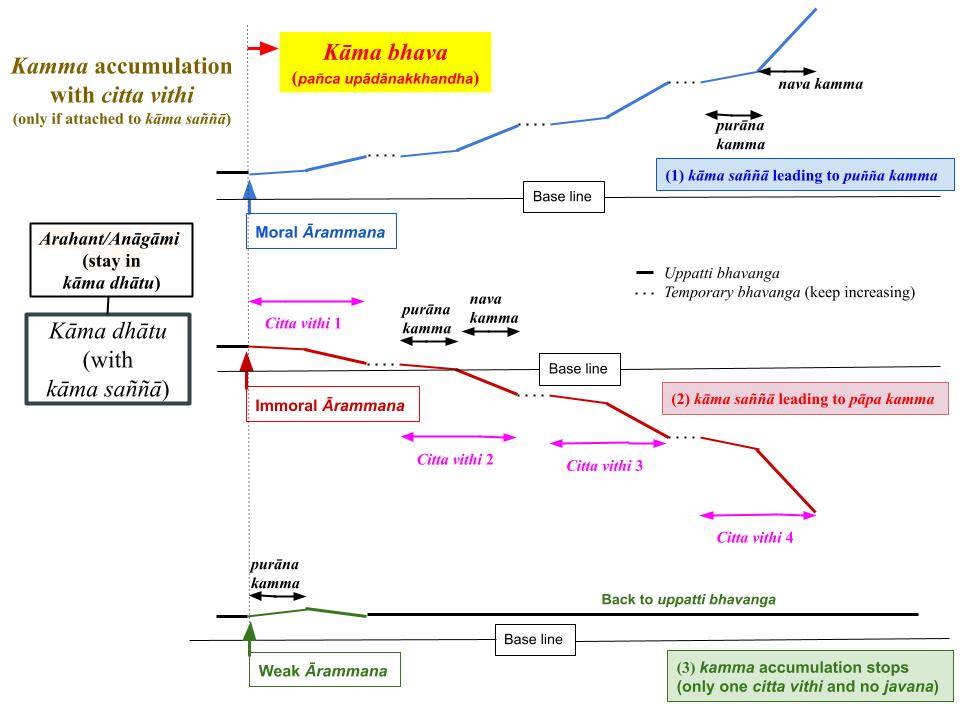
Download/Print: "Kamma accumulation with citta vithi"

  • If the ārammaṇa is not strong enough to trigger kāma guṇa (and generate kāmacchanda), then javana citta will not arise in the first citta vithi; thus, no "nava kamma" will be done. Furthermore, no more citta vithi will arise, as shown in the chart above. That is the case for most sensory inputs that go through our minds daily. We attach only to a small fraction.
  • See "Kāma Guṇa – Origin of Attachment (Tanhā)" for details on how kāma guṇa arise in the mind.
  • Obviously, kāma guṇa does not arise in the mind of an Arahant.

O versículo “Saññānidānā hi papañcasaṅkhā captura a causa fundamental para o surgimento das impurezas na mente. A “Saññā distorcida incorporada” é a razão pela qual é tão difícil eliminar a tendência de desejar prazeres sensuais.

26 de janeiro de 2024; revisado em 16 de março de 2025

Ensinamentos anteriormente desconhecidos de um Buddha

1. O Buddha chamou Saññā de miragem no “Pheṇapiṇḍūpama Sutta (SN 22.95)”, e discutimos isso nos ensaios “Estágio Sotapanna e Saññā Distorcida/Contaminada” e “Enganado pela Saññā Distorcida (Sañjānāti) – Origem do apego (Taṇhā)”.

  • Aqui, discutiremos outro Sutta crítico com o versículo acima para fornecer evidências de que a “doçura do açúcar” ou a “beleza de uma mulher” são uma “miragem” criada na mente humana pela “Saññā distorcida” incorporada em nossos corpos biológicos. Essas não são Vedanā, mas “Saññā inventada”. No entanto, “Saññā distorcida” leva a “Vedanā criada pela mente” ou “Samphassa-jā-Vedanā, ou seja, tornar-se alegre ou infeliz dependendo da informação sensorial.
  • Os corpos físico e mental de qualquer ser vivo surgem por meio da energia de Kamma (também chamada de Uppatti Bhava), que dá origem a essa existência. Isso acontece por meio da etapa “Paccaya Jāti” no Paṭicca Samuppāda
  • Esses são os “ensinamentos anteriormente desconhecidos de um Buddha”.
Jāti (Com um Corpo Físico) Ditado por Paṭicca Samuppāda

2. A etapa “Bhava Paccayā Jāti” no Paṭicca Samuppāda surgiu a partir do apego a estímulos sensoriais semelhantes (“Avijjā Paccayā Saṅkhāra”). O apego a certos estímulos (“paṭi icca”) leva a “nascimentos para proporcionar experiências correspondentes” (sama Samuppāda); veja “Paṭicca Samuppāda – “Pati+ichcha”+“Sama+Samuppāda”.

  • O nascimento de um porco é baseado em ações inferiores (Kamma) realizadas com “Avijjā Paccayā Saṅkhāra”. O nascimento de um leão é baseado em ações cruéis. 
  • Assim, a “doçura do açúcar” ou a “beleza de uma mulher” não surgiriam em um porco ou em um leão. A mente de um porco anseia por lixo como alimento. Um leão não anseia por açúcar ou lixo, mas pela carne de outros animais. Para mais detalhes, consulte “Gati to Bhava to Jāti – Ours to Control” e “Gati (Habits/Character) Determine Births – Saṃsappanīya Sutta”.
  • Os nascimentos humanos são baseados em “boas Gati”, mas misturado com Kāma Rāga (tendência a valorizar os prazeres sensoriais). A “doçura do açúcar” ou a “beleza de uma mulher” são inevitáveis para qualquer pessoa nascida com um corpo humano; o Buddha também as experimentou.  Assim, mesmo um Arahant nascido como humano geraria essa “Saññā distorcida” (a menos que estivesse em Jhāna ou samāpatti).
  • No entanto, se as pessoas compreenderem plenamente como esse Saññā distorcido” surge, suas mentes não serão mais enganadas. Foi isso que Bāhiya Dārucīriya (surpreendentemente) compreendeu quando o Buddha apenas lhe disse para perceber “diṭṭhe diṭṭhamattaṁ bhavissati, sute sutamattaṁ bhavissati, mute mutamattaṁ bhavissati, viññāte viññātamattaṁ bhavissatī’ti”. Isso significa: “Não vá além do que é visto, ouvido, experimentado pela língua, nariz, corpo ou mente”. O Venerável Bāhiya compreendeu que qualquer coisa que pareça “agradável à mente” não é uma representação verdadeira da realidade. Veja “Bāhiya Sutta (Ud 1.10); as traduções para o inglês são sempre inadequadas porque o tradutor não compreende o significado mais profundo.
A mente sempre recai sobre um dos três Lokās/Dhātus”

3. Quando não recebe estímulos sensoriais através de nenhum dos seis sentidos, a mente está no “estado uppatti Bhavaṅga”. Essa é a “mentalidade” com que se nasce. Como o nascimento humano resulta de “bom Kamma Vipāka”, esse estado de qualquer ser humano é positivo. Somente aqueles que estão nos apāyās (quatro reinos mais baixos) têm estados uppatti Bhavaṅga “negativos” ou “ruins”.

  • Enquanto no estado uppatti Bhavaṅga, a mente está inativa e nenhum Javana cittās surge. Quando um Ārammaṇa é recebido através de qualquer um dos seis sentidos, a mente se afasta desse estado uppatti Bhavaṅga e se concentra no Ārammaṇa, ou seja, torna-se ativa.
  • Isso é análogo a um carro estar “em ponto morto” e começar a se mover somente quando é colocado em uma marcha. Enquanto estiver em ponto morto, o carro está “vivo”, mas não está se movendo.
  • Um ser humano NÃO perderá esse “estado uppatti Bhavaṅga” até o fim da existência humana. Assim, um Arahant nascido como humano também terá a mente nesse “estado uppatti Bhavaṅga”, a menos que esteja em um Jhāna ou samāpatti.

4. Ao receber um Ārammaṇa, a mente humana “romperá” com o “estado Uppatti Bhava” e cairá primeiro no estágio “Kāma Dhātu” correspondente ao Bhava humano. Ela receberá automaticamente o “Kāma Saññā” associado ao “Bhava humano”. Isso inclui “Saññā distorcida” de “doçura do açúcar”, “beleza de uma mulher” ou “fedor de fezes”.

  • Em contraste, um porco receberia um “Saññā distorcido” de um “cheiro atraente” com uma pilha de fezes. Na realidade, as fezes são feitas de Suddhāṭṭhaka (átomos e moléculas na linguagem da ciência moderna) e não teriam qualidades “boas ou ruins”. Este é um ponto mais profundo que requer uma contemplação aprofundada.
  • Ficamos entusiasmados ao assistir a um show de mágica em que o mágico realiza “ações inacreditáveis”. Mas o mágico sempre usa um “truque”. Uma vez que o truque é descoberto, não há mais “emoção em assistir ao show de mágica”. 
  • Saññā distorcida” é o melhor truque de mágica do mundo. A própria natureza é o mágico. É tão bom que ninguém além de um Buddha pode descobri-lo. Como nossos corpos físicos são construídos para fornecer essa “Saññā distorcida”, não importa quantas investigações sejam feitas (com base em técnicas mundanas, incluindo experimentos científicos) para descobrir o truque, todas elas fracassarão.
  • É necessária uma “mudança de paradigma” para ver como esse truque é realizado. O Buddha descreveu como o Kamma feito com umaGatiespecífica levou a nascimentos com “Saññā” distorcida correspondente, conforme explicado no item 2 acima. Esses são os “ensinamentos anteriormente desconhecidos de um Buddha”.
“Saññānidānā hi papañcasaṅkhā”

5. À medida que avançamos, discutirei vários suttas críticos sobre “Saññā distorcida”. O versículo acima aparece no “Kalahavivāda Sutta (Snp 4.11)”. O versículo completo é:

Na saññasaññī na visaññasaññī, Nopi asaññī na vibhūtasaññī; Evaṁ sametassa vibhoti rūpaṁ, Saññānidānā hi papañcasaṅkhā”.

  • No Tipiṭaka, as palavras são combinadas para comprimir as linhas do texto. Se expandirmos o versículo:

Na sañña saññī na visañña saññī, Nopi asaññī na vibhūta saññī; Evaṁ sametassa vibhoti rūpaṁ, Saññā nidānā hi Papañca saṅkhā”.

6. “Evaṁ sametassa vibhoti rūpaṁ” significa “uma vez que se compreende a verdadeira natureza de Saññā, as rupās criadas pela mente deixam de surgir na mente”. Em outras palavras, o acúmulo de Akusala por meio de “dar prioridade ao imoral ou Papañca (Papañca saṅkhā) tem origem (nidāna) em Saññā, que se refere ao “Saññā distorcido”. Agora, vejamos a primeira parte do versículo.

  • Na sañña saññī” significa que não se pode compreender a verdade com o “Saññā distorcido naturalmente incorporado”. No entanto, não se pode resolver isso sem que esse “Saññā distorcido” seja experimentado (por exemplo, se alguém é um ummattakā ou “enlouqueceu”), e é isso que “na visañña saññī” significa.
  • Por exemplo, não se pode compreender isso perdendo completamente a Saññā e tornando-se “asañña”.  Sabemos que aqueles que cultivam técnicas “asañña Saññā” (“asañña Bhāvanā”) acabam no “reino asaññā”, onde Saññā não surge. Tal estado “asañña Saññā” é quando se fica inconsciente; enquanto inconsciente, Saññā de qualquer tipo não pode surgir porque nenhum cittās surge.
  • Em seguida, “na vibhūta saññī” significa que não se pode estar sem “(distorcido) Saññā” para compreender a verdade, ou seja, quando em um Arūpa samāpattī. Essas descrições estão no “Kalahavivāda Sutta niddesa”.
  • A verdadeira natureza do “Saññā distorcido” que experimentamos é discutida no “Mūlapariyāya Sutta – A Raiz de Todas as Coisas”. Como o nome do sutta indica, compreender essa “raiz de todas as coisas” é a chave para impedir que Papañca saṅkhā surja. Veja também “Enganado por Saññā Distorcida (Sañjānāti) – Origem do Apego (Taṇhā)”.
  • O Saññā distorcido” inclui “subha e Paṭigha Saññā, que precisam ser superados (através da compreensão de sua origem) por meio de Satipaṭṭhāna, após passar pelos estágios “jānato e passato”.
Saññā distorcidapermanece com um Arahant vivo

7. A arahantidade é alcançada enquanto se experimenta o “Saññā distorcido”, mas compreendendo com sabedoria como ele surge. A chave é compreender como esse “Saññā distorcido”, a “miragem” ou o truque” é feito. Ela é criada por nossas próprias mentes quando passamos pelo processo Paṭicca Samuppāda com Avijjā e criamos uppatti futuro (Bhava e Jāti). Esse renascimento (Jāti) apresentará automaticamente essa miragem ou o “Saññā distorcido”.

  • É um círculo vicioso que mantém o processo de Renascimento se repetindo perpetuamente ATÉ que o “truque” seja ouvido (jānato) e totalmente compreendido (passato).
  • Observe que o Saññā ideal (sem “Saññā distorcido”) é o Saññā que surge apenas em um “pabhassara citta”. Um Arahant em “Arahant Phala samadhi” experimenta esse “citta puro”. Esse “pabhassara citta” é experimentado pela primeira vez no momento do Arahant Phala.
  • Por outro lado, um Arahant, enquanto envolvido com kāma dhātu”, experimenta “cittās com kāma Saññā”, como discutimos. Além disso, um Arahant em um Jhāna ou samāpatti experimenta cittās com “rupa saññā (“prazeres Jhāna”) e “arupa saññā” (“prazeres samāpatti”), respectivamente, mas suas mentes também não se apegam a eles. Veja “Loka e Nibbāna (Aloka) – Visão Geral Completa”.
Os Arahants experimentam o “Saññā distorcido” – Evidência do Tipiṭaka 

8. O “Nibbānadhātu Sutta (Iti 44)” descreve um Arahant vivo como “Tassa tiṭṭhanteva pañcindriyāni yesaṁ avighātattā manāpāmanāpaṁ paccanubhoti, sukhadukkhaṁ paṭisaṁvedeti. Tassa yo rāgakkhayo, dosakkhayo, mohakkhayo—ayaṁ vuccati, bhikkhave, saupādisesā nibbānadhātu.”

Traduzido: “Suas cinco faculdades sensoriais permanecem. Enquanto suas faculdades sensoriais operam, eles continuam a experimentar o agradável/desagradável e a sentir prazer/dor corporal. O fim da ganância, do ódio e da ilusão neles é chamado de elemento de Nibbāna com algo restante.” Aqui, “o que resta” é seu corpo físico com as faculdades sensoriais.

  • Aqui, “agradável e desagradável” refere-se aos dois tipos principais de “Saññā distorcida”: subha Saññā para “experiências agradáveis à mente” e “Paṭigha Saññāpara “experiências desagradáveis”. Como discutimos, eles experimentam, por exemplo, a “doçura do açúcar” ou o “mau cheiro da carne podre”.
  • O ponto-chave é que suas mentes nem mesmo passam pelo estágio “purāna Kamma” (ao contrário de um Puthujjana) automaticamente. Assim, nenhuma adição adicional ao pañcupādānakkhandha acontecerá para um Arahant.
  • Até mesmo o Buddha experimentou o Saññā distorcido” porque nasceu com um corpo humano. Ao descrever várias “características do Buddha”, o “Brahmāyu Sutta (MN 91)” afirma: “Rasapaṭisaṁvedī kho pana so bhavaṁ gotamo āhāraṁ āhāreti, no ca rasarāgapaṭisaṁvedī OU “Ele come experimentando o sabor, mas sem experimentar apego pelo sabor”.
  • Para mais detalhes, consulte o nº 9 em “Sandiṭṭhiko – O que isso significa?”.
O apego ao “Saññā distorcidoinicia a acumulação de Kamma

9. Portanto, qualquer pessoa que nasça com um corpo humano experimentará o “Saññā distorcido”. Mas a mente de um Buddha ou de um Arahant não será enganada por ele. Eles compreendem plenamente que se trata de um “show de mágica”.

  • A mente de qualquer pessoa com kāma raga Anusaya/samyojana se apegará automaticamente a qualquer Ārammaṇa e o “estágio upaya” ou o estágio “purāna kamma” será iniciado. Nenhuma acumulação de Kamma ocorre neste PRIMEIRO estágio porque nenhum Javana cittas surge. Esse processo ocorre subconscientemente, sem nossa consciência.
  • No entanto, se a mente se interessar pelo Ārammaṇa, ela entra no “estágio Upādāna” ou no estágio “nava kamma”. Esse é o SEGUNDO estágio. O acúmulo de Kamma com Javana Cittas ocorre neste SEGUNDO estágio. Esse processo ocorre conscientemente, quando nos envolvemos em vaci e Kāya Saṅkhāra (ou seja, geramos vaci e Kāya Kamma).
  • Os estágios upaya e Upādāna foram discutidos em “Upaya e Upādāna – Dois Estágios do Apego”. A maneira alternativa de explicar o mesmo processo é chamá-los de estágios “purāna kamma” e “nava kamma”. Essa discussão está em “Purāna e Nava Kamma – Sequência da Geração de Kamma”.
  • Essas terminologias alternativas aparecem em diferentes Suttās. É bom estar ciente da nomenclatura.
Transição para o segundo estágio 

10. A transição para o acúmulo de Kamma ou estágio “nava Kamma” acontece se gerarmos Kāma guṇa para aquele Ārammaṇa. Isso significa que o estímulo sensorial (Ārammaṇa) é forte o suficiente para convencer a mente a persegui-lo. Isso é ilustrado no gráfico a seguir (e também que as mentes dos Arahants e Anāgāmis param no estágio kāma Dhātu com kāma Saññā). O acúmulo de kamma, uma vez iniciado com o primeiro Citta vithi, continuará até que (i) um kamma forte seja feito com vaci/Kāya Saṅkhāra), ou (ii) alguém conscientemente interrompa o estágio “nava kamma” próximo ao início.

Baixar/Imprimir:Acumulação de Kamma com Citta Vithi

  • Se o Ārammaṇa não for forte o suficiente para desencadear Kāma guṇa (e gerar kāmacchanda), então Javana citta não surgirá no primeiro citta vithi; assim, nenhum “nava kamma” será feito. Além disso, nenhum outro citta vithi surgirá, como mostrado no gráfico acima. Esse é o caso da maioria das entradas sensoriais que passam por nossas mentes diariamente. Nós nos apegamos apenas a uma pequena fração.
  • Veja “Kāma Guṇa – Origem do Apego (Tanhā)” para detalhes sobre como kāma guṇa surge na mente.
  • Obviamente, kāma guṇa não surge na mente de um Arahant.