🏠
⚗️ LABZ MODE — Stardust Overworld  ·  Features experimentais ativas  · 
Three Levels of Practice · Post 76 / 97 · TL.II.012

Purana And Nava Kamma Sequence Of Kamma Generation

Purana e Nava Kamma Sequência da geração de Kamma

PDPNTL.II.012
SectionThree Levels of Practice
Levelintermediate
Reading time17

A Paṭicca Samuppāda cycle starts at the "purāna kamma" stage. However, new and robust kamma (that could lead to rebirths in the future) is done in the "nava kamma" stage only if the mind starts generating vaci kamma consciously. 

January 11, 2024; revised last on December 13, 2025

Kamma accumulation Stats With a Sensory Input

1. Kamma accumulation happens in two distinctive stages. 

  1. In the first "purāna kamma" stage, the mind of a puthujjana attaches automatically to sensory input (if the corresponding saṁyojana remain unbroken) based on the "distorted saññā" we discussed in recent posts. Only weak kammic energies are accumulated initially. That attachment is due to "saññā vipallāsa." Thus, "saññā vipallāsa" arises ONLY IF "fooled by the distorted saññā"; see  “Fooled by Distorted Saññā (Sañjānāti) – Origin of Attachment (Taṇhā).”
  2.  If the mind becomes sufficiently interested in the sensory input, it will start the second "nava kamma" stage of kamma accumulation with javana cittās. Kamma accumulation occurs consciously in this second stage and produces kammic energies that can bring vipāka in the future. Even though we don't have control over the above "purāna kamma" stage, we have control over the "nava kamma" stage.
  • Any sensory experience with at least (i) above will be registered as "pañcupādānakkhandha," and a record of it (nāmagotta) will be preserved in viññāṇa dhātu (in the external world). Note that those records DO NOT stay with the hadaya vatthu or gandhabba. The gandhabba (in a physical body) must retrieve memories from the viññāṇa dhātu via the brain. See "Where Are Memories Stored? – Viññāṇa Dhātu." Only the defilements" (anusaya, saṁyojana, gati, etc. are associated with the hadaya vatthu/gandhabba.)

2. Consider the example of "seeing a beautiful woman" by a puthujjana and an Arahant.

  • Upon seeing the woman (as in a single snapshot), both minds enter the "kāma dhātu" stage, where they perceive her as beautiful.
  • The Arahant's mind will not pursue that "seeing." It will stay in the "kāma dhātu" stage.
  • However, since the puthujjana has "kāma rāga saṁyojana," his mind will instantly get into "kama loka" with bahiddha viññāṇa. That happens because his mind has not comprehended (avijjā) that the woman's "beauty " was a "distorted saññā." That led to the automatic arising of saṅkappa: "avijjā paccayā saṅkhāra" in Paṭicca Samuppāda (PS). Since he perceives the woman to be beautiful, his mind feels that it is worthwhile to take another look; that is the next step of ajjhatta viññāna. That completes "saṅkhāra paccayā viññāna" step in PS. Then, depending on the conditions, kāma guna may come into play, and his mind may go through the subsequent steps until "vēdanā paccayā taṇhā." If taṇhā is sufficiently strong, it will get to the next step of "taṇhā paccayā upādāna," pulling the mind firmly to the sight of the woman. That is when he will start accumulating strong kammic energies via "taking actions" consciously.
  • Critical point: Up to the "taṇhā paccayā upādāna" is the "purāna kamma" stage, and it could be over in a split second. That part can be discovered only by a Buddha. However, if the "nave kamma" stage is reached, the mind may spend a long time there, depending on the actions taken.
  • That is a basic overview of a sensory event, as explained via PS. You may want to reread this after going through (or while reading) the rest of the post.
Purāna and Nava Kamma Stages of a Sensory Event

3. Therefore, the first attachment stage ALWAYS happens at the "purāna kamma" stage. Kamma generation (with initial abhisaṅkhāra called saṅkappa) occurs in this stage but is not strong enough to bring vipāka in the future. Yet it initiates another round of pañca upādānakkhandha.

  • Therefore, a mind (sensory event) NEVER starts from the pañcakkhandha state for anyone below an Arahant. The pabhassara mind arises only after all ten saṁyojana are removed from the mind (i.e., hadaya vatthu) at the Arahant-phala moment.
  • If the second stage attachment ("nava kamma" stage) does not take place, no javana cittās will arise. Strong kamma that can bring future vipāka (including rebirth) will occur only if javana cittas arise within the "nava kamma" stage.

4. We have previously discussed the concepts of the following chart without using the terms "purāna kamma" and "nava kamma."
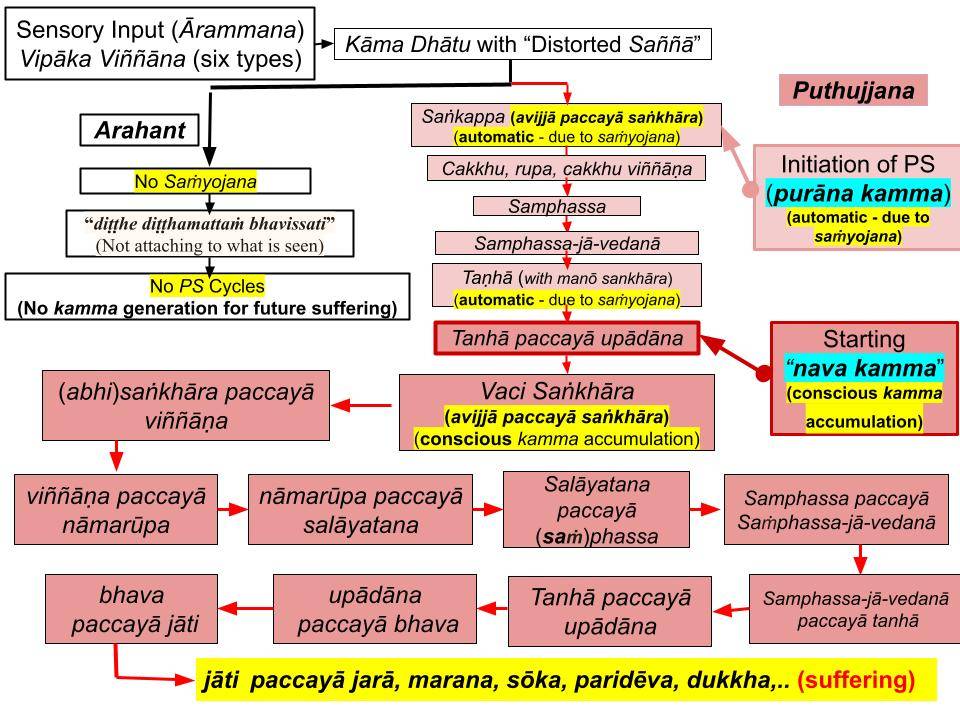
Download/Print: "Purana and Nava Kamma - 1-Revised"

Kāma Dhātu Stage First

5. Upon receiving a sensory input, a mind (of anyone born a human, whether an Arahant or a puthujjana), falls in the "kāma dhātu" stage as shown in the charts above and below. "Distorted saññā" is experienced at this initial stage. Note that this "distorted saññā" is imparted via the physical body (and the brain). Thus, an Arahant would also experience that "altered rupa" arising via "distorted saññā."   However, an Arahant (or an Anāgāmi, also free of kāma loka) would not attach to it.

  • Thus, the mind of an Arahant/Anāgāmi will stop at the "kāma dhātu" stage and not even get into the "purāna kamma" stage, as indicated in the charts. They have eliminated the first five saṁyojana that bind one to the kāma loka.
  • In the charts, I have considered a "seeing event." The "seeing event" for an Arahant/Anāgāmi will not lead to entry into the kāma loka. Unless the mind enters kāma loka, the "seeing event" is not called cakkhu viññāṇa. It is called “diṭṭhe diṭṭhamattaṁ bhavissati” (implying "not attaching to what is seen").
  • That is what the Buddha explained to Ven. Bāhiya in the “Bāhiya Sutta (Ud 1.10)” with the verse, “diṭṭhe diṭṭhamattaṁ bhavissati, sute sutamattaṁ bhavissati, mute mutamattaṁ bhavissati..” 
  • The Sutta Central translation in the link is: “In the seen will be merely seen; in the heard will be merely heard..” A better translation is: “seeing without rāga, dosa, moha arising in the mind.” The same holds for hearing, tasting, etc. Note: taste, smell, and touch are combined as "muta."
  • The rest of the post is focused on how a puthujjana accumulates kamma via a series of steps in two distinct stages: "Purāna kamma" and "nava kamma" stages.
Purāna Kamma Stage

6. A Paṭicca Samuppāda (PS) process for a puthujjana always starts with an ārammaṇa, i.e., a sense input. The chart below shows how a "seeing event" begins with a rupa (visual) as a sensory input. A sensory event starts on the left at the "dhātu stage." While the mind of an Arahant stops there, that of a puthujjana keeps evolving to the right, becoming increasingly defiled via many steps. Some of the steps are shown in the chart below.
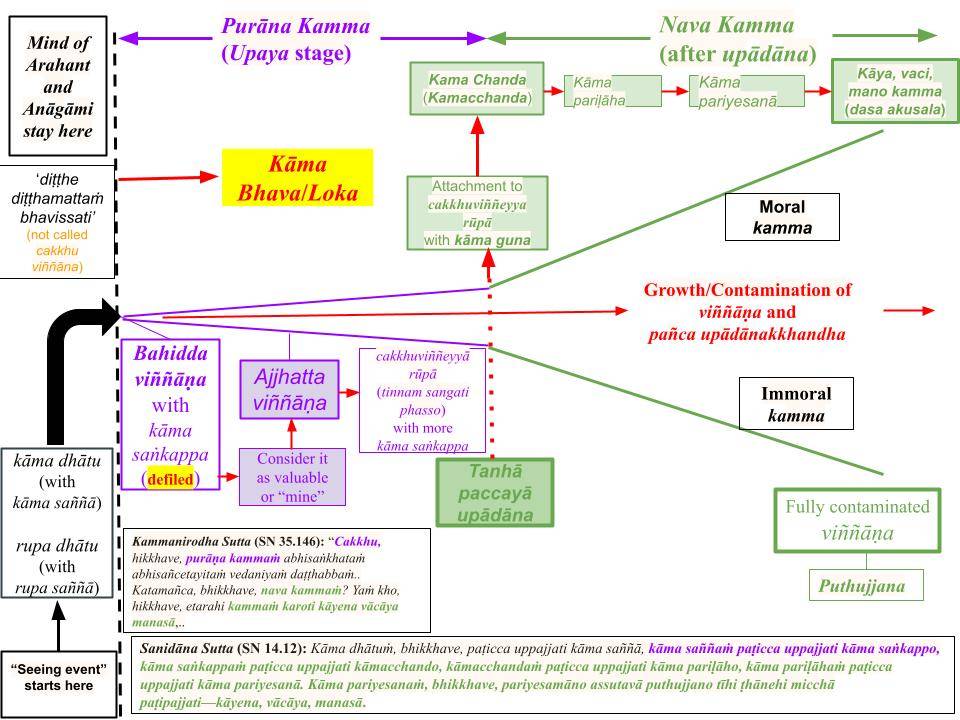
Download/Print: "Purana and Nava Kamma -2-revision 3"

  • "Purāna kamma" can be translated as "initial kamma" or "base-level of kamma generation." Purāna does not mean "old."
  • That stage occurs automatically due to attachment to the "distorted saññā." 
  • Within the "purāna kamma" stage, a mind goes through several steps in Paṭicca Samuppāda. It starts with “avijjā paccayā saṅkhāra," where the mind first attaches to the sensory input; only weak saṅkhāra (saṅkappa) arise. Then the following steps also occur within the "purāna kamma" stage: saṅkhāra paccayā viññāna; viññāna paccayā nāmarūpa, nāmarūpa paccayā salāyatana, salāyatana paccayā phassō, phassa paccayā vēdanā, vēdanā paccayā taṇhā.
  • (I adopted the "cone representation" of the "expansion of viññāṇa" in the above chart from the Sinhala discourse series
  • "බුදු දහම, මාර්ග ඵල සහ මග වැඩීම". I highly recommend it for a Sinhala-speaking audience. I have modified it to a "two-cone structure" to represent the "purāna kamma" and "nava kamma" stages.)
Bahiddha and Ajjhatta Viññāṇa

7. Kamma viññāṇa of a puthujjana starts right after the kāma dhātu stage when the mind automatically attaches to the "distorted saññā" due to the "hidden defilements" (anusaya/saṁyojana)  and turns into "bahiddha viññāṇa" and moves to the "purāna kamma" stage. That initial attachment happens automatically with saṅkappa (only mano saṅkhārā).

  • That first attachment is where the "altered rupa" with "distorted saññā" triggers the mind to generate the first stage of viññāṇa (bahiddha viññāṇa). This is when the mind enters kāma loka. 
  • In the next step, the mind again attaches with more saṅkappa (taking the bahiddha viññāṇa to be valuable) and reaches the "ajjhatta viññāṇa" stage. That leads to the use of cakkhu indriya as an āyatana; henceforth, in the process, "cakkhu" refers to "cakkhu āyatana." See both charts.
  • A critical point: An Arahant (or an Anāgāmi, also free of kāma loka) would not generate cakkhu, rūpa (except for the rupa in the kāma dhātu stage), or cakkhu viññāṇa as they appear in most suttās. All three can be stopped from arising (nirodha.)

8. "Kammanirodha Sutta (SN 35.146)": Cakkhu, bhikkhave, purāṇa kammaṁ abhisaṅkhataṁ abhisañcetayitaṁ vedaniyaṁ daṭṭhabbaṁ..

Translated: "Cakkhu arises via purāṇa kamma. It is to be understood (daṭṭhabbaṁ) to lead to abhisaṅkhāra (abhisaṅkhataṁ) and can lead to abhisañcetanā (abhisañcetayitaṁ) and leads to (mind-made) vedanā (vedaniyaṁ.)

  • Here, "purāṇa kamma" means "initial kamma generation" that automatically occurred with the initial attachment to the "distorted saññā" (same as "kāma saññā" in kāma loka).
  • When seeing an object, "cakkhu viññāṇa arises based on cakkhu and rūpa" OR "Cakkhuñca paṭicca rūpe ca uppajjati cakkhu viññāṇaṁ." At this step, cakkhu viññāṇa is already at the "ajjhatta viññāṇa" stage.
  • Here, "cakkhu" does not mean "eyes;" it means defiled "cakkhu āyatana" (versus undefiled "cakkhu indriya" for an Arahant/Anāgāmi.) That is precisely what the above verse says: It has already been defiled when the mind got contaminated by the "distorted saññā" when it moved from the "kāma dhātu" stage to the "kāma bhava/loka."  
  • This is depicted in the second chart above.
"Distorted Saññā" Arises in Anyone Born With a Human Body

9. Anyone born with a physical human body will automatically get the "distorted saññā." Thus, the "rupa" that comes to mind does not accurately represent the external rupa. Therefore, even an Arahant/Anāgāmi would taste sugar to be sweet. This is not a "superficial trick" by a third-rate magician but a "sophisticated trick" that can be uncovered only by a Buddha. A human body is designed (by kammic influence) to provide that "attractive saññā" because those born humans had craved them in past lives. See the first two posts in “Worldview of the Buddha.

  • The primary reason for our tendency to indulge in sensual pleasures is this "distorted and made-up saññā." See "Kāma Rāga Arises Due to “Distorted Saññā” (Note: "distorted saññā" leads to "saññā vipallāsa" ONLY for those not comprehending how that "trick" plays out as explained in the first few posts in “Worldview of the Buddha”).
  • To break the kāma rāga saṁyojana, one MUST understand how kāma rāga arises via "distorted saññā" in the purāṇa kamma stage. Understanding this process will also help attain the Sotapanna stage.
  • Many people mistakenly believe they must remove kāma rāga from their minds through willpower. That could make things worse by the generation of paṭigha in the mind. On the other hand, once one comprehends that there is no intrinsic "sweetness in sugar" or "beauty of a woman," it is much easier to get rid of kāma rāga
Root Cause of Attachment - "Distorted Saññā"

10. As we can see in the above chart, this "distorted saññā" is the root cause of our attachment to "attractive sensory inputs." When we try to get "more of such made-up enjoyments," we engage in akusala kamma that bring us "unintended harmful consequences (kamma vipāka)," including rebirth in suffering-filled realms (like the animal realm.)

  • Enjoying "sensory pleasures" is like watching a good magic show. That is why the Buddha called viññāṇa a "magician." See “Pheṇapiṇḍūpama Sutta (SN 22.95).” However, the danger is that people tend to engage in akusala kamma for more such "pleasures." That happens after the "taṇhā paccayā upādāna" step in Paṭicca Samuppāda, as indicated in the above charts.
  • I have emphasized this in many recent posts because it is a critical point: "Mūlapariyāya Sutta – The Root of All Things" and "Fooled by Distorted Saññā (Sañjānāti) – Origin of Attachment (Taṇhā)."
  • We accumulate such akusala kamma in two stages. The first "subtle stage" is the "purāna kamma stage," when kamma accumulation starts at a subtle level that our minds are unaware of. 
  • If the mind sufficiently attaches to sensory input, we consciously begin to accumulate new, strong kamma through speech and actions based on vaci and kāya saṅkhārā. As shown in the first chart above, that happens after the "taṇhā paccayā upādāna" step in the Paṭicca Samuppāda process. That is the "nava kamma" stage. However, subtle/weak kamma accumulation has already started in the "purāna kamma" stage.
Nava Kamma Stage

11. Once in the "nava kamma" stage, the rest of the steps in Paṭicca Samuppāda will follow: upādāna paccayā bhavō, bhava paccayā jāti, jāti paccayā jarā, marana, soka-paridēva-dukkha-dōmanassupāyasā sambhavan’ti”

  • Only the strong kamma generation in the step "upādāna paccayā bhavō" (culminating in kaya, vaci, and mano kamma generation as shown in the second chart above). 
  • The first chart shows all the steps of Paṭicca Samuppāda in the "nava kamma" stage.
  • Also see “Difference Between Tanhā and Upādāna” for some insights.

12. "Kammanirodha Sutta (SN 35.146)": "Katamañca, bhikkhave, nava kammaṁ? Yaṁ kho, hikkhave, etarahi kammaṁ karoti kāyena vācāya manasā,.."

Translated: "What is a nava kamma? This is when one consciously accumulates kamma via body, speech, and the mind."

  • The wider cone in the second chart above shows how a mind gets defiled in real-time by consciously and repeatedly attaching to a sensory input. This stage occurs only when the mind strongly attaches to sensory input and initiates the "taṇhā paccayā upādāna" step in the Paṭicca Samuppāda process.
  • In this "nava kamma" stage, the mind passes through several stages (kāmacchanda, kāma pariḷāha, kāma pariyesanā; see #11 below) where attachment becomes increasingly intense. It culminates in accumulating strong kamma done via the body, speech, and mind (kammaṁ karoti kāyena vācāya manasā).
  • The mind of anyone born a human (including an Arahant) starts at the kāma dhātu stage. That physical body (and the brain) will automatically present to the mind an "altered rupa" instead of a "true representation of the external rupa." That is why a "distorted saññā" (e.g., the sweetness of sugar) arises in an Arahant as well as for a puthujjana.
  • However, the mind of an Arahant would not attach to that "altered rupa" because that mind has fully grasped how that "trick" takes place, as explained in the above charts. 
General Attachment Sequence for Kāma Dhātu

13. The “Sanidāna Sutta (SN 14.12)“ points out the general sequence of steps involved in kamma accumulation based on any sensory input in kāma loka. We discussed that in the post "Upaya and Upādāna – Two Stages of Attachment."

  • Kāma dhātuṁ, bhikkhave, paṭicca uppajjati kāma saññā, kāma saññaṁ paṭicca uppajjati kāma saṅkappokāma saṅkappaṁ paṭicca uppajjati kāmacchando, kāmacchandaṁ paṭicca uppajjati kāma pariḷāho, kāma pariḷāhaṁ paṭicca uppajjati kāma pariyesanā.” OR “Attachment to kāma dhātu leads to kāma saññā, attachment to kāma saññā leads to kāma saṅkappa, attachment to kāma saṅkappa leads to kāmacchanda..and so on to kāma pariyesanā.
  • The "nava kamma" stage starts with the 'kāma saṅkappaṁ paṭicca uppajjati kāmacchando' step in the above verse. This is also the "taṇhā paccayā upādāna" step in the Paṭicca Samuppāda process. The mind attaches (taṇhā) with kāmacchanda; then the mind desires to fulfill the desire quickly in the "kāma pariḷāha" stage; then it starts investigating ways to do that quickly (kāma pariyesanā), leading to potent kamma accumulation via the body, speech, and mind (kammaṁ karoti kāyena vācāya manasā).
  • Also note that rupa paṭisaṁvedī for a seeing event or rasa paṭisaṁvedī for a tasting event occurs in the "kāma dhātu" stage for both an Arahant and a puthujjana; rūpa rāga paṭisaṁvedī or rasa rāga paṭisaṁvedī occurs in the purāna kamma stage when the bahiddha viññāṇa is generated only in a puthujjana. See #9, #10 in "Sandiṭṭhiko – What Does It Mean?."

14. In the post "Contamination of a Human Mind – Detailed Analysis," we discussed the following verse in the “Saññānānatta Sutta (SN 14.7),” which examines the six types of sensory inputs available in the kāma loka. Thus, it expanded the general statement in the above verse for a "seeing event":

 “Rūpa dhātuṁ, bhikkhave, paṭicca uppajjati rūpa saññā, rūpa saññaṁ paṭicca uppajjati rūpa saṅkappo, rūpa saṅkappaṁ paṭicca uppajjati rūpacchando, rūpacchandaṁ paṭicca uppajjati rūpa pariḷāho, rūpa pariḷāhaṁ paṭicca uppajjati rūpa pariyesanā” OR “Rūpa dhātu gives rise to the perception of that sight (rūpa saññā.) That perception (if mind-attaching) gives rise to thoughts about it (rūpa saṅkappa.) Thoughts give rise to the desire for such sights (rūpacchanda.) The desire for sights gives rise to the passion for sights (rūpa pariḷāha.) The passion for sights gives rise to pursuing/investigating sights (rūpa pariyesanā.) In the last one, “pariyesanā” means “investigations;” when one becomes interested in something, one explores how to use it optimally.

  • Then the verse is repeated for all SIX senses ending with “dhamma dhātuṁ paṭicca uppajjati dhamma saññā, dhamma saññaṁ paṭicca uppajjati dhamma saṅkappo, dhamma saṅkappaṁ paṭicca uppajjati dhammacchando, dhammacchandaṁ paṭicca uppajjati dhamma pariḷāho, dhammapariḷāhaṁ paṭicca uppajjati dhamma pariyesanā.”
Broader View Including All Realms

15. The second chart above explains the effect of the "distorted saññā" on initiating the defilement of the mind (i.e., the growth of "kamma viññāṇa" or the "pañca upādānakkhandha") in the kāma loka

  • A somewhat similar "distorted saññā" also arises in the 16 realms of the rupa loka (rupāvacara Brahma realms) and the four realms in the arupa loka (arupāvacara Brahma realms). However, strong "kamma accumulation" (which can lead to rebirths) DOES NOT occur significantly in those realms. 
  • An anariya yogi born in any of those 20 realms will experience the "jhānic/samāpatti sukha" until the end of their lifetime there. Then, they will be reborn in the kāma loka due to kammic energies accumulated in previous lives.
  • An Ariya born in one of those realms will also experience the "jhānic/samāpatti sukha," which ALSO arises from "distorted saññā.However, they can again remove attachment to that "distorted saññā" and move to the "rupa dhatu" or "arupa dhatu" as shown in the chart below for an Arahant
  • Note again that the "nava kamma" stage is missing in rupa and arupa loka.
Sabbe Saṅkhārā Aniccā
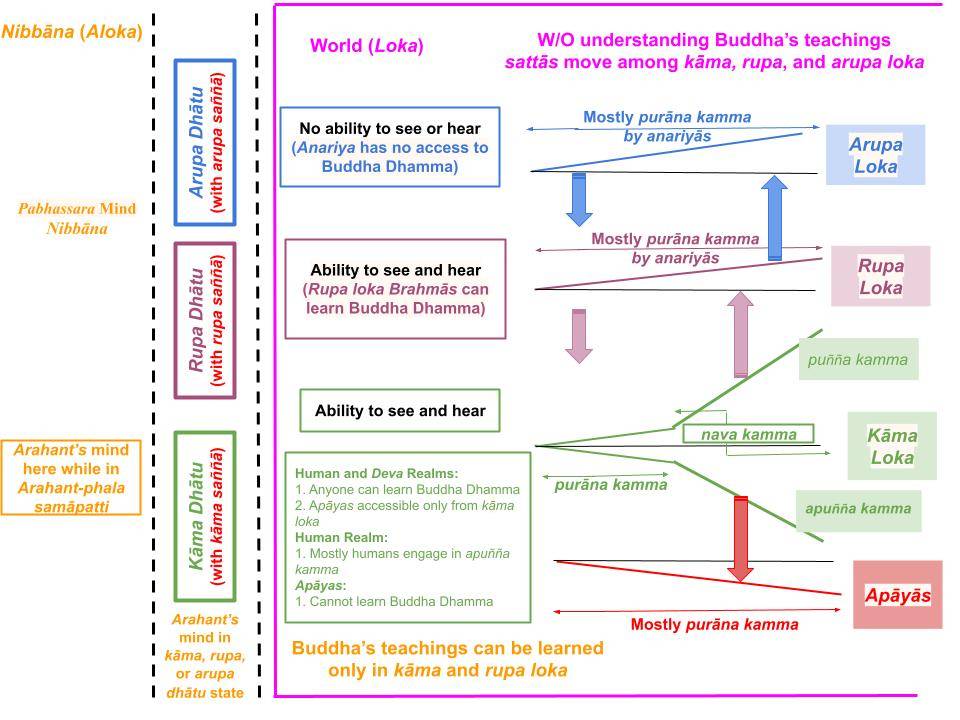
Download/Print: “Loka and Aloka – Totally Separated

16. A mind MUST first fall on one of the three dhātus (upon receiving an ārammaṇa.) Those in rupa or arupa loka cannot experience "sensual sensory inputs" (because they don't have dense bodies), so their minds fall on either the "rupa dhātu" or the "arupa dhātu."

  • For example, anariya Brahma in a "rupa loka Brahma realm" only receives the "distorted saññā" of "rupāvacara jhānic sukha" and will automatically attach to it with "saññā vipallāsa." They do not accumulate more kamma but will return to kāma loka at the end of Brahma's life. Unlike in the kāma loka, there is no way to accumulate strong kamma (that can bring rebirths) while in the rupa or arupa Brahma realms.
  • An Anāgāmi in rupa loka will also get the "distorted saññā" of "rupāvacara jhānic sukha" but can see the "anicca nature" of that saññā and can stop attaching to it.
  • The above chart is discussed in "Pāth to Nibbāna – Learning Dhamma to Become a Sotapanna."

17. Therefore, an anariya's mind can never move toward the "suffering-free pabhassara mind." That is the crucial point to see in the above third chart. Upon receiving a sense input, it ALWAYS moves away from the pabhassara mind or Nibbāna (shown on the left).

  • In particular, ANY action, speech, or thought of a human puthujjana will ALWAYS move their minds   AWAY from the "suffering-free" pabhassara mind. That is a key reason why the abhisaṅkhāra generation (via "avijjā paccayā saṅkhārā") is of "anicca nature." In other words, "sabbe saṅkhārā aniccā."
  • That also means the mind of a puthujjana NEVER moves in the "parināmi" direction or "for the better." It always moves in the "viparināmi" or "for the worse."
  • That is discussed in "Aniccaṁ Vipariṇāmi Aññathābhāvi – A Critical Verse" and "Vipariṇāma – Two Meanings."
Purāna and Nava Kamma Stages - Connection to Paṭicca Samuppāda

18. As you may be able to see, the purāna and nava kamma stages correspond to the Avyākata Paṭicca Samuppāda and Akusala-Mula Paṭicca Samuppāda processes we had discussed in old posts, respectively. See, for example, "Paṭicca Samuppāda Cycles."

  • In the Sutta Piṭaka, those two PS processes are not discussed separately, but treated as just "Paṭicca Samuppāda." The separation into two distinct processes is seen only in the Commentaries.
  • Also see "Upaya and Upādāna – Two Stages of Attachment."

19. I tried to include a wide variety of information in this rewritten version, which became a bit long. Hopefully, that will help get a good idea of the complete Paṭicca Samuppāda process. 

Um ciclo Paṭicca Samuppāda começa na fase “purāna kamma”. No entanto, um kamma novo e robusto (que pode levar a renascimentos no futuro) é realizado na fase “nava kamma” apenas se a mente começar a gerar vaci kamma conscientemente. 

11 de janeiro de 2024; revisado pela última vez em 13 de dezembro de 2025

Estatísticas de acumulação de Kamma com um input sensorial

1. O acúmulo de Kamma ocorre em dois estágios distintos. 

  1. No primeiro estágio, “purāna kamma”, a mente de um Puthujjana se apega automaticamente à entrada sensorial (se o saṁyojana correspondente permanecer ininterrupto) com base no “Saññā distorcido” que discutimos em ensaios recentes. Inicialmente, apenas energias de Kamma fracas são acumuladas. Esse apego se deve aoSaññā Vipallāsa”. Assim, “saññā Vipallāsa surge SOMENTE SE “enganado pelo Saññā distorcido; veja “Enganado pelo Saññā Distorcido (Sañjānāti) – Origem do Apego (Taṇhā)”.
  2.  Se a mente se tornar suficientemente interessada na informação sensorial, ela iniciará o segundo estágio “nava kamma” de acumulação de kamma com Javana cittās. A acumulação de kamma ocorre conscientemente neste segundo estágio e produz energias cármicas que podem trazer Vipāka no futuro. Mesmo que não tenhamos controle sobre o estágio “purāna kamma” acima, temos controle sobre o estágio “nava kamma”.
  • Qualquer experiência sensorial com pelo menos (i) acima será registrada como “pañcupādānakkhandha, e um registro dela (nāmagotta) será preservado em Viññāṇa Dhātu (no mundo externo). Observe que esses registros NÃO permanecem com o Hadaya Vatthu ou Gandhabba. O gandhabba (em um corpo físico) deve recuperar as memórias do Viññāṇa Dhātu através do cérebro. Veja “Onde as memórias são armazenadas? – Viññāṇa Dhātu”. Apenas as impurezas (Anusaya, saṁyojana, gati, etc.) estão associadas ao Hadaya Vatthu/Gandhabba.

2. Considere o exemplo de “ver uma mulher bonita” por um Puthujjana e um Arahant.

  • Ao ver a mulher (como em um único instantâneo), ambas as mentes entram no estágio Kāma Dhātu”, onde a percebem como bonita.
  • A mente do Arahant não perseguirá essa “visão”. Ela permanecerá no estágio “kāma dhātu”.
  • No entanto, como o puthujjana tem “Kāma Rāga”, sua mente entrará instantaneamente em “Kāma Loka” com bahiddha Viññāṇa. Isso acontece porque sua mente não compreendeu (Avijjā) que a “beleza” da mulher era uma “Saññā distorcida”. Isso levou ao surgimento automático de saṅkappa: “Avijjā Paccayā Saṅkhāra” em Paṭicca Samuppāda (PS). Como ele percebe a mulher como bonita, sua mente sente que vale a pena dar outra olhada; esse é o próximo passo de ajjhatta viññāna. Isso completa a etapa “Saṅkhāra Paccayā viññāna” em PS. Então, dependendo das condições, Kāma guna pode entrar em ação, e sua mente pode passar pelas etapas subsequentes até “vēdanā paccayā Taṇhā”. Se Taṇhā for suficientemente forte, chegará ao próximo passo de “Taṇhā Paccayā Upādāna, puxando a mente firmemente para a visão da mulher. É quando ele começará a acumular fortes energias de Kamma por meio de “ações” conscientes.
  • Ponto crítico: até Taṇhā Paccayā Upādāna” é o estágio “purāna kamma”, e pode terminar em uma fração de segundo. Essa parte só pode ser descoberta por um Buddha. No entanto, se o estágio “nave kamma” for alcançado, a mente pode passar muito tempo lá, dependendo das ações realizadas.
  • Essa é uma visão geral básica de um evento sensorial, conforme explicado via PS. Você pode querer reler isso depois de ler (ou enquanto lê) o resto da postagem.
Estágios Purāna e Nava Kamma de um evento sensorial

3. Portanto, o primeiro estágio de apego SEMPRE ocorre no estágio “purāna kamma”. A geração de kamma (com Abhisaṅkhāra inicial chamado saṅkappa) ocorre neste estágio, mas não é forte o suficiente para trazer Vipāka no futuro. No entanto, ela inicia outra rodada de pañca upādānakkhandha.

  • Portanto, uma mente (evento sensorial) NUNCA começa a partir do estado Pañcakkhandha para ninguém abaixo de um Arahant. A mente pabhassara surge somente depois que todos os dez saṁyojana são removidos da mente (ou seja, Hadaya Vatthu) no momento Phala-Arahant.
  • Se o apego do segundo estágio (estágio “nava kamma”) não ocorrer, nenhum Javana cittās surgirá. O kamma forte que pode trazer Vipāka futuro (incluindo Renascimento) ocorrerá apenas se Javana cittas surgirem dentro do estágio “nava kamma”.

4. Já discutimos anteriormente os conceitos do quadro a seguir sem usar os termos “purāna Kamma” e “nava Kamma”.

Baixar/Imprimir: Purana e Nava Kamma - 1-Revisado”

Estágio Kāma Dhātu Primeiro

5. Ao receber um estímulo sensorial, a mente (de qualquer pessoa nascida como humana, seja um Arahant ou um Puthujjana) entra no estágio “Kāma Dhātu, conforme mostrado nos gráficos acima e abaixo. ASaññā distorcida” é experimentada neste estágio inicial. Observe que essa “Saññā distorcida” é transmitida através do corpo físico (e do cérebro). Assim, um Arahant também experimentaria essa “Rūpa alterada” surgindo através da “Saññā distorcida”. No entanto, um Arahant (ou um Anāgāmi, também livre do Kāma Loka) não se apegaria a ela.

  • Assim, a mente de um Arahant/Anāgāmi irá parar no estágio “kāma dhātu” e nem mesmo entrará no estágio “purāna kamma”, conforme indicado nos gráficos. Eles eliminaram os primeiros cinco saṁyojana que prendem a pessoa ao Kāma Loka.
  • Nos gráficos, considerei um “evento de visão”. O “evento de visão” para um Arahant/Anāgāmi não levará à entrada no Kāma Loka. A menos que a mente entre no Kāma Loka, o “evento de visão” não é chamado de Cakkhu Viññāṇa. É chamado de “diṭṭhe diṭṭhamattaṁ bhavissati” (implicando “não se apegar ao que é visto”).
  • Isso é o que o Buddha explicou ao Ven. Bāhiya no “Bāhiya Sutta (Ud 1.10)” com o verso: “diṭṭhe diṭṭhamattaṁ bhavissati, sute sutamattaṁ bhavissati, mute mutamattaṁ bhavissati...”. 
  • A tradução do Sutta Central no link é: “No visto será apenas visto; no ouvido será apenas ouvido...” Uma tradução melhor é: “ver sem que Rāga, Dosa, Moha surjam na mente”. O mesmo se aplica à audição, ao paladar, etc. Nota: paladar, olfato e tato são combinados como “muta”.
  • O restante do ensaio concentra-se em como um Puthujjana acumula Kamma por meio de uma série de etapas em dois estágios distintos: os estágios “Purāna Kamma” e “nava Kamma”.
Estágio Purāna Kamma

6. Um processo Paṭicca Samuppāda (PS) para um Puthujjana sempre começa com um Ārammaṇa, ou seja, um estímulo sensorial. O gráfico abaixo mostra como um “evento de visão” começa com um Rūpa (visual) como estímulo sensorial. Um evento sensorial começa à esquerda, na “fase Dhātu”. Enquanto a mente de um Arahant pára aí, a de um Puthujjana continua evoluindo para a direita, tornando-se cada vez mais contaminada por meio de muitas etapas. Algumas das etapas são mostradas no gráfico abaixo.

Baixar/Imprimir: Purana e Nava Kamma -2-revisão 3”

  • Purāna kamma” pode ser traduzido como “Kamma inicial” ou “nível básico de geração de Kamma”. Purāna não significa “antigo”.
  • Esse estágio ocorre automaticamente devido ao apego ao “Saññā distorcido”. 
  • Dentro do estágio “purāna kamma”, a mente passa por várias etapas em Paṭicca Samuppāda. Começa com “Avijjā Paccayā Saṅkhāra, onde a mente primeiro se apega à informação sensorial; apenas Saṅkhāra (saṅkappa) fraco surge. Em seguida, as seguintes etapas também ocorrem dentro do estágio “purāna kamma”: Saṅkhāra Paccayā viññāna; viññāna Paccayā Nāmarūpa, Nāmarūpa Paccayā Saḷāyatana, Saḷāyatana Paccayā Phassa, Phassa Paccayā Vēdanā, Vēdanā Paccayā Taṇhā.
  • (Adotei a “representação cônica” da “expansão de Viññāṇa” no gráfico acima da série de discursos em Cingalês
  • බුදු දහම, මාර්ග ඵල සහ මග වැඩීම”. Eu o recomendo fortemente para um público que fala Cingalês. Eu o modifiquei para uma “estrutura de dois cones” para representar os estágiospurāna Kamma” e “nava Kamma”.
Bahiddha e Ajjhatta Viññāṇa

7. O kamma viññāṇa de um puthujjana começa logo após o estágio Kāma Dhātu, quando a mente se apega automaticamente ao “Saññā distorcido” devido às “impurezas ocultas” (Anusaya/saṁyojana)  e se transforma em bahiddha viññāṇa, passando para o estágio “purāna kamma”. Esse apego inicial acontece automaticamente com saṅkappa (apenas mano saṅkhārā).

  • Esse primeiro apego é onde o “Rūpa alterado” com “Saññā distorcido” faz com que a mente gere o primeiro estágio de Viññāṇa (bahiddha Viññāṇa). É quando a mente entra em Kāma Loka. 
  • Na etapa seguinte, a mente novamente se apega com mais saṅkappa (considerando o bahiddha Viññāṇa como valioso) e alcança o estágio “ajjhatta Viññāṇa”. Isso leva ao uso de Cakkhu Indriya como um Āyatana; doravante, no processo, “Cakkhu” refere-se a “Cakkhu Āyatana”. Veja os dois gráficos.
  • Um ponto crítico: um Arahant (ou um Anāgāmi, também livre do Kāma Loka) não geraria cakkhu, rūpa (exceto o rupa no estágio do Dhātu Kāma) ou Cakkhu Viññāṇa, como aparecem na maioria das Suttās. Todos os três podem ser impedidos de surgir (Nirodha).

8. “Kammanirodha Sutta (SN 35.146): Cakkhu, bhikkhave, purāṇa kammaṁ abhisaṅkhataṁ abhisañcetayitaṁ vedaniyaṁ daṭṭhabbaṁ...

Traduzido: Cakkhu surge através de purāṇa Kamma. Deve ser entendido (daṭṭhabbaṁ) que leva a Abhisaṅkhāra (Abhisaṅkhataṁ) e pode levar a abhisañcetanā (abhisañcetayitaṁ) e leva a (mentalmente criado) Vedanā (Vedaniyaṁ).

  • Aqui, “purāṇa kamma” significa “geração inicial de kamma” que ocorreu automaticamente com o apego inicial ao “Saññā distorcido” (o mesmo que Kāma saññā” em Kāma Loka).
  • Ao ver um objeto, “Cakkhu Viññāṇa surge com base em Cakkhu e Rūpa” OU “Cakkhuñca Paṭicca Rūpe ca uppajjati Cakkhu Viññāṇaṁ”. Nesta etapa, Cakkhu Viññāṇa já está no estágio “ajjhatta viññāṇa”.
  • Aqui, “cakkhu” não significa “olhos”; significa “cakkhu Āyatana” contaminado (em oposição a “Cakkhu Indriya” não contaminado para um Arahant/Anāgāmi). É exatamente isso que o versículo acima diz: ele já estava contaminado quando a mente foi contaminada pelo “Saññā distorcido” ao passar do estágio “kāma Dhātu” para o “Kāma Bhava/Loka”.  
  • Isso é ilustrado no segundo gráfico acima.
Saññā distorcida” surge em qualquer pessoa nascida com um corpo humano

9. Qualquer pessoa nascida com um corpo físico humano obterá automaticamente o Saññā distorcido”. Assim, o “Rūpa” que vem à mente não representa com precisão o Rūpa externo. Portanto, mesmo um Arahant/Anāgāmi sentiria o açúcar como doce. Isso não é um “truque superficial” de um mágico de terceira categoria, mas um “truque sofisticado” que só pode ser descoberto por um Buddha. Um corpo humano é projetado (pela influência de Kamma) para fornecer essa “Saññā atraente” porque aqueles que nasceram humanos a desejaram em vidas passadas. Veja as duas primeiras postagens em “Visão de mundo do Buddha”.

  • A principal razão para nossa tendência de nos entregarmos aos prazeres sensuais é essa “Saññā distorcida e inventada”. Veja “Kāma Rāga surge devido ao ‘Saññā distorcido’ (Observação: o Saññā distorcido’ leva ao ‘Saññā Vipallāsa’ SOMENTE para aqueles que não compreendem como esse ‘truque’ funciona, conforme explicado nos primeiros ensaios em “Visão de mundo do Buddha”).
  • Para quebrar o Kāma Rāga saṁyojana, é PRECISO compreender como o Kāma Rāga surge através do “Saññā distorcido” no estágio purāṇa Kamma. Compreender esse processo também ajudará a alcançar o estágio Sotāpanna.
  • Muitas pessoas acreditam erroneamente que devem remover Kāma Rāga de suas mentes através da força de vontade. Isso pode piorar as coisas, gerando Paṭigha na mente. Por outro lado, uma vez que se compreende que não há “doçura intrínseca no açúcar” ou “beleza intrínseca em uma mulher”, é muito mais fácil se livrar de Kāma Rāga
Causa raiz do apego - Saññā distorcida”

10. Como podemos ver no quadro acima, essa “Saññā distorcida” é a causa raiz do nosso apego a “estímulos sensoriais atraentes”. Quando tentamos obter “mais desses prazeres inventados”, nos envolvemos em Akusala Kamma, que nos traz “consequências prejudiciais não intencionais (Kamma Vipāka)”, incluindo o renascimento em reinos cheios de sofrimento (como o reino animal).

  • Desfrutar de “prazeres sensoriais” é como assistir a um bom show de mágica. É por isso que o Buddha chamou Viññāṇa de “mágico”. Veja “Pheṇapiṇḍūpama Sutta (SN 22.95)”. No entanto, o perigo é que as pessoas tendem a se envolver em Akusala Kamma para obter mais desses “prazeres”. Isso acontece após a etapa “Taṇhā Paccayā Upādāna” em Paṭicca Samuppāda, conforme indicado nos gráficos acima.
  • Eu enfatizei isso em muitos ensaios recentes porque é um ponto crítico: “Mūlapariyāya Sutta – A Raiz de Todas as Coisas” e “Enganado por Saññā Distorcida (Sañjānāti) – Origem do Apego (Taṇhā)”.
  • Acumulamos esse Akusala Kamma em duas etapas. A primeira “etapa sutil” é a “etapa purāna kamma”, quando a acumulação de Kamma começa em um nível sutil que nossas mentes não percebem. 
  • Se a mente se apega suficientemente aos estímulos sensoriais, começamos conscientemente a acumular um novo e forte Kamma por meio da fala e das ações baseadas em vaci e kāya saṅkhārā. Conforme mostrado no primeiro gráfico acima, isso acontece após a etapa “Taṇhā Paccayā Upādāna” no processo Paṭicca Samuppāda. Essa é a etapa “nava kamma”. No entanto, o acúmulo sutil/fraco de Kamma já começou no estágio “purāna kamma”.
Estágio Nava Kamma

11. Uma vez no estágio “nava kamma”, os demais passos do Paṭicca Samuppāda se seguirão: Upādāna Paccayā Bhavō, Bhava Paccayā Jāti, Jāti Paccayā Jarā, Maraṇa, Soka-paridēva-Dukkha-Dōmanassupāyasā Sambhavan’ti”

  • Apenas a forte geração de kamma na etapa Upādāna Paccayā bhavō” (culminando na geração de kaya, vaci e mano kamma, conforme mostrado no segundo gráfico acima). 
  • O primeiro gráfico mostra todas as etapas do Paṭicca Samuppāda no estágio “nava kamma”.
  • Veja também “Diferença entre Tanhā e Upādāna” para algumas ideias.

12. “Kammanirodha Sutta (SN 35.146)”: “Katamañca, bhikkhave, nava kammaṁ? Yaṁ kho, hikkhave, etarahi kammaṁ karoti kāyena vācāya manasā,..”

Traduzido: “O que é um nava Kamma? É quando alguém acumula conscientemente Kamma através do corpo, da fala e da mente.”

  • O cone mais amplo no segundo gráfico acima mostra como a mente se contamina em tempo real ao se apegar consciente e repetidamente a um estímulo sensorial. Esse estágio ocorre apenas quando a mente se apega fortemente ao estímulo sensorial e inicia a etapa “Taṇhā Paccayā Upādāna” no processo Paṭicca Samuppāda.
  • Nesse estágio “nava kamma”, a mente passa por vários estágios (kāmacchanda, kāma pariḷāha, kāma pariyesanā; veja o nº 11 abaixo) em que o apego se torna cada vez mais intenso. Isso culmina no acúmulo de forte kamma feito através do corpo, da fala e da mente (kammaṁ karoti kāyena vācāya manasā).
  • A mente de qualquer pessoa nascida como humana (incluindo um Arahant) começa no estágio kāma dhātu. Esse corpo físico (e o cérebro) apresentará automaticamente à mente uma “rupa alterada” em vez de uma “representação verdadeira da rupa externa”. É por isso que uma “Saññā distorcida” (por exemplo, a doçura do açúcar) surge tanto em um Arahant quanto em um Puthujjana.
  • No entanto, a mente de um Arahant não se apegaria a essa Rūpa alterada” porque essa mente compreendeu totalmente como esse “truque” ocorre, conforme explicado nos gráficos acima. 
Sequência geral de apego para Kāma Dhātu

13. O “Sanidāna Sutta (SN 14.12)” aponta a sequência geral de etapas envolvidas na acumulação de kamma com base em qualquer entrada sensorial em Kāma Loka. Discutimos isso na postagem “Upaya e Upādāna – Dois estágios do apego”.

  • Kāma dhātuṁ, bhikkhave, paṭicca uppajjati kāma Saññā, kāma Saññāṁ paṭicca uppajjati kāma saṅkappo, kāma saṅkappaṁ paṭicca uppajjati kāmacchando, kāmacchandaṁ Paṭicca uppajjati kāma pariḷāho, kāma pariḷāhaṁ Paṭicca uppajjati kāma pariyesanā.” OU “O apego a kāma Dhātu leva a kāma Saññā, o apego a kāma Saññā leva a kāma saṅkappa, o apego a kāma saṅkappa leva a kāmacchanda... e assim por diante até kāma pariyesanā.
  • O estágio “nava kamma” começa com o passo “kāma saṅkappaṁ paṭicca uppajjati kāmacchando” no versículo acima. Este também é o passo “Taṇhā Paccayā Upādāna” no processo Paṭicca Samuppāda. A mente se apega (Taṇhā) com kāmacchanda; então a mente deseja satisfazer rapidamente o desejo no estágio “kāma pariḷāha”; então ela começa a investigar maneiras de fazer isso rapidamente (kāma pariyesanā), levando a uma potente acumulação de Kamma através do corpo, da fala e da mente (kammaṁ karoti kāyena vācāya manasā).
  • Observe também que rupa paṭisaṁvedī para um evento visual ou rasa paṭisaṁvedī para um evento gustativo ocorre no estágio “Kāma Dhātutanto para um Arahant quanto para um Puthujjana; Rūpa Rāga ou rasa rāga paṭisaṁvedī ocorre no estágio purāna kamma quando o bahiddha Viññāṇa é gerado apenas em um Puthujjana. Veja #9, #10 em “Sandiṭṭhiko – O que isso significa?”.

14. Na postagem “Contaminação da Mente Humana – Análise Detalhada, discutimos o seguinte versículo do “Saññānānatta Sutta (SN 14.7), que examina os seis tipos de estímulos sensoriais disponíveis no Kāma Loka. Assim, ele expandiu a afirmação geral do versículo acima para um “evento de visão”:

 “Rūpa dhātuṁ, bhikkhave, Paṭicca uppajjati rūpa Saññā, rūpa Saññāṁ Paṭicca uppajjati rūpa saṅkappo, rūpa saṅkappaṁ Paṭicca uppajjati rūpacchando, Rūpacchandaṁ Paṭicca uppajjati Rūpa pariḷāho, Rūpa pariḷāhaṁ Paṭicca uppajjati Rūpa pariyesanā” OURūpa Dhātu dá origem à percepção dessa visão (Rūpa Saññā). Essa percepção (se ligada à mente) dá origem a pensamentos sobre ela (Rūpa saṅkappa). Os pensamentos dão origem ao desejo por tais visões (Rūpacchanda). O desejo por visões dá origem à paixão por visões (Rūpa pariḷāha). A paixão por visões dá origem à busca/investigação de visões (Rūpa pariyesanā). No último, “pariyesanā” significa “investigações”; quando alguém se interessa por algo, explora como usá-lo de maneira ideal.

  • Então, o verso é repetido para todos os SEIS sentidos, terminando com “dhamma dhātuṁ Paṭicca uppajjati dhamma Saññā, dhamma saññaṁ Paṭicca uppajjati dhamma saṅkappo, Dhamma saṅkappaṁ Paṭicca uppajjati dhammacchando, dhammacchandaṁ Paṭicca uppajjati dhamma pariḷāho, dhammapariḷāhaṁ Paṭicca uppajjati dhamma pariyesanā.”
Visão mais ampla, incluindo todos os reinos

15. O segundo gráfico acima explica o efeito do Saññā distorcido” no início da impureza da mente (ou seja, o crescimento do Kamma Viññāṇa” ou do “pañca upādānakkhandha”) no Kāma Loka

  • Um “Saññā distorcido” um tanto semelhante também surge nos 16 reinos do rupa loka (reinos rupāvacara Brahmā) e nos quatro reinos do arupa loka (reinos arupa Brahmā). No entanto, uma forte “acumulação de Kamma” (que pode levar a renascimentos) NÃO ocorre significativamente nesses reinos. 
  • Um iogue Anariya nascido em qualquer um desses 20 reinos experimentará o Jhāna/Samāpatti Sukha” até o fim de sua vida ali. Então, eles renascerão no Kāma Loka devido às energias de Kamma acumuladas em vidas anteriores.
  • Um Ariya nascido em um desses reinos também experimentará o “Jhāna/samāpatti Sukha, que TAMBÉM surge do “Saññā distorcido”. No entanto, ele pode novamente remover o apego a esse “Saññā distorcido” e passar para o “Rūpa Dhātu” ou “Arupa Dhātu”, conforme mostrado no gráfico abaixo para um Arahant
  • Observe novamente que o estágio “nava Kamma” está ausente em Rūpa e arupa Loka.
Sabbe Saṅkhārā Aniccā

Baixar/Imprimir:Loka e Aloka – Totalmente Separados”

16. A mente DEVE primeiro cair em um dos três Dhātus (ao receber um Ārammaṇa). Aqueles em Rūpa ou arupa Loka não podem experimentar “estímulos sensoriais” (porque não têm corpos densos), então suas mentes caem no “Rūpa Dhātu” ou no “arupa Dhātu”.

  • Por exemplo, Anariya Brahmā em um “reino Rūpa loka Brahmā” recebe apenas o “Saññā distorcido” de “rupāvacara Jhāna Sukha” e automaticamente se apega a ele com “Saññā Vipallāsa”. Eles não acumulam mais Kamma, mas retornarão ao Kāma Loka no final da vida de Brahmā. Ao contrário do Kāma Loka, não há como acumular Kamma forte (que pode trazer Renascimentos) enquanto estiver nos reinos Rūpa ou Arupa Brahmā.
  • Um Anāgāmi em rupa loka também obterá o “saññā distorcido” de “rupāvacara Jhāna Sukha”, mas poderá ver a “natureza Anicca” desse saññā e poderá parar de se apegar a ele.
  • O gráfico acima é discutido em “Pāth to Nibbāna – Aprendendo Dhamma para se tornar um Sotāpanna”.

17. Portanto, a mente de um Anariya nunca pode se mover em direção à “mente pabhassara livre de sofrimento”. Esse é o ponto crucial a ser observado no terceiro gráfico acima. Ao receber um estímulo sensorial, ela SEMPRE se afasta da mente pabhassara ou Nibbāna (mostrado à esquerda).

  • Em particular, QUALQUER ação, fala ou pensamento de um Puthujjana SEMPRE afastará sua mente da mente pabhassara “livre do sofrimento”. Essa é uma razão fundamental pela qual a geração de Abhisaṅkhāra (por meio de “Avijjā Paccayā saṅkhārā”) é de “natureza Anicca”. Em outras palavras, “sabbe saṅkhārā aniccā”.
  • Isso também significa que a mente de um Puthujjana NUNCA se move na direção “parināmi” ou “para melhor”. Ela sempre se move na direção “viparināmi” ou “para pior”.
  • Isso é discutido em “Aniccaṁ Vipariṇāmi Aññathābhāvi – Um Verso Crítico” e “Vipariṇāma – Dois Significados”.
Estágios Purāna e Nava Kamma - Conexão com Paṭicca Samuppāda

18. Como você pode ver, os estágios purāna e nava kamma correspondem aos processos Avyākata Paṭicca Samuppāda e Akusala-Mula Paṭicca Samuppāda que discutimos em ensaios anteriores, respectivamente. Veja, por exemplo, “Ciclos Paṭicca Samuppāda”.

  • No Sutta Piṭaka, esses dois processos PS não são discutidos separadamente, mas tratados apenas como “Paṭicca Samuppāda”. A separação em dois processos distintos é vista apenas nos Comentários.
  • Veja também “Upaya e Upādāna – Dois Estágios do Apego”.

19. Tentei incluir uma grande variedade de informações nesta versão reescrita, que ficou um pouco longa. Espero que isso ajude a ter uma boa ideia do processo completo de Paṭicca Samuppāda