Distorted Sanna Arises In Every Adult But Not In A Newborn
Sanna distorcida surge em todo adulto, mas não em um recém-nascido
PD#PN
TL.II.011
Section
Three Levels of Practice
Level
intermediate
Reading time
11
Sections:
Seções:
Distorted saññā (and, therefore, defiled thoughts) do not arise in a newborn, per the "Mahāmālukya Sutta (MN 64.)" By looking into that, we can learn about the mechanism that gives rise to "distorted saññā" and the connection between the gandhabba and the physical body.
January 5, 2024; revised March 25, 2025 (Chart in #9 updated)
As we have discussed, there is no inherent sweetness in sugar. Similarly, our perceptions of "pleasing music" or "attractive people" are "mind-made" due to "distorted saññā." See #5 and #6 of "Vedanā (Feelings) Arise in Two Ways."
Our minds attach to such "mind-pleasing" sensory inputs and try to get more of them. That is when we start engaging in actions, speech, and thoughts to "get more of them" and generate "defiled thoughts" (dasa akusala.)
The problem is that our actions, speech, and thoughts are based on kāya, vaci, and manosaṅkhāra, giving rise to suffering in the future. Those saṅkhāra lead to the dasa akusala (three with actions, four with speech, and three with the mind). See relevant posts in "Search Results for dasa akusala."
That is what happens at the "avijjāpaccayāsaṅkhāra" step in Paṭicca Samuppāda.
Importance of Understanding "Person = Mental Body (Gandhabba) + Physical Body"
2. A big “mental block” exists in many people’s minds to view the gandhabba as an alien entity. You are your “mental body,” and the physical body is secondary.Your thoughts (cittās) arise in your mental body. Once outside the physical body, the mental body can see, hear, and think independently; of course, it cannot taste, smell, or touch.
It has been ingrained in our minds (primarily via modern science) that our physical body (or the brain) creates thoughts. But the physical body is just a “shell” that becomes useless once the mental body (gandhabba) emerges from it.
As we have discussed, a human bhava (existence) may last many thousands of years. It is that “mental body” that lasts through that whole time.
Your essence is not your physical body or the brain but your mental body (gandhabba.) However, the physical body and the brain play significant roles, while the mental body is inside the physical body.
Mutual Interactions Between Mental Body and Physical Body
3. The issue is understanding how the gandhabba (mental body) trapped inside the physical body receives sensory inputs from the external world. That must be understood before understanding how gandhabbarecognizes things in the external world (saññā).
So, the first step is: How does the gandhabba receive information about the external world? How does it see someone standing in front of the physical body?
Facts:
Gandbabba consists of only a hadaya vatthu (seat of the mind) and five pasada rupa (cakkhu, sota, ghāna, jivhā, kāya.)
If the gandhabba isoutside the physical body (as in an out-of-body experience, such as an OBE/NDE), it can see and hear by itself; see the chart in #5 below. Here, seeing and hearing happen via mechanisms we don’t understand.
But when the gandhabba is inside the physical body, it is completely shielded from the external world; the physical body must function well to transmit sensory signals to the gandhabba trapped inside. Take vision first. To see something, the physical eyes must work. That light signal must be transmitted to the brain via optical nerves and processed by the brain. The brain MUST pass that information to the gandhabba (by a mechanism we don’t fully understand).
Sometimes, during accidents or due to other medical reasons, one of those three components (physical eyes, optical nerves, brain function) may permanently or temporarily stop.
If the brain function stops (temporarily), the patient cannot see, hear, or respond in any way.
4. That is what happened to the woman in the following video. She temporarily lost brain function.
Notes:
In most cases, the patient is unaware of the external world until the brain recovers. However, in the above case, the patient's gandhabba came out of her body and enabled her to see without the help of her physical body.
The woman’s gandhabba may have come out of the paralyzed body at some point. It was in the room when Dr. Greyson came and followed him to the other room where her friend was. The gandhabba was watching and listening to the conversation between her friend and Dr. Greyson.
Once medical treatment restored her brain function, she could recall the conversation and tell Dr. Greyson about it in great detail. She not only heard but also saw the full details. That is why she noticed the stain on Dr. Greyson’s tie!
So, she was able to see with her gandhabba body. Can there be any doubts about that?
The gandhabba coming out of the physical body is not a common occurrence. However, he mentioned (maybe in another video) that about 10% of all people have experienced such an OBE. It is more common when patients undergo heart operations because the hadaya vatthu in the mental body overlaps the heart in the physical body.
Seeing While Gandhabba Being Outside and Inside a Physical Body
5. The following figure explains how the gandhabba sees when outside and inside a physical body.
a. While being OUTSIDE the physical body, the gandhabba sees using a different mechanism that does not involve light.
It is possible that the brain converts the image received from the eyes (via the optic nerve) to a type of signal used by the gandhabba while being OUTSIDE.
b. A gandhabba (while being INSIDE the physical body) will also not see if the eyes are damaged, even if the brain works.
c. The point is that while INSIDE the physical body, a gandhabbaCAN NOT see on its own. It also cannot hear, smell, etc., if the brain is not functioning.
That is also true for recalling memories “stored” in the external world (in viññāna dhātu). They also need to come through the brain. Therefore, a gandhabba is totally isolated from the world while INSIDE a physical body. The brain plays a critical role. See “Memory Recall for Gandhabba in a Human Body.” It is a good idea to read this post. It talks about how the brain uses a transmitter and a receiver to exchange information with viññāna dhātu (bullet #4). We will use that in the next step.
That also happens while we are sleeping. The brain goes into an inactive mode while sleeping. But the gandhabba never goes to sleep. Yet, if it does not get a signal from the brain, it cannot experience anything.
Why Doesn't a Newborn Have Any Perceptions, Let alone "Incorrect Views"?
6. Now, let us look into the following statement of the Buddha in the "Mahāmālukya Sutta (MN 64)": "A baby doesn’t even have a concept of ‘sakkāya,’ so how could 'sakkāya diṭṭhi' possibly arise in her?
Here, ‘sakkāya’ means to "crave worldly pleasures." Thus, ‘sakkāya’ means the same as "pañca upādānakkhandha" (conventionally translated as "grasping five aggregates.")
In the recent posts mentioned in #1 above, we noted the fact that our cravings for sensual pleasures arise based on the "distorted saññā" (or "distorted perceptions about sensory inputs.")
So, why doesn't a newborn get that "distorted saññā" about sensory inputs?
7. As emphasized above, the baby's thoughts arise in the mental body, specifically at the "seat of the mind" or "hadaya vatthu."
But sensory signals can come to the hadaya vatthu ONLY via the brain! A newborn does not have a developed brain.
A baby's brain doesn't grow much while in the womb. After being born (i.e., after coming out of the womb), it takes about seven years for the brain to develop and fully understand the external world.
The following short video explains that.
8. Also, neural connections must grow in the brain to RECOGNIZE a given sensory signal. For example, a newborn does not know anything about "mother," "milk," toys," etc. She would not perceive ANYTHING in the external world.
As the baby grows, it will first recognize its Mom, Dad, family, a milk bottle, etc., in the first few weeks.
That baby is NOT just the physical body nor just the mental body. Those two must work together to give the baby her identity and function.
A Baby or an Adult is the Combination of Gandhabba and Physical Body
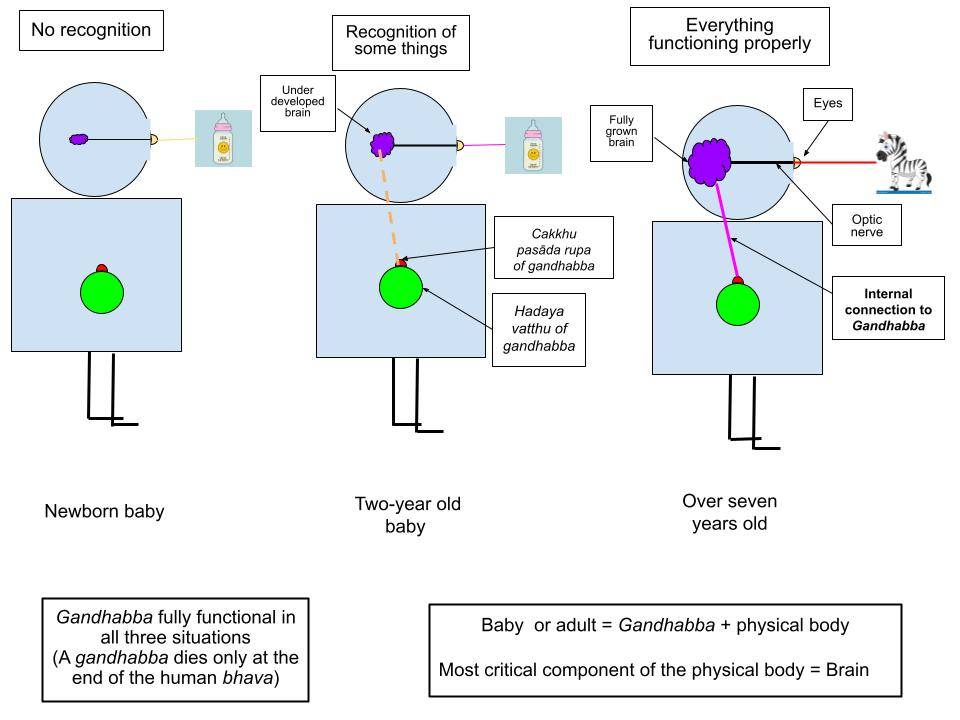
9. The following figure shows why a “baby” or a “grown adult” is the COMBINATION of the mental body (gandhabba) and the physical body.
A human gandhabba may live for many thousand of years. During that time, it can be born with many different physical bodies.
The gandhabba is fully shielded from the outside world by the physical body. That way, gandhabba‘s experience is limited to only those sensory inputs that can come via the physical body. Being trapped in a physical body is a consequence of one’s craving to enjoy “close contact” like tastes, smells, and touch (sex.) But that limits the capabilities for seeing and hearing.
If it comes out of the physical body, a gandhabba can see and hear at long distances; it can also travel far by merely thinking about where to go.
Formation of Neural Networks in the Brain Requires for Recognition (Saññā)
10. A newborn (just born) has not seen anything yet and, thus, has no idea about her milk bottle. She gets used to seeing it with time, and neural connections are made in her brain to identify it (see the above figure.) She understands that it has her food. In the same way, neural networks will be established in her brain (which keeps growing) to identify Mom, Dad, and others in the family, as well as her toys.
Until the brain grows to its full development and most neural connections are established, the baby’s understanding (or perception or saññā)
about the external world will not be complete.
Until the ability to recognize/identify a specific item (saññā) is established, the baby cannot form a like or dislike for it.
11. First, the baby will identify the Mom and start bonding with her. That is the first type of “rāga” or attachment to this world. With time, the baby will start attaching to more things. In the same way, if she does not like a specific food, she may form a dislike (paṭigha) for it.
That is why the Buddha said a newborn has no idea about diṭṭhi, defilements, etc.
Of course, the gandhabba inside the baby's physical body has all saṁyojana and anusayaintact (unless it is a jātiSotapanna.) But they must be triggered by a sensory event for defilements (rāga, dosa, diṭṭhi, etc.) to "come to the surface."
For Defilements to Arise, Saṁyojana/AnusayaMust be Triggered
12. For saṁyojana or anusaya, etc., to be triggered (and to initiate kammaor pañcupādānakkhandha or sakkāyaaccumulation,) the baby must first recognize things (saññā) and form a like or dislike for them.
Even when the brain is fully formed around seven years of age, strong kāma rāga (of a sexual nature) will not arise in a child. That saññāwill grow over time. In other words, a strong kama raga of a sexual nature is not likely to be triggered in a seven-year-old, even though they will have the kāma rāgaanusaya/saṁyojana intact.
“Distorted Saññā” Is Based on Gati
13. The “distorted saññā” is “built-in” to our mental AND physical bodies by kammic energy (via Paṭicca Samuppāda.) That is why it is hard to confirm that it is indeed a “mirage” or a “trick,” as the Buddha emphasized in the “Pheṇapiṇḍūpa Sutta (SN 22.95).”
Human gati differs vastly from those of animals, and within the animal realm, there is a wide variety of gati.
This is a more profound point connected to gati cultivated as a human. For example, those born as pigs accumulated the kammic energy to “be born a pig” by engaging in lowly and “morally rotten” deeds when they were human. Thus, they are reborn as pigs “to like rotten things.” See #5 and #6 of "Vedanā (Feelings) Arise in Two Ways."
14. The “old physical body” that Arahant lives with still plays a critical role in bringing the “distorted saññā” even to the mind of an Arahant(if not in a samāpatti.)
However, Arahant'shadaya vatthu has eliminated all anusaya and saṁyojana. Thus, Arahant‘s mind would not attach to that “distorted saññā” presented by the physical body (or the brain.)
Another way to say the above: “Arahant‘s (and also Anāgami‘s) mind gets to the “kāma dhātu” stage but not to “kāmabhava.”
A Saññā distorcida (e, portanto, os pensamentos impuros) não surgem em um recém-nascido, de acordo com o “Mahāmālukya Sutta (MN 64.)”. Ao examinar isso, podemos aprender sobre o mecanismo que dá origem à “Saññā distorcida” e a conexão entre o Gandhabba e o corpo físico.
5 de janeiro de 2024; revisado em 25 de março de 2025 (gráfico no nº 9 atualizado)
Como discutimos, não há doçura inerente ao açúcar. Da mesma forma, nossas percepções de “música agradável” ou “pessoas atraentes” são “criadas pela mente” devido à “Saññā distorcida”. Veja os itens 5 e 6 de “Vedanā (sentimentos) surgem de duas maneiras”.
Nossas mentes se apegam a esses estímulos sensoriais “agradáveis à mente” e tentam obter mais deles. É aí que começamos a nos envolver em ações, palavras e pensamentos para “obter mais deles” e gerar “pensamentos impuros” (Dasa Akusala).
O problema é que nossas ações, palavras e pensamentos são baseados em Kāya, vaci e ManoSaṅkhāra, dando origem ao sofrimento no futuro. Esses Saṅkhāra levam ao Dasa Akusala (três com ações, quatro com palavras e três com a mente). Veja os ensaios relevantes em “Resultados da pesquisa para Dasa Akusala”.
Isso é o que acontece na etapa “AvijjāPaccayāSaṅkhāra” em Paṭicca Samuppāda.
Importância de compreender “Pessoa = Corpo Mental (Gandhabba) + Corpo Físico”
2. Existe um grande “bloqueio mental” na mente de muitas pessoas para ver o Gandhabba como uma entidade alienígena. Você é o seu “corpo mental”, e o corpo físico é secundário.Seus pensamentos (cittās) surgem em seu corpo mental. Uma vez fora do corpo físico, o corpo mental pode ver, ouvir e pensar de forma independente; é claro que não pode saborear, cheirar ou tocar.
Foi incutido em nossas mentes (principalmente pela ciência moderna) que nosso corpo físico (ou o cérebro) cria pensamentos. Mas o corpo físico é apenas uma “casca” que se torna inútil quando o corpo mental (Gandhabba) emerge dele.
Como discutimos, um Bhava (existência) humano pode durar muitos milhares de anos. É esse “corpo mental” que dura todo esse tempo.
Sua essência não é seu corpo físico ou o cérebro, mas seu corpo mental (Gandhabba).No entanto, o corpo físico e o cérebro desempenham papéis significativos, enquanto o corpo mental está dentro do corpo físico.
Interações mútuas entre o corpo mental e o corpo físico
3. A questão é entender como o Gandhabba (corpo mental) preso dentro do corpo físico recebe estímulos sensoriais do mundo externo. Isso deve ser entendido antes de compreender como o Gandhabbareconhece as coisas no mundo externo (Saññā).
Portanto, o primeiro passo é: como o Gandhabba recebe informações sobre o mundo externo? Como ele vê alguém parado na frente do corpo físico?
Fatos:
O gandhabba consiste apenas em um Hadaya Vatthu (sede da mente) e cinco pasada rupa (Cakkhu, sota, ghāna, jivhā, Kāya).
Se o Gandhabba estiverfora do corpo físico (como em uma experiência fora do corpo, como uma OBE/NDE), ele pode ver e ouvir por si mesmo; veja o gráfico no nº 5 abaixo. Aqui, a visão e a audição acontecem por meio de mecanismos que não compreendemos.
Mas quando o Gandhabba está dentro do corpo físico, ele fica completamente protegido do mundo externo; o corpo físico deve funcionar bem para transmitir sinais sensoriais ao Gandhabba preso dentro dele. Veja primeiro a visão. Para ver algo, os olhos físicos devem funcionar. Esse sinal de luz deve ser transmitido ao cérebro através dos nervos ópticos e processado pelo cérebro. O cérebro DEVE passar essa informação ao Gandhabba (por um mecanismo que não compreendemos totalmente).
Às vezes, durante acidentes ou devido a outras razões médicas, um desses três componentes (olhos físicos, nervos ópticos, função cerebral) pode parar permanente ou temporariamente.
Se a função cerebral parar (temporariamente), o paciente não pode ver, ouvir ou responder de forma alguma.
4. Foi o que aconteceu com a mulher no vídeo a seguir. Ela perdeu temporariamente a função cerebral.
Observações:
Na maioria dos casos, o paciente não tem consciência do mundo externo até que o cérebro se recupere. No entanto, no caso acima, o Gandhabba da paciente saiu de seu corpo e permitiu que ela visse sem a ajuda de seu corpo físico.
O Gandhabba da mulher pode ter saído do corpo paralisado em algum momento. Ele estava na sala quando o Dr. Greyson chegou e o seguiu até a outra sala onde sua amiga estava. O Gandhabba observava e ouvia a conversa entre sua amiga e o Dr. Greyson.
Assim que o tratamento médico restaurou sua função cerebral, ela conseguiu se lembrar da conversa e contar ao Dr. Greyson sobre ela em detalhes. Ela não apenas ouviu, mas também viu todos os detalhes. É por isso que ela percebeu a mancha na gravata do Dr. Greyson!
Portanto, ela foi capaz de ver com seu corpo Gandhabba. Pode haver alguma dúvida sobre isso?
O Gandhabba saindo do corpo físico não é uma ocorrência comum. No entanto, ele mencionou (talvez em outro vídeo) que cerca de 10% de todas as pessoas já experimentaram tal OBE. É mais comum quando os pacientes são submetidos a operações cardíacas, porque o Hadaya Vatthu no corpo mental se sobrepõe ao coração no corpo físico.
Vendo enquanto o Gandhabba está fora e dentro do corpo físico
5. A figura a seguir explica como o Gandhabba vê quando está fora e dentro de um corpo físico.
a. Enquanto está FORA do corpo físico, o Gandhabba vê usando um mecanismo diferente que não envolve luz.
É possível que o cérebro converta a imagem recebida dos olhos (através do nervo óptico) em um tipo de sinal usado pelo Gandhabba enquanto está FORA.
b. Um Gandhabba (enquanto estiver DENTRO do corpo físico) também não verá se os olhos estiverem danificados, mesmo que o cérebro funcione.
c. A questão é que, enquanto estiver DENTRO do corpo físico, um Gandhabba NÃO PODE ver por conta própria. Ele também não pode ouvir, cheirar, etc., se o cérebro não estiver funcionando.
Isso também se aplica à recuperação de memórias “armazenadas” no mundo externo (em viññāna Dhātu). Elas também precisam passar pelo cérebro. Portanto, um Gandhabba fica totalmente isolado do mundo enquanto está DENTRO de um corpo físico. O cérebro desempenha um papel fundamental. Veja “Recuperação de Memórias para Gandhabba em um Corpo Humano”. É uma boa ideia ler este ensaio. Ele fala sobre como o cérebro usa um transmissor e um receptor para trocar informações com viññāna Dhātu (ponto 4). Usaremos isso na próxima etapa.
Isso também acontece enquanto dormimos. O cérebro entra em modo inativo durante o sono. Mas o Gandhabba nunca dorme. No entanto, se ele não receber um sinal do cérebro, não poderá experimentar nada.
Por que um recém-nascido não tem nenhuma percepção, muito menos “visões incorretas”?
6. Agora, vamos examinar a seguinte declaração do Buddha no “Mahāmālukya Sutta (MN 64)”: “Um bebê nem mesmo tem o conceito de ‘Sakkāya’, então como ‘Sakkāya Diṭṭhi’ poderia surgir nele?
Aqui, “Sakkāya” significa “desejar prazeres mundanos”. Assim, “Sakkāya” significa o mesmo que “pañca upādānakkhandha” (convencionalmente traduzido como “agarrar-se aos cinco agregados”).
Nas postagens recentes mencionadas no nº 1 acima, observamos o fato de que nossos desejos por prazeres sensoriais surgem com base na “Saññā distorcida” (ou “percepções distorcidas sobre os estímulos sensoriais”).
Então, por que um recém-nascido não tem essa “Saññā distorcida” sobre os estímulos sensoriais?
7. Conforme enfatizado acima, os pensamentos do bebê surgem no corpo mental, especificamente na “sede da mente” ou “Hadaya Vatthu”.
Mas os sinais sensoriais só podem chegar ao Hadaya Vatthu através do cérebro! Um recém-nascido não tem um cérebro desenvolvido.
O cérebro de um bebê não cresce muito enquanto está no útero. Após o nascimento (ou seja, após sair do útero), leva cerca de sete anos para que o cérebro se desenvolva e compreenda totalmente o mundo externo.
O breve vídeo a seguir explica isso.
8. Além disso, as conexões neurais devem crescer no cérebro para RECONHECER um determinado sinal sensorial. Por exemplo, um recém-nascido não sabe nada sobre “mãe”, “leite”, “brinquedos”, etc. Ele não perceberia NADA no mundo externo.
À medida que o bebê cresce, ele reconhecerá primeiro sua mãe, seu pai, sua família, uma mamadeira, etc., nas primeiras semanas.
Esse bebê NÃO é apenas o corpo físico nem apenas o corpo mental. Esses dois devem trabalhar juntos para dar ao bebê sua identidade e função.
Um bebê ou um adulto é a combinação de Gandhabba e corpo físico
9. A figura a seguir mostra por que um “bebê” ou um “adulto” é a COMBINAÇÃO do corpo mental (Gandhabba) e do corpo físico.
Um Gandhabba humano pode viver por muitos milhares de anos. Durante esse tempo, ele pode nascer com muitos corpos físicos diferentes.
O Gandhabba é totalmente protegido do mundo exterior pelo corpo físico. Dessa forma, a experiência do Gandhabba é limitada apenas às entradas sensoriais que podem vir através do corpo físico. Ficar preso em um corpo físico é uma consequência do desejo de desfrutar de “contato íntimo”, como sabores, cheiros e toque (sexo). Mas isso limita as capacidades de ver e ouvir.
Se sair do corpo físico, um Gandhabba pode ver e ouvir a longas distâncias; ele também pode viajar para longe simplesmente pensando em onde ir.
A formação de redes neurais no cérebro requer reconhecimento (Saññā)
10. Um recém-nascido (que acabou de nascer) ainda não viu nada e, portanto, não tem ideia sobre sua mamadeira. Ele se acostuma a vê-la com o tempo, e conexões neurais são feitas em seu cérebro para identificá-la (veja a figura acima). Ele entende que ela contém sua comida. Da mesma forma, redes neurais serão estabelecidas em seu cérebro (que continua crescendo) para identificar a mãe, o pai e outros membros da família, bem como seus brinquedos.
Até que o cérebro cresça até seu pleno desenvolvimento e a maioria das conexões neurais seja estabelecida, a compreensão (ou percepção ou Saññā
) do
bebê sobre o mundo externo não estará completa.
Até que a capacidade de reconhecer/identificar um item específico (Saññā) seja estabelecida, o bebê não pode formar uma preferência ou aversão por ele.
11. Primeiro, o bebê identificará a mãe e começará a se apegar a ela. Esse é o primeiro tipo de “Rāga” ou apego a este mundo. Com o tempo, o bebê começará a se apegar a mais coisas. Da mesma forma, se ele não gostar de um alimento específico, poderá formar uma aversão (Paṭigha) por ele.
É por isso que o Buddha disse que um recém-nascido não tem noção de diṭṭhi, impurezas, etc.
É claro que o Gandhabba dentro do corpo físico do bebê tem todos os saṁyojana e Anusayaintactos (a menos que seja um JātiSotapanna). Mas eles devem ser desencadeados por um evento sensorial para que as impurezas (Rāga, Dosa, diṭṭhi, etc.) “venham à tona”.
Para que as impurezas surjam, Saṁyojana/Anusayadevem ser acionados
12. Para que saṁyojana ou Anusaya, etc., sejam acionados (e iniciem Kammaou pañcupādānakkhandha ou acumulação de Sakkāya), o bebê deve primeiro reconhecer as coisas (Saññā) e formar uma preferência ou aversão por elas.
Mesmo quando o cérebro está totalmente formado por volta dos sete anos de idade, um forte Kāma Rāga (de natureza sexual) não surgirá em uma criança. Essa Saññācrescerá com o tempo. Em outras palavras, um forte Kāma Rāga de natureza sexual provavelmente não será desencadeado em uma criança de sete anos, mesmo que ela tenha o Anusaya/saṁyojana intacto.
O “Saññā distorcido” é baseado em Gati
13. O “saññā distorcido” é “incorporado” aos nossos corpos mentais E físicos pela energia de Kamma (via Paṭicca Samuppāda). É por isso que é difícil confirmar que se trata realmente de uma “miragem” ou um “truque”, como o Buddha enfatizou no “Pheṇapiṇḍūpa Sutta (SN 22.95)”.
O gati humano difere muito do dos animais, e dentro do reino animal, há uma grande variedade de Gati.
Esta é uma questão mais profunda relacionada à Gati cultivada como humano. Por exemplo, aqueles que nasceram como porcos acumularam a energia Kamma para “nascer como porco” ao se envolverem em ações vis e “moralmente podres” quando eram humanos. Assim, eles renascem como porcos “para gostar de coisas podres”. Veja os itens 5 e 6 de “Vedanā (sentimentos) surgem de duas maneiras”.
14. O “velho corpo físico” com o qual o Arahant vive ainda desempenha um papel crítico em trazer o “Saññā distorcido” até mesmo para a mente de um Arahant(se não em um samāpatti).
No entanto, o Hadaya Vatthu do Arahant eliminou todos os Anusaya e saṁyojana. Assim, a mente do Arahant não se apega àquele “Saññā distorcido” apresentado pelo corpo físico (ou pelo cérebro).
Outra maneira de dizer o acima exposto: “A mente do Arahant (e também do anāgami) chega ao estágio “kāmadhātu”, mas não ao “kāmabhava”.