🏠
⚗️ LABZ MODE — Stardust Overworld  ·  Features experimentais ativas  · 
Living Dhamma · Post 22 / 52 · LD.CC.007

Citta Mano Vinnana Nine Stages Of Mind Contamination

Citta Mano Vinnana: Os nove estágios da contaminação da mente

PD#PNLD.CC.007
SectionLiving Dhamma
Levelintermediate
Reading time13

A mind becomes active only upon receiving a sensory input (nimitta.) The mind of a puthujjana (average human) will automatically attach to that nimitta, turning it into an ārammaṇa. However, strong kamma accumulation (with all nine steps) occurs only if the mind goes through the "taṇhā paccayā upādāna" stage. Even though all of them get to the viññāṇak­khan­dha stage, many may not go through all nine stages.

January 24, 2018; rewritten with new title August 30, 2024

All Nine Stages Contamination May Not Happen

1. The reference to the "nine stage of mind progression" is in the “Paṭic­ca­samup­pāda­ Vibhaṅga”: Tattha katamaṃ saṅ­khā­ra ­pac­cayā viññāṇaṃ? Yaṃ cittaṃ mano mānasan hadayan paṇḍaran mano manāyatanaṃ manindriyaṃ viññāṇaṃ viññā­ṇak­khan­dho tajjā­mano­viñ­ñā­ṇa­dhātuidaṃ vuccati “saṅ­khā­ra­pac­cayā viññāṇaṃ.” 

  • The brief utterance (uddesa) of the steps -- without a detailed explanation -- is in answer to the question: "What is meant by 'saṅ­khā­ra ­pac­cayā viññāṇaṃ'? OR "How does viññāṇa evolve with saṅ­khā­ra"? The nine steps are mentioned as the answer to that question. The generation/accumulation of saṅkhāra does not happen in one step; it could happen over relatively long times. 
  • Therefore, the nine steps of "mind progression" should be analyzed in that context, i.e., when a mind gets attached to a sensory input and becomes increasingly defiled.
  • This progression may not involve all nine steps in all cases. Furthermore, some sensory events last only a fraction of a second, while others may occupy a mind for minutes and even hours, depending on the specific sensory input and one's mindset at that time.
Importance of Understanding the "Mind Contamination" Sequence

2. Answering the question "What is meant by 'saṅ­khā­ra ­pac­cayā viññāṇa'?" leads to the clarification of several critical concepts in Budha Dhamma. The following is a list of the most important:

  1. A "suffering-free" (pabhassara) state of mind is hidden deep inside the mind of any living being. 
  2. That pabhassara mind (or pabhassara citta) is covered by ten layers of saṁsāric bonds (saṁyojana.)
  3. Those saṁyojanās automatically trigger attachment to any sensory input (attachment is to the "distorted saññā" associated with any sensory input.)
  4. Depending on one's gati at that time and the specific sensory input, the mind may go through several more stages of saṅkhāra generation. The mind gets further defiled at each step, and those nine terms refer to those stages. 
  5. In kāma loka, all minds (except for Arahants and Anagamis) go through the first stage of attachment ("purāna kamma" stage with citta, mano, mānasan, and hadayan steps.) Also, see the chart in #10 below, which shows an alternative explanation with bahiddha/ajjhatta viññāṇa; they describe the same process.
  • These details are necessary to understand how pañcupādānakkhandha accumulates via Idappaccayatā Paṭicca Samuppāda. It also helps explain the meaning of "sandiṭṭhika Dhamma." 
  • Until one understands this process, one may be unable to contemplate how to "recover the suffering-free mind" or Nibbāna. The "saṅkhāra generation" NEVER leads to recovering the suffering-free mind," which is possible only via two steps: (i) Controlling the "nava kamma generation" (see the chart in #10 below) with indriya saṁvara (restraining sensory faculties), and (ii) cultivating wisdom (paññā), i.e., by understanding this "mind expansion/contamination" process (see the chart in #10 below.) 
All Minds Have a "Suffering-Free State" Deep Inside

3.  As we have discussed, there is a "suffering-free, pabhassara sate" of the mind deep inside the mind of any sentient being, but it is covered with ten layers of saṁsāric bonds (saṁyojana.) See "Uncovering the Suffering-Free (Pabhassara) Mind."

  • Because of the presence of the ten layers of saṁyojana, the mind cannot discern the "real nature of the sensory input." Instead, the ten saṁyojana force the mind to "see/discern" an "altered version of the sensory input." 
  • Based on the number of saṁyojana associated with a given mind, it automatically generates sankappa (mano saṅkhāra). It is the first stage of kamma accumulation with very subtle and weak kamma due to ignorance of the "real nature of things" or "yathā bhūta." (Here, "yathā" means "truth" and "bhūta" refers to "all living and inert things.") See "Bhūta and Yathābhūta – What Do They Really Mean."

4. Since Arahants have cultivated yathā bhūta nana, their minds do not reach the purāna kamma stage for sensory inputs.

  • They experience the "distorted saññā" associated with any sensory input (at the "bahiddha viññāna" stage), but their minds do not get attached.
  • Note that bahiddha viññāna (which comes with "distorted saññā") is not the same as the "pabhassara citta," but it is still defilement-free (no rāga, dosa, moha.) An Arahant can experience the "pabhassara citta" while in Arahant-phala Samāpatti. That is a technical detail and not critical to understand.
The Nine Stages of "Expansion/Contamination" of a Mind

5. Knowing the nine possible steps is beneficial. Let us take a specific event: Suppose the sensory input (ārammaṇa) is seeing a beautiful woman. The following is a simple account, leaving out some details that are not necessary here.

  • As we said above, at the first citta stage, one is only aware that a thought object came to the mind via the eyes and the brain.
  • Then, in the manō stage, the mind “measures” or “compares” (that is why it is called the “manō” stage) with past experiences to decide whether the object is a tree, a car, a man, a woman, etc. In this case, it determines that it is a woman.
  • The “mānasan” stage decides on specific connections or features of the nimitta. In this case, it turns out that it is a woman. Furthermore, it is specific: it perceives the woman as “beautiful.” In the same way, the mind of a human (whether an average human or an Arahant) perceives honey to be sweet, the odor of feces is repulsive, etc. Thus, such “saññā” are built-in for anyone born human. This subject requires an in-depth analysis: “Sotapanna Stage via Understanding Perception (Saññā).
  • All the above steps occur in a split second; no "conscious thinking" is involved.

6. The first two steps occur for any human, including an Arahant or the Buddha. In particular, in the “mānasan” stage, anyone born human will automatically generate specific saññā common to all humans.

  • For example, the Buddha was able to differentiate between Ven. Ananda, Ven. Sāriputta, Lady Visāka, or King Kosala, and addressed them accordingly. Furthermore, he would see Lady Visāka as a beautiful woman or Ven. Lakuṇḍakabhaddiya as ugly by “human standards”: “Lakuṇḍakabhaddiya Sutta (SN 21.6).”
  • In fact, in the “Metta Sutta (Kp 9)“: “Mānasan bhāva ye aparimāṇaṁ..” means to cultivate “mānasan” to the optimum level. That way, one can quickly figure out how to deal with any situation.
  • See “Saññā – What It Really Means” and “Saññā Gives Rise to Most of the Vedanā We Experience.”
  • However, the mind of a Buddha or Arahant will not reach the next stage through attachment to that ārammaṇa.

7. At the next step of the “hadayan” stage, an average human may attach to the “saññā” generated at the  “mānasan” stage. This step also occurs automatically, determined by the saṁyojana associated with a given mind.

  • In our example of a beautiful woman, people attach to that sight at different levels, some more than others.
  • However, whether they will pursue that woman will depend on the person’s mindset (gati) and other conditions present at that time. For example, a lustful man, while drunk, may generate lustful thoughts about the woman. 

8. Proceeding to the next stage of “paṇḍaran,” that feeling established at the “hadayan” stage strengthens depending on the conditions at that time. This is similar to the "taṇhā paccayā upādāna" step in Paṭicca Samuppāda.

  • In the above example, the drunk, lustful man may start generating thoughts about raping the woman if no one is around.
  • It is also important to note that it may go the opposite way for an arch-enemy. Here, one will generate bad feelings about such a person. If such feelings intensify, one may think about hitting that person.

9. Now comes the next stage of “manō manāyatanam.” Here, one’s mind becomes an “āyatana and “receptive” to proceeding with the rape and may start giving it serious thought. He will begin planning how to proceed.

  • All this time, he keeps watching the woman, and his lust will also grow, and at some point, all else will be forgotten to give priority to the task of raping the woman. This is the “mana indriyam stage.  This is where the "mano" (defiled mind) becomes stronger, i.e., indriya. This corresponds to the “parilāha stage,” where the mind becomes impatient to “proceed with the task” or  “a sense of urgency to act on it.” See #7 of “Contamination of a Human Mind – Detailed Analysis.”
  • At the viññāna stage, one’s mind is removed from “ñāna” or wisdom or “the reality of nature.” As long as one has worldly desires (i.e., cravings), one has not stopped the viññāna stage (i.e., until one becomes an Arahant).
  • The last stage of viññānakkhandha embodies the fact that viññāna has taken into account the past events (atīta) and future expectations (anāgata), as well as the conditions at the current (paccuppanna) moment. It has taken into account the ajjhatta and bahiddda stages (that we recently discussed in detail). It has also taken into account the coarse (olārika) and fine/subtle (sukumakamma accumulated, all lower (hīna) and higher (paṇīta) realms it has experienced, whether that mind is far away from Nibbāna (dure) or close to (santike) it. In other words, it represents the current (paccuppanna) status of the mind based on all those factors.
  • Note that the 11 categories discussed above apply to each entity (rupa, vedanā, saññā, saṅkhāra, viññāṇa) in the five aggregates: “Khandha Sutta (SN 22.48).”
Nine Steps Occur in Two Stages: Purāna and New Kamma

10. The process can be separated into two distinct stages called "purāna kamma" and "nava kamma." Furthermore, the "nine-step process" can be described in different ways. We have used the following chart to discuss the "progression of the mind" somewhat differently in "Purāna and Nava Kamma – Sequence of Kamma Generation."
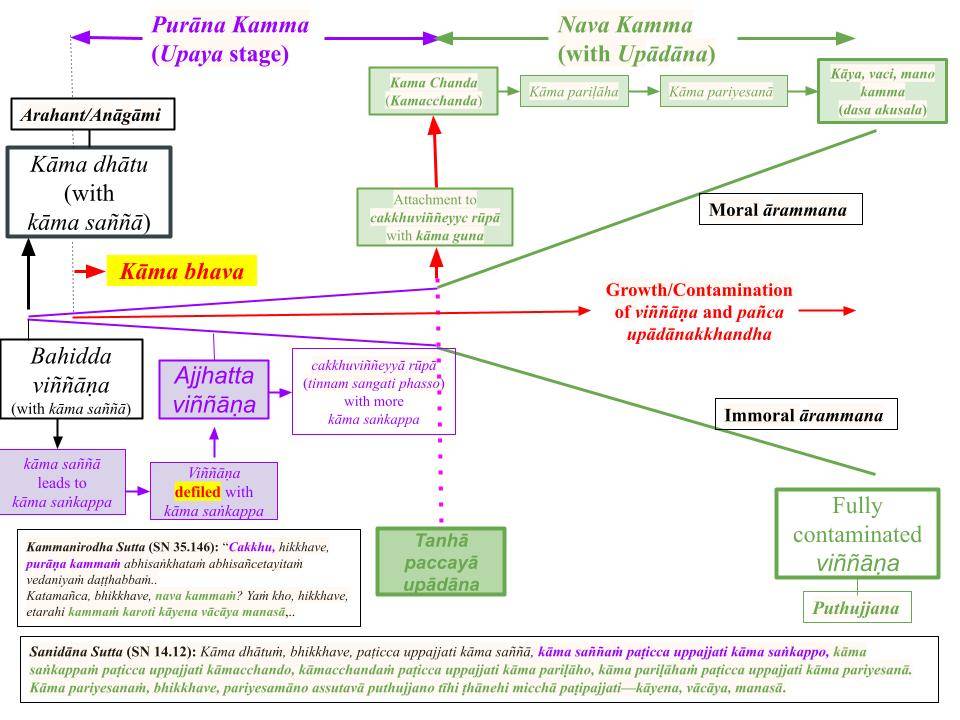
Download/Print: Purāna and Nava Kamma – 2- revised

  • The point is that an average human ALWAYS proceeds away from the bahiddha viññā­ṇa stage (which is close to the "suffering-free mind") and toward the viññānakkhandha (contaminated) stage. 
  • The “evolvement” or the progression of a citta to viññā­ṇak­khan­dha is a “progression in the wrong direction” away from the "suffering-free mind." That is the mindset of a puthujjana to “go with the flow” or “anusotagāmī.”
  • Only a Noble Person (at or above the Sotapanna stage) can proceed toward the "suffering-free mind" or Nibbāna. That is “paṭisotagāmī,” the opposite of anusotagāmī. See “Anusota Sutta (AN 4.5).” One must comprehend this to practice Satipaṭṭhāna.
  • Now, let us discuss some issues with the terminology.
Citta - Meaning in Abhdhamma Versus suttās

11. In Abhidhamma analyses, citta represents a "unit of cognition" that lasts only a billionth of a second and has only seven cetasika (mental factors that arise with it). However, in most cittās, citta refers to the "mind" in general. 

  • For example, the "Rūpādivagga (AN 1.1-10)" states,  “Nāhaṁ, bhikkhave, aññaṁ ekarūpampi samanupassāmi yaṁ evaṁ purisassa cittaṁ pariyādāya tiṭṭhati yathayidaṁ, bhikkhave, itthirūpaṁ." OR “Bhikkhus, I do not see a single sight that occupies a man’s mind like the sight of a woman."
  • All ten suttās point out some key features of men's and women's minds. The word "citta" is used here not to represent the basic unit of cognition (as in Abhidhamma) but to refer to the "mind" in general.
  • Furthermore, in the suttās, all three words citta, mano, and viññāna may be used to indicate "mind." See, for example, "Assutavā Sutta (SN 12.61)" where it says, "Yañca kho etaṁ, bhikkhave, vuccati cittaṁ itipi, mano itipi, viññāṇaṁ itipi, tatrāssutavā puthujjano nālaṁ nibbindituṁ nālaṁ virajjituṁ nālaṁ vimuccituṁ." OR "But when it comes to which is called ‘citta,’ ‘mano’ or ‘viññāṇa’ (all refer to the mind), an unlearned ordinary person is unable to become disillusioned, dispassionate, or freed (because one considers it to be 'one's own')."
  • It is easier to remember as follows: The mind starts at the citta stage, inevitably goes through the "mano" stage, and ends up in the viññāna stage. That is why those three terms are interchangeably used in the suttās.
More Examples - Citta as Mind

12. The "Paduṭṭhacitta Sutta (Iti 20)" states, “Idhāhaṁ, bhikkhave, ekaccaṁ puggalaṁ paduṭṭha cittaṁ evaṁ cetasā ceto paricca pajānāmi: imamhi cāyaṁ samaye puggalo kālaṁ kareyya yathābhataṁ nikkhitto evaṁ niraye’." OR “Bhikkhus, when I see the "corrupt mind" of a person, I understand (or I can see): If this person were to die right now, they would be born in hell (niraya)."

  • In the "Maṅgala Sutta (Kp 5)": "Phuṭṭhassa lokadhammehi, cittaṁ yassa na kampati" OR "When touched by worldly conditions, their mind does not tremble." 
  • In all those examples, "citta" does not refer to the "unit of cognition" but to a "mind" in general.
  • Therefore, in the Sutta Piṭaka, the words citta, mano, and viññāna all refer to a "mind." A mind's "nine stages of expansion/contamination" may occur over a relatively long time. 
Examples - Mano as Mind

13. The "Manonivāraṇa Sutta (SN 1.24)": 

Yato yato mano nivāraye,                                                                       “Whatever you’ve shielded the mind from
Na dukkhameti naṁ tato tato;                                                                    can’t cause you suffering. 
Sa sabbato mano nivāraye,                                                                          So you should shield the mind from everything,

Sa sabbato dukkhā pamuccatī”ti.                                                            then you’re freed from all suffering.

Na sabbato mano nivāraye,                                                                       “You needn’t shield the mind from everything.
Na mano saṁyatattamāgataṁ;                                                                    When the mind is under control, 

Yato yato ca pāpakaṁ,                                                                                   you need only shield the mind 

Tato tato mano nivāraye”ti.                                                                        from engaging in pāpa kamma."

  • The Buddha frequently used the word "mano" for the mind in general. 
  • I quoted the complete sutta because it is informative in other ways, too. The first verse was cited by a Deva, who says the mind should not be exposed to anything. But the Buddha, in the second verse, says the mind should not be exposed only to pāpa (or akusala) kamma.We need to expose the mind to Buddha Dhamma to be free of suffering!
One Must Understand the "Suffering-Free" Mind to Cultivate Satipaṭṭhāna

14. The “Accharāsaṅghātavagga (AN 1.51-60) has two very short suttās. Here is the first suttaPabhassa­ra­midaṃ, bhikkhave, cittaṃTañca kho āgantukehi upakkilesehi upakkiliṭṭhaṃ. Taṃ assutavā puthujjano yathābhūtaṃ nappajānāti. Tasmā ‘assutavato puthujjanassa cittabhāvanā natthī’ti vadāmī”ti.

Translated: “Bhikkhus, a mind is of pabhassara nature. That mind is contaminated by defilements (keles or kilesa).  A normal human who has not heard my Dhamma (assutavā puthujjano) is unaware of this true nature. I do not recommend citta bhāvana to them. By “citta bhāvana” the Buddha means Satipaṭṭhāna/Ānāpānasati

  • The second sutta states, “Pabhassa­ra­midaṃ, bhikkhave, cittaṃTañca kho āgantukehi upakkilesehi vippamuttaṁ. Taṃ sutavā ariyasāvako yathābhūtaṁ pajānāti. Tasmā ‘sutavato ariyasāvakassa cittabhāvanā atthī’ti vadāmī”ti.

Translated: “Bhikkhus, a mind is of pabhassara nature. Once uncovered, it cannot be contaminated by defilements (keles or kilesa).  A Noble Person who has heard my Dhamma (sutavā ariyasāvako) knows this true nature. I recommend citta bhāvana to them”. 

What Is a Pabhassara Citta?

15. What is meant by “pabhassara“?

  • The word comes from three sounds at the root: “pa” means again and again, “bha” is related to “bhava, “and “sara” means “to engage/participate” (“සැරිසැරීම” in Sinhala.) Thus, a “pabhasara citta” with only one “s” in the word (NOT pabhassara) is a contaminated citta that will lead to the saṁsāric journey or the rebirth process.
  • The opposite of “pabha sara” is “pabha assara,” where “assara” means “not take part in.” It rhymes with “pabhassara.
  • Thus, someone who has cleansed the mind to generate pabhassara citta is not liable to be reborn among the 31 realms, i.e., only an Arahant can generate “pabhassara citta.
  • See “Pabhassara Citta, Radiant Mind, and Bhavaṅga” for details.

Note: This is a rewritten version of an old  post, "Citta Evolving To Viññāna And Viññākkhanda In Nine Steps." 

A mente só se torna ativa ao receber um estímulo sensorial (Nimitta). A mente de um Puthujjana (ser humano comum) se apega automaticamente a esse Nimitta, transformando-o em um Ārammaṇa. No entanto, um forte acúmulo de Kamma (com todas as nove etapas) só ocorre se a mente passar pela fase “Taṇhā Paccayā Upādāna”. Embora todos cheguem ao estágio viññāṇak­khan­dha, muitos podem não passar por todos os nove estágios.

24 de janeiro de 2018; reescrito com novo título em 30 de agosto de 2024

A contaminação das nove etapas pode não ocorrer

1. A referência aos “nove estágios da progressão da mente” está no “Paṭicca-samuppāda-Vibhaṅga”: Tattha katamaṃ saṅkhāra paccayā viññāṇaṃ? Yaṃ cittaṃ mano mānasan hadayan paṇḍaran mano manāyatanaṃ manindriyaṃ viññāṇaṃ viññā­ṇak­khan­dho tajjā­mano­viñ­ñā­ṇa­dhātuidaṃ vuccati “saṅ­khā­ra­pac­cayā viññāṇaṃ.” 

  • A breve declaração (uddesa) das etapas — sem uma explicação detalhada — é a resposta à pergunta: “O que significa ‘saṅ­khā­ra ­pac­cayā viññāṇaṃ?” OU “Como o Viññāṇa evolui com o Saṅkhāra? As nove etapas são mencionadas como resposta a essa pergunta. A geração/acumulação de Saṅkhāra não ocorre em uma única etapa; ela pode ocorrer ao longo de períodos relativamente longos. 
  • Portanto, as nove etapas da “progressão da mente” devem ser analisadas nesse contexto, ou seja, quando a mente se apega a um estímulo sensorial e se torna cada vez mais contaminada.
  • Essa progressão pode não envolver todas as nove etapas em todos os casos. Além disso, alguns eventos sensoriais duram apenas uma fração de segundo, enquanto outros podem ocupar a mente por minutos e até horas, dependendo do estímulo sensorial específico e do estado mental da pessoa naquele momento.
Importância de compreender a sequência da “contaminação da mente”

2. Responder à pergunta “O que significa ‘saṅ­khā­ra ­pac­cayā Viññāṇa?” leva ao esclarecimento de vários conceitos críticos no Budha Dhamma. A seguir, uma lista dos mais importantes:

  1. Um estado mental “livre de sofrimento” (pabhassara) está oculto nas profundezas da mente de qualquer ser vivo. 
  2. Essa mente pabhassara (ou pabhassara Citta) está coberta por dez camadas de laços samsáricos (saṁyojana).
  3. Esses saṁyojanās desencadeiam automaticamente o apego a qualquer estímulo sensorial (o apego é ao “Saññā distorcido” associado a qualquer estímulo sensorial).
  4. Dependendo da sua Gati naquele momento e do estímulo sensorial específico, a mente pode passar por vários outros estágios de geração de Saṅkhāra. A mente fica ainda mais contaminada a cada etapa, e esses nove termos se referem a esses estágios. 
  5. No Kāma Loka, todas as mentes (exceto Arahants e Anāgāmīs) passam pelo primeiro estágio de apego (estágio “purāna kamma” com as etapas Citta, Mano, Mānasan e Hadayan). Veja também o gráfico no nº 10 abaixo, que mostra uma explicação alternativa com bahiddha/ajjhatta Viññāṇa; eles descrevem o mesmo processo.
  • Esses detalhes são necessários para compreender como pañcupādānakkhandha se acumula por meio do Idappaccayatā Paṭicca Samuppāda. Isso também ajuda a explicar o significado de “sandiṭṭhika Dhamma”. 
  • Até que se compreenda esse processo, pode-se ser incapaz de contemplar como “recuperar a mente livre do sofrimento” ou Nibbāna. A “geração de Saṅkhāra” NUNCA leva à recuperação da mente livre do sofrimento, o que só é possível por meio de duas etapas: (i) Controlar a “geração de nava Kamma” (veja o gráfico no nº 10 abaixo) com Indriya saṁvara (restrição das faculdades sensoriais), e (ii) cultivar sabedoria (Paññā), ou seja, compreendendo esse processo de “expansão/contaminação da mente” (veja o gráfico no nº 10 abaixo). 
Todas as mentes têm um “estado livre de sofrimento” no seu íntimo

3. Como discutimos, existe um “pabhassara sate, livre de sofrimento” da mente no fundo da mente de qualquer ser senciente, mas ele está coberto por dez camadas de laços samsáricos (saṁyojana). Veja “Descobrindo a Mente Livre de Sofrimento (Pabhassara)”.

  • Devido à presença das dez camadas de saṁyojana, a mente não consegue discernir a “verdadeira natureza da informação sensorial”. Em vez disso, os dez saṁyojana forçam a mente a “ver/discernir” uma “versão alterada da informação sensorial”. 
  • Com base no número de saṁyojana associados a uma determinada mente, ela gera automaticamente sankappa (Mano Saṅkhāra). É o primeiro estágio do acúmulo de Kamma com Kamma muito sutil e fraco devido à ignorância da “verdadeira natureza das coisas” ou “yathā bhūta”. (Aqui, yathā” significa “verdade” e “bhūta” refere-se a “todas as coisas vivas e inertes”.) Veja “Bhūta e Yathābhūta – O que eles realmente significam”.

4. Como os Arahants cultivaram yathā bhūta nana, suas mentes não atingem o estágio de purāna Kamma em relação aos estímulos sensoriais.

  • Eles experimentam o Saññā distorcido” associado a qualquer estímulo sensorial (no estágio “bahiddha viññāna”), mas suas mentes não se apegam.
  • Observe que bahiddha viññāna (que vem com “Saññā distorcida”) não é o mesmo que “pabhassara citta, mas ainda assim é livre de impurezas (sem Rāga, Dosa, Moha). Um Arahant pode experimentar o “pabhassara citta” enquanto estiver em Phala Samāpatti. Esse é um detalhe técnico e não é essencial para a compreensão.
Os Nove Estágios de “Expansão/Contaminação” de uma Mente

5. Conhecer os nove passos possíveis é benéfico. Tomemos um evento específico: suponhamos que a entrada sensorial (Ārammaṇa) seja ver uma mulher bonita. O que se segue é um relato simples, omitindo alguns detalhes que não são necessários aqui.

  • Como dissemos acima, no primeiro estágio Citta, a pessoa apenas percebe que um objeto de pensamento chegou à mente através dos olhos e do cérebro.
  • Então, no estágio manō, a mente “avalia” ou “compara” (por isso é chamado de estágio “manō”) com experiências passadas para decidir se o objeto é uma árvore, um carro, um homem, uma mulher, etc. Neste caso, ela determina que se trata de uma mulher.
  • O estágio “mānasan” decide sobre conexões ou características específicas do Nimitta. Nesse caso, verifica-se que é uma mulher. Além disso, é específico: percebe a mulher como “bela”. Da mesma forma, a mente de um ser humano (seja um ser humano comum ou um Arahant) percebe o mel como doce, o odor de fezes como repulsivo, etc. Assim, tais “Saññā” são inerentes a qualquer pessoa nascida humana. Este assunto requer uma análise aprofundada: “Estágio de Sotāpanna por meio da Percepção Compreensiva (Saññā)”.
  • Todas as etapas acima ocorrem em uma fração de segundo; nenhum “pensamento consciente” está envolvido.

6. As duas primeiras etapas ocorrem para qualquer ser humano, incluindo um Arahant ou o Buddha. Em particular, no estágio “mānasan”, qualquer pessoa nascida humana gerará automaticamente Saññā específicas comuns a todos os seres humanos.

  • Por exemplo, o Buddha era capaz de diferenciar entre o Venerável Ananda, o Venerável Sāriputta, a Senhora Visāka ou o Rei Kosala, e dirigia-se a eles de acordo com isso. Além disso, ele via a Senhora Visāka como uma mulher bonita ou o Venerável Lakuṇḍakabhaddiya como feio segundo os “padrões humanos”: “Lakuṇḍakabhaddiya Sutta (SN 21.6).”
  • De fato, no “Mettā Sutta (Kp 9)”: “Mānasan bhāva ye aparimāṇaṁ..” significa cultivar “mānasan” até o nível ideal. Dessa forma, pode-se rapidamente descobrir como lidar com qualquer situação.
  • Veja “Saññā – O que realmente significa” e “Saññā dá origem à maior parte da Vedanā que experimentamos”.
  • No entanto, a mente de um Buddha ou Arahant não alcançará o próximo estágio por meio do apego a esse Ārammaṇa.

7. Na etapa seguinte do estágio “hadayan”, um ser humano comum pode apegar-se ao “Saññā” gerado no estágio “mānasan”. Essa etapa também ocorre automaticamente, determinada pelo saṁyojana associado a uma determinada mente.

  • Em nosso exemplo de uma mulher bonita, as pessoas se apegam àquela visão em diferentes níveis, algumas mais do que outras.
  • No entanto, se irão perseguir essa mulher dependerá da mentalidade (Gati) da pessoa e de outras condições presentes naquele momento. Por exemplo, um homem lascivo, enquanto estiver bêbado, pode gerar pensamentos lascivos sobre a mulher. 

8. Passando para o próximo estágio de “paṇḍaran”, esse sentimento estabelecido no estágio “hadayan” se fortalece dependendo das condições naquele momento. Isso é semelhante à etapa “Taṇhā Paccayā Upādāna” no Paṭicca Samuppāda.

  • No exemplo acima, o homem bêbado e lascivo pode começar a gerar pensamentos sobre estuprar a mulher se não houver ninguém por perto.
  • Também é importante observar que isso pode ocorrer de maneira oposta em relação a um arqui-inimigo. Nesse caso, a pessoa gerará sentimentos negativos em relação a tal indivíduo. Se tais sentimentos se intensificarem, a pessoa pode pensar em agredir essa pessoa.

9. Agora vem a próxima etapa de “manō manāyatanam”. Aqui, a mente se torna um “Āyatana” e “receptiva” para prosseguir com o estupro, podendo começar a pensar seriamente nisso. Ele começará a planejar como proceder.

  • Durante todo esse tempo, ele continua observando a mulher, e sua luxúria também crescerá; em algum momento, tudo o mais será esquecido para dar prioridade à tarefa de estuprar a mulher. Esse é o estágio “Mana indriyam”.  É aqui que o “Mano” (mente contaminada) se torna mais forte, ou seja, Indriya. Isso corresponde ao “estágio parilāha”, em que a mente se torna impaciente para “prosseguir com a tarefa” ou “uma sensação de urgência para agir”. Veja o nº 7 de “Contaminação da Mente Humana – Análise Detalhada”.
  • No estágio viññāna, a mente se afasta do “ñāna” ou sabedoria ou “da realidade da natureza”. Enquanto a pessoa tiver desejos mundanos (ou seja, ânsias), ela não terá superado o estágio viññāna (ou seja, até se tornar um Arahant).
  • O último estágio de viññānakkhandha incorpora o fato de que viññāna levou em consideração os eventos passados (atīta) e as expectativas futuras (anāgata), bem como as condições no momento presente (paccuppanna). Ele levou em consideração os estágios ajjhatta e bahiddha (que discutimos recentemente em detalhes). Também levou em consideração o Kamma grosseiro (olārika) e fino/sutil (sukuma) acumulado, todos os reinos inferiores (hīna) e superiores (paṇīta) que experimentou, independentemente de a mente estar distante do Nibbāna (dure) ou próxima (santike) dele. Em outras palavras, representa o estado atual (paccuppanna) da mente com base em todos esses fatores.
  • Observe que as 11 categorias discutidas acima se aplicam a cada entidade (Rūpa, Vedanā, Saññā, Saṅkhāra, Viññāṇa) nos cinco agregados: “Khandha Sutta (SN 22.48).”
Nove etapas ocorrem em duas fases: Purāna e Novo Kamma

10. O processo pode ser dividido em dois estágios distintos chamados “purāna kamma” e “nava kamma”. Além disso, o “processo de nove etapas” pode ser descrito de diferentes maneiras. Utilizamos o quadro a seguir para discutir a “progressão da mente” de maneira um pouco diferente em “Purāna e Nava Kamma – Sequência da Geração de Kamma”.

Baixar/Imprimir: Purāna e Nava Kamma – 2 – revisado”

  • A questão é que um ser humano comum SEMPRE se afasta do estágio bahiddha viññā­ṇa (que está próximo da “mente livre do sofrimento”) e se aproxima do estágio viññānakkhandha (contaminado). 
  • A “evolução” ou a progressão de um Citta para viññāṇakkhandha é uma “progressão na direção errada”, afastando-se da “mente livre do sofrimento”. Essa é a mentalidade de um Puthujjana de “seguir a corrente” ou “anusotagāmī”.
  • Somente uma Pessoa Nobre (no estágio de Sotāpanna ou acima) pode avançar em direção à “mente livre do sofrimento” ou Nibbāna. Isso é “paṭisotagāmī”, o oposto de anusotagāmī. Veja “Anusota Sutta (AN 4.5)”. É preciso compreender isso para praticar Satipaṭṭhāna.
  • Agora, vamos discutir algumas questões relacionadas à terminologia.
Citta – Significado no Abhidhamma versus nos Suttā

11. Nas análises do Abhidhamma, Citta representa uma “unidade de cognição” que dura apenas um bilionésimo de segundo e possui apenas sete Cetasika (fatores mentais que surgem com ela). No entanto, na maioria dos cittās, Citta refere-se à “mente” em geral. 

  • Por exemplo, o “Rūpādivagga (AN 1.1-10)” afirma:  “Nāhaṁ, bhikkhave, aññaṁ ekarūpampi samanupassāmi yaṁ evaṁ purisassa cittaṁ pariyādāya tiṭṭhati yathayidaṁ, bhikkhave, itthirūpaṁ.” OU “Bhikkhū, não vejo nenhuma outra visão que ocupe a mente de um homem como a visão de uma mulher.”
  • Todos os dez Suttā apontam algumas características-chave das mentes dos homens e das mulheres. A palavra “Citta” é usada aqui não para representar a unidade básica da cognição (como no Abhidhamma), mas para se referir à “mente” em geral.
  • Além disso, nos suttas, todas as três palavras Citta, Mano e Viññāna podem ser usadas para indicar “mente”. Veja, por exemplo, o “Assutavā Sutta (SN 12.61)”, onde se diz: “Yañca kho etaṁ, bhikkhave, vuccati cittaṁ itipi, Mano itipi, viññāṇaṁ itipi, tatrāssutavā puthujjano nālaṁ nibbindituṁ nālaṁ virajjituṁ nālaṁ vimuccituṁ.” OU “Mas quando se trata do que é chamado de ‘Citta,Mano’ ou ‘Viññāṇa’ (todos se referem à mente), uma pessoa comum e ignorante é incapaz de se desiludir, se desapegar ou se libertar (porque a considera como ‘sua’).”
  • É mais fácil lembrar da seguinte forma: a mente começa no estágio Citta, passa inevitavelmente pelo estágio “Mano” e termina no estágio viññāna. É por isso que esses três termos são usados de forma intercambiável nos Suttā.
Mais exemplos — Citta como mente

12. O “Paduṭṭhacitta Sutta (Iti 20)” afirma: “Idhāhaṁ, bhikkhave, ekaccaṁ puggalaṁ paduṭṭha cittaṁ evaṁ cetasā ceto paricca pajānāmi: imamhi cāyaṁ samaye puggalo kālaṁ kareyya yathābhataṁ nikkhitto evaṁ niraye’.” OU “Bhikkhūs, quando vejo a ‘mente corrupta’ de uma pessoa, compreendo (ou consigo ver): Se essa pessoa morresse agora mesmo, renasceria no inferno (Niraya).”

  • No “Maṅgala Sutta (Kp 5)”: “Phuṭṭhassa lokadhammehi, cittaṁ yassa na kampati” OU “Quando tocada pelas condições mundanas, sua mente não treme.” 
  • Em todos esses exemplos, “Citta” não se refere à “unidade de cognição”, mas a uma “mente” em geral.
  • Portanto, no Sutta Piṭaka, as palavras Citta, Mano e viññāna referem-se todas a uma “mente”. Os “nove estágios de expansão/contaminação” de uma mente podem ocorrer ao longo de um período relativamente longo. 
Exemplos – Mano como Mente

13. O “Manonivāraṇa Sutta (SN 1.24)”: 

Yato yato Mano nivāraye, “O que quer que você tenha protegido a mente de
Na dukkhameti naṁ tato tato;                                                                    isso não pode causar-te sofrimento.
Sa sabbato mano nivāraye, Portanto, deves proteger a mente de tudo,

Sa sabbato dukkhā pamuccatī”ti. então você estará livre de todo sofrimento.

Na sabbato Mano, “Você não precisa proteger a mente de tudo.
Na mano saṁyatattamāgataṁ; Quando a mente está sob controle,

Yato yato ca pāpakaṁ,                                                                                   basta proteger a mente

Tato tato Mano nivāraye”ti.                                                                        de se envolver em pāpa Kamma.”

  • O Buddha frequentemente usava a palavra “Mano” para se referir à mente em geral. 
  • Citei o sutta completo porque ele também é informativo de outras maneiras. O primeiro verso foi citado por um Deva, que diz que a mente não deve ser exposta a nada. Mas o Buddha, no segundo verso, diz que a mente não deve ser exposta apenas ao pāpa (ou Akusala) Kamma. Precisamos expor a mente ao Buddha Dhamma para nos livrarmos do sofrimento!
É preciso compreender a mente “livre do sofrimento” para cultivar Satipaṭṭhāna

14. O “Accharāsaṅghātavagga (AN 1.51-60) contém duas Suttā muito curtas. Aqui está a primeira Suttā: Pabhassa­ra­midaṃ, bhikkhave, cittaṃTañca kho āgantukehi upakkilesehi upakkiliṭṭhaṃ. Taṃ assutavā puthujjano yathābhūtaṃ nappajānāti. Tasmā ‘assutavato puthujjanassa cittabhāvanā natthī’ti vadāmī”ti.

Traduzido:Bhikkhū, a mente é de natureza pabhassara. Essa mente está contaminada por impurezas (Kilesā ou Kilesa).  Um ser humano comum que não ouviu meu Dhamma (assutavā puthujjano) não tem consciência dessa verdadeira natureza. Não recomendo citta bhāvana a eles. Por “citta bhāvana”, o Buddha se refere a Satipaṭṭhāna/Ānāpānasati

  • O segundo sutta afirma: “Pabhassa­ra­midaṃ, bhikkhave, cittaṃ. Tañca kho āgantukehi upakkilesehi vippamuttaṁ. Taṃ sutavā ariyasāvako yathābhūtaṁ pajānāti. Tasmā ‘sutavato ariyasāvakassa cittabhāvanā atthī’ti vadāmī”ti.

Traduzido:Bhikkhūs, a mente é de natureza pabhassara. Uma vez revelada, ela não pode ser contaminada por impurezas (Kilesa ou Kilesā). Uma Pessoa Nobre que ouviu meu Dhamma (sutavā ariyasāvako) conhece essa verdadeira natureza. Eu recomendo Citta bhāvana a eles”. 

O que é um Pabhassara Citta?

15. O que significa “pabhassara”?

  • A palavra deriva de três sons na raiz: “pa” significa repetidamente, “bha” está relacionado a “Bhava”, e “sara” significa “engajar-se/participar” (“සැරිසැරීම” em cingalês). Assim, um “pabhasara Citta” com apenas um “s” na palavra (NÃO pabhassara) é um Citta contaminado que levará à jornada samsárica ou ao processo de Renascimento.
  • O oposto de “pabha sara” é “pabha assara”, onde “assara” significa “não participar”. Rima com “pabhassara”.
  • Assim, alguém que purificou a mente para gerar pabhassara Citta não está sujeito a renascer entre os 31 reinos, ou seja, apenas um Arahant pode gerar “pabhassara Citta”.
  • Veja “Pabhassara Citta, Mente Radiante e Bhavaṅga” para mais detalhes.

Nota: Esta é uma versão reescrita de um ensaio antigo, “Citta Evoluindo para Viññāna e Viññākkhanda em Nove Passos”.