Revised February 27, 2019; July 16, 2022; September 10, 2002 (#11)
Humans have many gati (gati) or character qualities. These character qualities lead to one's future existence (bhava). It is that important.
1. We see that there are three major "bhava" or existence corresponding to the three major levels of existence that the 31 realms can be divided into kāma bhava, rūpa bhava, and arūpa bhava.
- Each can now be subdivided into the 31 realms; see "31 Realms of Existence".
- These living beings with kāma bhava live in kāma lōka: 4 apāyās, one human, and six deva realms. Those with rūpa bhava live in rūpa lōka made of 16 rūpavacara Brahma realms. Those with arūpa bhava live in the four arūpavacara Brahma realms in the arūpa lōka.
2. The following chart shows the division of the 11 kāma lōka realms into the four apāyās, the human realm, and six deva realms.
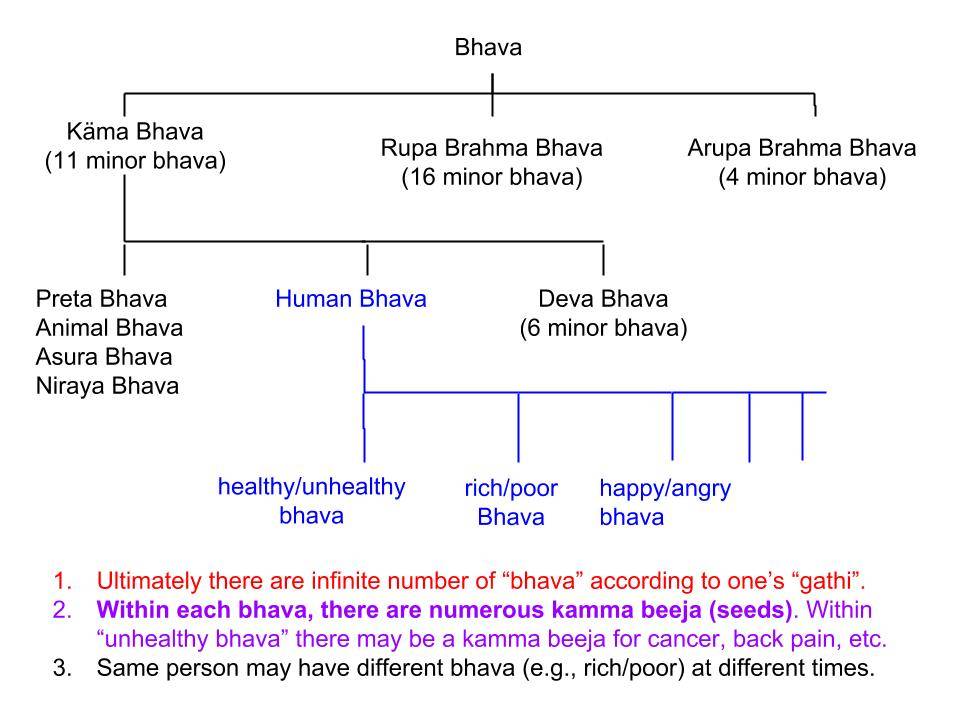
Click to open and print the above chart: "Bhava, Gathi, Kamma Beeja Chart."
- The human realm (or bhava) can now be subdivided into an infinite number of smaller subdivisions, corresponding to the vast number of varieties that "human gati" can give rise to: healthy/unhealthy, rich/poor, happy/angry, etc. as shown in the chart. Now we are getting into personal gati. We inherit most major ones (rich/poor, healthy/unhealthy, etc.) from the kamma bīja responsible for this birth.
3. Most human activities are associated with the enjoyment of sensual pleasures in the kāma lōka. Instead of enjoying jhānic pleasures like a few of us (see below), most of us normally enjoy sensual pleasures associated with the five physical senses.
- We like to see eye-pleasing views, hear ear-pleasing sounds, taste tongue-pleasing flavors, smell nose-pleasing odors, and touch body-pleasing objects.
- All five sense faculties are there only in the kāma lōka
- Rūpa lōka Brahmās do not have noses or tongues, and in arūpa lōka, there is only the mind.
4. When we are unable to satisfy some sense desires, we as humans tend to do immoral things to fulfill such sense desires; these are the apunnābhisaṅkhāra associated with strong "kamma patha" that will generate "bad kamma bīja" to bring about bad consequences or vipāka that could lead to rebirth in the lowest four realms of kāma lōka; see the previous post, "Namagotta, Bhava, Kamma Bīja, and Mano Loka (Mind Plane)."
- For example, a married man, not satisfied with sex with his wife, may have sex with another woman or, even worse, with a child. His tendency to do that may even come from previous lives, or he may have slowly built up that "gati" over time, increasingly engaging in sexual activities outside the marriage. Either way, such acts are done by animals; they engage in sex without discrimination. Thus, such activities will generate kamma bīja (or kamma bija) in the animal bhava; see the above chart.
- Or, one may engage in fishing or hunting both for the pleasure of it or even to make a living. Either way, it is an "animal gati"; animals kill for food. Thus, one is building up kamma seeds in animal bhava.
5. If greedy, one may build up kamma bīja appropriate for "hungry ghosts" in the preta lōka. If one is lazy and depends on others for their livelihood, one may build up kamma seeds in the asura bhava; see the chart. We can thus think about how the desire for sense pleasures can lead to the generation of "bad kamma bīja" in three of the four lowest realms.
- "Bad kamma bīja" in the lowest realm of niraya (hell) are generated by strong hate or vyāpāda. As we have discussed, attachment to sense pleasures (greed) can turn to hate when someone else gets in the way. Most heinous crimes, including killing other humans, are done with such strong hate.
- As one follows the Path, one will gradually lose an animal, preta, asura, and niraya gati, and one day will attain the Sōtapanna stage.
- Thus, birth in the lowest realms of the kāma lōka is not just due to kāma rāga but strong versions of greed (lōbha) and hate (dōsa); see "Sorting out Some Key Pāli Terms (Tanha, Lobha, Dosa, Moha, etc.)."
6. If you think about it for a minute, you will realize that most of the abhisaṅkhāra that we do, are done targeting one or more of those sense-pleasing activities (and they are normally not even immoral, i.e., but they are still apunnābhisaṅkhāra, but with less kammic energy). But these do not lead to births in the apāyās.
- Since we crave those things, we are attached to those things, and according to "pati+ichcha" (or bonding with liking or desire), leading to "sama + uppāda" (births accordingly).
- Thus, the more we engage in these activities with zest (Arahant does some of these, too, but without any cravings), the more we make kamma bīja in the kāma bhava; we keep strengthening "kāma gati."
7. On the other hand, some people get dissatisfied with the sensory pleasures and cultivate jhānās to enjoy "mind pleasures" either in the rūpa lōka or arūpa lōka.
- Thus, those who have kāma rāga will generate kāma bhava;
- Rūpa rāga and arūpa rāga (in #2 above) lead respectively to rūpa bhava and arūpa bhava.
- Thus we can see how "bhava" are prepared and strengthened by habitually doing things one likes according to one's gati.
- Doing things involve kāya saṅkhāra; speaking and thinking about them involve vaci saṅkhāra. This is why saṅkhārās lead to a "defiled mindset" or viññāna, which in turn leads to the corresponding bhava via those steps in Paṭicca Samuppāda.
8. Thus, "bhava" is an energy that we build up through our actions. Even if someone does not like being born a dog, if one keeps doing things normally done by dogs, then one is preparing bhava to be born in the "dog bhava."
- One time, I heard over the radio on the news that a person was arrested for engaging in sex with a female dog. Even though he was still in the human realm, he got "born" in the "dog bhava" for a while. Since he willingly does that, he will likely be born a dog at death. This is an excellent example of "pavutti kamma bhava" and "uppatti kamma bhava."
- This is also an excellent example of how one can become morally blind (kāmaccandha nivarana) when greed or lust rises to a high level.
9. One thing that should have become clear is that even if we do not do any immoral deeds, we are bound to be reborn in the kāma lōka (sense realms of the four apāyās and the human and Deva realms) as long as we crave sense pleasures. But such sensual cravings, by themselves, do not lead to birth in the apāyās; birth in the apāyās is due to apunnābhisaṅkhāra or immoral saṅkhāra (see #5 above).
- As long as we like sense pleasures (and do not realize the dangers in them), we will have "kāma gati," and thus we will have "kāma bhava," i.e., we will keep generating both good and bad kamma bīja that belong to the kāma bhava.
- So, what are the dangers of remaining in kāma lōka? Even though we may not do immoral deeds in this birth (because of our circumstances of being born in a good family, good country, etc.), we are bound to be reborn in a bad environment where we may have to do immoral deeds to survive. Then, we will make kamma bīja suitable for rebirth in the apāyās.
- We all likely already have such bad kamma bīja because we have no idea what types of deeds we have done in our past lives.
10. The mundane way to escape from the kāma lōka is to cultivate anariya jhānās (either rūpa jhānās or arūpa jhānās) and seek rebirth in rūpa or arūpa lōka. But the problem is even then, we will not be "really free" from rebirth in the kāma lōka in the future. This is because after the kammic energy of that rūpa bhava or arūpa bhava is worn out, that anariya person will be reborn in kāma lōka again.
- This is why the Buddha admonished the bhikkhus to strive hard to attain at least the Sōtapanna stage of Nibbāna. He said if we knew the dangers of rebirth in the kāma lōka, we would make haste like a person trying to find a way to extinguish a fire engulfing oneself.
- Some people think these are depressing thoughts. But the facts cannot be avoided by not thinking about them. When one realizes the true nature of this world and makes some progress to be free from that predicament, one will start feeling relieved and happy; this is the nirāmisa sukha of Nibbāna.
11. As we have mentioned, "bhava" means existence somewhere in "this world." It is even better to say that "bhava" means the "potential for existence" somewhere "in this world of 31 realms".
- When someone cultivates "rūpa lōka" jhānās, one generates a kammic energy in a kamma bīja that can lead to "existence in the rūpa lōka." That means, even while in the human realm, he/she can get into a jhāna and "effectively live in the rūpa lōka" because that is what a being (a Brahma) in the rūpa lōka experiences; this is called "pavutti kamma bhava" (NOT "kāma bhava," which we will discuss below).
- Furthermore, the more one practices that jhāna, the one makes that kamma bīja strong, and when one dies, one will be born in that rūpa lōka because that kamma bīja will be the one he/she will "upādāna" or grasp at the moment of death; this is "uppatti kamma bhava." Note: If one loses the ability to get into (anariya) jhāna before death, they will not be grasping a Brahma birth. That happened to Devadatta.
- Thus, that kamma bīja is said to be in "rūpa lōka bhava."
12. Similarly, another person practicing arūpa jhānās will be cultivating a kamma bīja in "arūpa lōka bhava." Furthermore, he/she is likely to display qualities or "gati" of an "arūpa Brahma" even while leading a human life.
- Therefore, when one cultivates a certain bhava, one has the potential to be born in that bhava for a short time during the current life (called pavutti kamma bhava) or to be born in that realm at death (uppatti kamma bhava).
13. The strength of a kamma bīja comes from the javana of the citta while engaging in the activity. The worst consequences and strong kamma bīja are generated by a mind that enjoys the evil act. This is why the "sōmanassa sahagata diṭṭhi sampayutta citta," or the "thought (act) done with pleasure and with wrong views that arises automatically," is the strongest immoral citta. Such a thought arises automatically when one has "gati" compatible with such acts.
- For example, when one engages in unlawful and immoral sexual activities, the more one enjoys such acts and "gets used to such activities" by building up that habit or "gati." The likelihood of such a thought arising automatically will be higher. Then, one will have higher and higher levels of kāmaccandha (one of the five nivarana that covers the mind); thus, one will not think twice before committing such an act. The only way to break out of that vicious cycle is to contemplate the consequences (possible rebirth in the animal or worse realms) and commit to stopping such activities.
- The danger in building up bad habits (gati) is that one could progressively get into worse habits. A teenager who starts drinking could start using drugs, which could lead to hanging out with even worse friends and getting into drug dealing or even killings. As we saw in the previous post, "Dhammō ha ve rakkhati dhammacāri" or "Dhamma will guide one in the direction of the type of dhamma one associate with" can work both ways, moral or immoral.
14. To break away from bad gati, one needs to decide not only to stop such bad activities but also to build up the opposite good gati and start heading in the right direction. We must follow the mundane Eightfold and Noble Eightfold Path in the sequence listed; see "Buddha Dhamma - In a Chart."
15. Also, it is impossible to grasp all this with a mind that is not purified. As I often emphasize, what matters in making progress is not the "book knowledge" but cleansing the mind and grasping the key Dhamma concepts.
- No matter how intelligent or educated, any person cannot grasp the dangers of the rebirth process UNTIL the mind is cleansed of defilements to a certain extent by both staying away from highly immoral acts AND learning Dhamma.
16. Some people worry about whether they can get rid of certain bad habits. They try to suppress them quickly by sheer willpower, but that does not work most of the time. One has to be patient and follow the Path while learning and grasping the key Dhamma concepts.
- The Buddha gave the following example: When a farmer cultivates his plot, he needs to provide enough water, get rid of weeds, fertilize, etc. There is no point in worrying about "when am I going to get the harvest?". The crop will grow in due time and bring a good harvest IF the necessary work is done.
- In the same way, if one follows the Path by leading a moral life and learning Dhamma, one will be guided in the right direction. Just like the farmer could see that the crop was growing well, one will be able to experience progress but not the result in a single step.
17. In the previous post, "Namagotta, Bhava, Kamma Bīja, and Mano Loka (Mind Plane)," we discussed how both nāma gotta, and kamma bīja (and bhava) are "located" in the mind plane. Nāma gottās are just records without any embedded energy; when one thinks, speaks, and bodily acts, a trace of those thoughts, speech, and actions are recorded (like a tape) in the mind plane.
- On the other hand, the kammic energies associated with those activities are also recorded in the mental plane as kamma bīja, and those have kammic energies associated with them. Those kamma bījā are in different "bins" or "categories" called bhava.
Revisado em 27 de fevereiro de 2019; 16 de julho de 2022; 10 de setembro de 2002 (n.º 11)
Os seres humanos possuem muitos gati (gati) ou qualidades de caráter. Essas qualidades de caráter determinam a existência futura (Bhava) de cada um. Isso é muito importante.
1. Vemos que existem três principais “Bhava” ou existências correspondentes aos três principais níveis de existência em que os 31 reinos podem ser divididos: Kāma Bhava, Rūpa Bhava e Arūpa Bhava.
- Cada um deles pode agora ser subdividido nos 31 reinos; veja “31 Reinos da Existência”.
- Esses seres vivos com kāma bhava vivem no kāma lōka: 4 apāyās, um reino humano e seis reinos Deva. Aqueles com rūpa bhava vivem no rūpa lōka, composto por 16 reinos Brahmā rūpavacara. Aqueles com arūpa bhava vivem nos quatro reinos Brahmā arūpavacara no arūpa lōka.
2. O gráfico a seguir mostra a divisão dos 11 reinos Kāma lōka nos quatro apāyās, no reino humano e nos seis reinos Deva.
Clique para abrir e imprimir o gráfico acima: “Gráfico de Bhava, Gathi e Kamma Beeja”.
- O reino humano (ou Bhava) pode agora ser subdividido em um número infinito de subdivisões menores, correspondendo ao vasto número de variedades que a “Gati humana” pode gerar: saudável/doente, rico/pobre, feliz/irritado, etc., conforme mostrado no gráfico. Agora estamos entrando na Gati pessoal. Herdamos a maioria dos principais (rico/pobre, saudável/doente, etc.) do Kamma Bīja responsável por este nascimento.
3. A maioria das atividades humanas está associada ao desfrute de prazeres sensuais no Kāma lōka. Em vez de desfrutar de prazeres Jhāna, como alguns de nós (veja abaixo), a maioria de nós normalmente desfruta de prazeres sensuais associados aos cinco sentidos físicos.
- Gostamos de ver imagens agradáveis aos olhos, ouvir sons agradáveis aos ouvidos, saborear sabores agradáveis à língua, cheirar odores agradáveis ao nariz e tocar objetos agradáveis ao corpo.
- Todas as cinco faculdades sensoriais existem apenas no Kāma lōka
- Os Brahmās do lōka Rūpa não têm nariz nem língua, e no lōka Arūpa existe apenas a mente.
4. Quando somos incapazes de satisfazer alguns desejos sensoriais, nós, como seres humanos, tendemos a fazer coisas imorais para satisfazer tais desejos sensoriais; estes são os apunnābhisaṅkhāra associados a um forte “Kamma Patha” que gerará “bad kamma bīja” para provocar consequências ruins ou Vipāka que poderiam levar ao renascimento nos quatro reinos mais baixos do Kāma Lōka; veja a postagem anterior, “Namagotta, Bhava, Kamma Bīja e Mano Loka (Plano Mental)”.
- Por exemplo, um homem casado, insatisfeito com o sexo com sua esposa, pode ter relações sexuais com outra mulher ou, pior ainda, com uma criança. Sua tendência a fazer isso pode até vir de vidas anteriores, ou ele pode ter construído lentamente esta “Gati” ao longo do tempo, envolvendo-se cada vez mais em atividades sexuais fora do casamento. De qualquer forma, tais atos são praticados por animais; eles se envolvem em sexo sem discriminação. Assim, tais atividades gerarão Kamma Bīja (ou Kamma Bija) no Bhava animal; veja o gráfico acima.
- Ou, pode-se dedicar à pesca ou à caça tanto pelo prazer quanto para ganhar a vida. De qualquer forma, trata-se de uma “Gati animal”; os animais matam para se alimentar. Assim, a pessoa está acumulando sementes de Kamma no Bhava animal.
5. Se for ganancioso, pode-se acumular Kamma Bīja apropriado para “fantasmas famintos” no preta lōka. Se for preguiçoso e depender dos outros para seu sustento, pode-se acumular sementes de Kamma no Bhava Asura; veja o gráfico. Podemos, assim, refletir sobre como o desejo por prazeres sensoriais pode levar à geração de “mau Kamma Bīja” em três dos quatro reinos mais baixos.
- “Kamma Bīja” no reino mais baixo de Niraya (inferno) são geradas por ódio intenso ou Vyāpāda. Como já discutimos, o apego aos prazeres sensoriais (ganância) pode se transformar em ódio quando alguém se interpõe no caminho. A maioria dos crimes hediondos, incluindo matar outros seres humanos, é cometida com esse ódio intenso.
- À medida que se segue o Caminho, perde-se gradualmente as Gati animais, pretas, Asuras e Niraya, e um dia alcança-se o estágio de Sotāpanna.
- Assim, o nascimento nos reinos mais baixos do kāma lōka não se deve apenas ao Kāma Rāga, mas a formas intensas de ganância (Lobha) e ódio (Dosa); veja “Esclarecendo alguns termos-chave em Pālī (Taṇhā, Lobha, Dosa, Moha, etc.)”.
6. Se você pensar nisso por um minuto, perceberá que a maioria dos Abhisaṅkhāra que praticamos é direcionada a uma ou mais dessas atividades que agradam aos sentidos (e elas normalmente nem sequer são imorais, ou seja, ainda são apunnābhisaṅkhāra, mas com menos energia de Kamma). Mas essas não levam a nascimentos nos apāyās.
- Como ansiamos por essas coisas, estamos apegados a elas e, de acordo com “pati+Ichcha” (ou ligação com o gosto ou o desejo), isso leva a “sama + Uppāda” (nascimentos em conformidade).
- Assim, quanto mais nos envolvemos nessas atividades com entusiasmo (o Arahant também faz algumas delas, mas sem qualquer desejo), mais criamos Kamma Bīja no kāma Bhava; continuamos fortalecendo a “kāma Gati”.
7. Por outro lado, algumas pessoas ficam insatisfeitas com os prazeres sensoriais e cultivam jhānās para desfrutar dos “prazeres mentais”, seja no Rūpa lōka ou no Arūpa lōka.
- Assim, aqueles que têm Kāma Rāga gerarão kāma Bhava;
- Rūpa Rāga e Arūpa Rāga (no item 2 acima) levam, respectivamente, a rūpa bhava e arūpa bhava.
- Assim, podemos ver como os “Bhava” são preparados e fortalecidos ao fazer habitualmente as coisas de que se gosta, de acordo com sua Gati.
- Fazer coisas envolve kāya saṅkhāra; falar e pensar sobre elas envolve vaci saṅkhāra. É por isso que os saṅkhārās levam a uma “mentalidade contaminada” ou viññāna, que, por sua vez, leva ao Bhava correspondente por meio dessas etapas no Paṭicca Samuppāda.
8. Assim, “Bhava” é uma energia que acumulamos por meio de nossas ações. Mesmo que alguém não goste de nascer como um cão, se continuar fazendo coisas normalmente feitas por cães, estará preparando o Bhava para nascer no “Bhava de cão”.
- Certa vez, ouvi no noticiário do rádio que uma pessoa foi presa por ter relações sexuais com uma cadela. Embora ainda estivesse no reino humano, ela “nasceu” no “Bhava de cão” por um tempo. Como ela faz isso voluntariamente, provavelmente nascerá como um cão após a morte. Este é um excelente exemplo de “pavutti Kamma Bhava” e “Uppatti Bhava”.
- Este também é um excelente exemplo de como alguém pode se tornar moralmente cego (kāmaccandha Nīvaraṇa) quando a ganância ou a luxúria atingem um nível elevado.
9. Uma coisa que deve ter ficado clara é que, mesmo que não cometamos atos imorais, estamos fadados a renascer no Kāma lōka (reinos sensoriais dos quatro apāyās e dos reinos humano e dos Devā) enquanto desejarmos prazeres sensoriais. Mas tais desejos sensuais, por si só, não levam ao nascimento nos apāyās; o nascimento nos apāyās se deve ao apunnābhisaṅkhāra ou Saṅkhāra imoral (ver #5 acima).
- Enquanto gostarmos de prazeres sensoriais (e não percebermos os perigos neles), teremos “kāma gati” e, assim, teremos “kāma bhava”, ou seja, continuaremos gerando Kamma Bīja bons e maus que pertencem ao kāma bhava.
- Então, quais são os perigos de permanecer no Kāma lōka? Mesmo que não cometamos atos imorais nesta vida (devido às nossas circunstâncias de termos nascido em uma boa família, um bom país, etc.), estamos fadados a renascer em um ambiente ruim, onde talvez tenhamos que cometer atos imorais para sobreviver. Assim, criaremos Kamma Bīja adequados para o renascimento nos apāyās.
- Provavelmente todos nós já temos esses Kamma Bīja ruins, pois não temos ideia de que tipos de ações cometemos em nossas vidas passadas.
10. A maneira mundana de escapar do kāma lōka é cultivar Anariya jhānās (sejam rūpa jhānās ou Arūpa jhānās) e buscar o renascimento no Rūpa ou Arūpa lōka. Mas o problema é que, mesmo assim, não estaremos “realmente livres” do renascimento no kāma lōka no futuro. Isso porque, depois que a energia Kamma daquele Rūpa Bhava ou Arūpa Bhava se esgotar, essa pessoa Anariya renascerá no Kāma Lōka novamente.
- É por isso que o Buddha advertiu os Bhikkhū a se esforçarem arduamente para atingir pelo menos o estágio de Sotāpanna do Nibbāna. Ele disse que, se conhecêssemos os perigos do Renascimento no Kāma lōka, nos apressaríamos como uma pessoa tentando encontrar uma maneira de extinguir um incêndio que a envolve.
- Algumas pessoas acham que esses são pensamentos deprimentes. Mas os fatos não podem ser evitados simplesmente por não se pensar neles. Quando alguém percebe a verdadeira natureza deste mundo e faz algum progresso para se libertar dessa situação difícil, começa a se sentir aliviado e feliz; este é o nirāmisa Sukha do Nibbāna.
11. Como já mencionamos, “Bhava” significa existência em algum lugar “neste mundo”. É ainda melhor dizer que “Bhava” significa o “potencial para a existência” em algum lugar “neste mundo dos 31 reinos”.
- Quando alguém cultiva os jhānās do “Rūpa lōka”, gera-se uma energia Kamma em um Kamma Bīja que pode levar à “existência no Rūpa lōka”. Isso significa que, mesmo enquanto estiver no reino humano, ele/ela pode entrar em um Jhāna e “efetivamente viver no rūpa lōka”, pois é isso que um ser (um Brahmā) no rūpa lōka experimenta; isso é chamado de “pavutti kamma bhava” (NÃO “Kāma bhava”, que discutiremos abaixo).
- Além disso, quanto mais se pratica esse Jhāna, mais se fortalece esse Kamma Bīja, e quando se morre, renasce-se nesse Rūpa lōka porque esse Kamma Bīja será aquele que ele/ela “Upādāna” ou agarrará no momento da morte; isso é “Uppatti Bhava”. Nota: Se alguém perder a capacidade de entrar no Jhāna (Anariya) antes da morte, não se agarrará a um nascimento em Brahmā. Isso aconteceu com Devadatta.
- Assim, diz-se que esse Kamma Bīja está no “rūpa Bhava”.
12. Da mesma forma, outra pessoa que pratique arūpa jhānās estará cultivando um Kamma Bīja em “arūpa lōka Bhava”. Além disso, é provável que ela manifeste qualidades ou “Gati” de um “Arūpa Brahmā” mesmo enquanto leva uma vida humana.
- Portanto, quando alguém cultiva um determinado Bhava, tem o potencial de nascer nesse Bhava por um curto período durante a vida atual (chamado pavutti Kamma Bhava) ou de nascer nesse reino após a morte (Uppatti Bhava).
13. A força de um Kamma Bīja provém da Javana do Citta enquanto se realiza a atividade. As piores consequências e o Kamma Bīja mais forte são gerados por uma mente que desfruta do ato maligno. É por isso que o “sōmanassa sahagata diṭṭhi sampayutta citta”, ou o “pensamento (ato) feito com prazer e com visões erradas que surge automaticamente”, é o Citta imoral mais forte. Tal pensamento surge automaticamente quando se tem “Gati” compatível com tais atos.
- Por exemplo, quando alguém se envolve em atividades sexuais ilegais e imorais, quanto mais desfruta de tais atos e “se acostuma a tais atividades”, acumulando esse hábito ou “Gati”, maior será a probabilidade de tal pensamento surgir automaticamente. Então, a pessoa terá níveis cada vez mais elevados de kāmaccandha (um dos cinco Nīvaraṇa que obscurecem a mente); assim, não pensará duas vezes antes de cometer tal ato. A única maneira de romper esse ciclo vicioso é contemplar as consequências (possível Renascimento nos reinos animal ou piores) e comprometer-se a interromper tais atividades.
- O perigo de cultivar maus hábitos (Gati) é que a pessoa pode, progressivamente, cair em hábitos ainda piores. Um adolescente que começa a beber pode passar a usar drogas, o que pode levá-lo a se envolver com amigos ainda piores e a se envolver com tráfico de drogas ou até mesmo assassinatos. Como vimos no ensaio anterior, “Dhammō ha ve rakkhati dhammacāri” ou “O Dhamma guiará a pessoa na direção do tipo de Dhamma com o qual ela se associa” pode funcionar nos dois sentidos, moral ou imoral.
14. Para romper com as Gati ruins, é preciso decidir não apenas parar com tais atividades ruins, mas também construir as boas Gati opostas e começar a seguir na direção certa. Devemos seguir o Óctuplo Caminho mundano e o Nobre Óctuplo Caminho na sequência listada; veja “Buddha Dhamma – Em um Gráfico”.
15. Além disso, é impossível compreender tudo isso com uma mente que não esteja purificada. Como costumo enfatizar, o que importa para progredir não é o “conhecimento acadêmico”, mas purificar a mente e compreender os conceitos-chave do Dhamma.
- Não importa o quão inteligente ou instruída seja, nenhuma pessoa pode compreender os perigos do processo de Renascimento ATÉ que a mente seja purificada de impurezas até certo ponto, tanto afastando-se de atos altamente imorais quanto aprendendo o Dhamma.
16. Algumas pessoas se preocupam se conseguirão se livrar de certos maus hábitos. Elas tentam suprimi-los rapidamente com pura força de vontade, mas isso não funciona na maioria das vezes. É preciso ser paciente e seguir o Caminho enquanto se aprende e compreende os conceitos-chave do Dhamma.
- O Buddha deu o seguinte exemplo: quando um agricultor cultiva seu terreno, ele precisa fornecer água suficiente, remover as ervas daninhas, fertilizar, etc. Não adianta se preocupar com “quando vou colher?”. A plantação crescerá no devido tempo e trará uma boa colheita SE o trabalho necessário for feito.
- Da mesma forma, se alguém seguir o Caminho levando uma vida moral e aprendendo o Dhamma, será guiado na direção certa. Assim como o agricultor podia ver que a plantação estava crescendo bem, a pessoa será capaz de experimentar o progresso, mas não o resultado em um único passo.
17. No ensaio anterior, “Namagotta, Bhava, Kamma Bīja e Mano Loka (Plano Mental)”, discutimos como tanto nāma gottas quanto kamma bījas (e Bhava) estão “localizados” no plano mental. Nāma gottās são apenas registros sem qualquer energia incorporada; quando se pensa, fala e age fisicamente, um traço desses pensamentos, palavras e ações é registrado (como uma fita) no plano mental.
- Por outro lado, as energias Kamma associadas a essas atividades também são registradas no plano mental como Kamma Bīja, e estas possuem energias Kamma associadas a elas. Esses Kamma Bīja estão em diferentes “compartimentos” ou “categorias” chamados Bhava.